
In this guide
- What changed on 1 February 2026
- The print cost, worked out
- What you earn on one sale
- The rest of the setup: ISBN, files, and distribution
- FAQ
- IngramSpark in 2026: free setup, free revisions, and the 1.875 percent market access fee, explained.
- Is IngramSpark free to publish on?
- What is the IngramSpark market access fee?
- How much does IngramSpark cost to print a paperback?
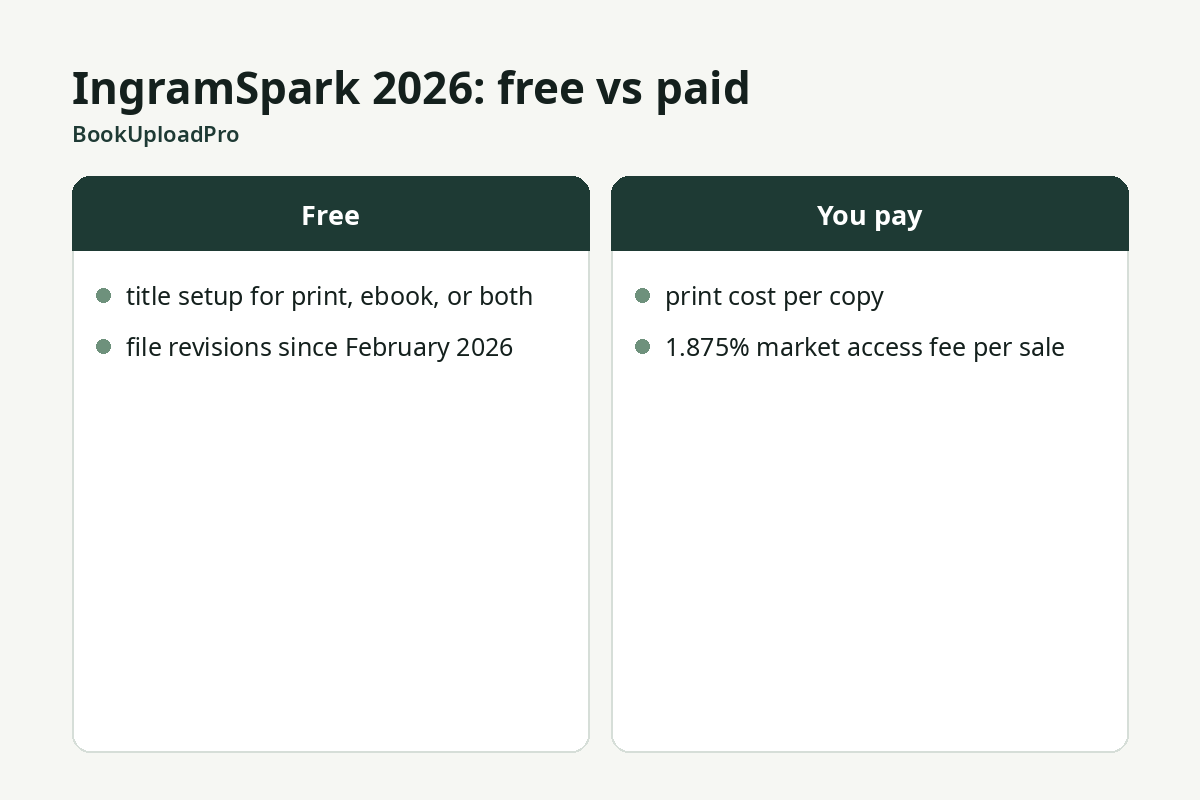
IngramSpark costs nothing to set up a title and nothing to revise one in 2026. Title setup is free for print, ebook, or both, and revisions have been free since 1 February 2026, when IngramSpark removed its old revision fee. What you do pay is the physical cost of printing each copy, plus a 1.875 percent market access fee on every copy sold through Ingram’s distribution network. There is no monthly subscription and no per title charge, so the platform itself is free until a reader buys a book: https://blog.bookuploadpro.com/self-publishing-store-fees-compared/
Key takeaways:
- Title setup is free for print, ebook, or both, on the rate card effective 1 February 2026.
- File revisions are free and unlimited since 1 February 2026, when IngramSpark removed its old $25 revision fee.
- The market access fee is 1.875 percent of the local list price on every copy sold through Ingram’s distribution network, up from 1.5 percent before February 2026.
- Print cost for a 300 page 6 by 9 black and white paperback is about $5.71 a copy on the 2026 rate card.
What changed on 1 February 2026
IngramSpark’s own help centre announcement lists three changes effective 1 February 2026: print on demand pricing was adjusted, so some books cost more to print and others less; books enabled for distribution are assessed a 1.875 percent market access fee; and revisions are free, with revision fees removed for all books from that date. The rate card calls the fee the global distribution fee, and the help centre calls it the market access fee. They are the same charge. The rate card also reserves the right to change prices once a year, by no more than 5 percent, so treat every figure here as the February 2026 card and recheck it before you price a new title: https://blog.bookuploadpro.com/ingramspark-paperback-distribution-cost/
The print cost, worked out
IngramSpark publishes its print prices as a formula: cost per page times the number of pages, plus a cost per unit. For a black and white paperback on 50 lb white paper in a trim under 6.15 inches wide, such as 6 by 9, the 2026 rate card lists $1.33 a copy plus $0.0146 a page. A 300 page book therefore costs about $1.33 plus $4.38, or $5.71, to print. That is the figure to compare with KDP, where the same book costs about $4.60 to print on Amazon.com. IngramSpark costs more per copy to print, and that is the price of reaching bookstores and libraries that order through Ingram’s wholesale catalogue, a network of more than 45,000 retailers, libraries, universities, and educators: https://blog.bookuploadpro.com/royalty-mechanics-explained/
What you earn on one sale
IngramSpark pays on wholesale economics, not on a royalty percentage. You set a wholesale discount, usually 55 percent, which is what bookstores take, and your compensation is what remains of the wholesale price after printing and the market access fee. Take a $16.99 paperback at a 55 percent discount: the wholesale price is about $7.65, the print cost is about $5.71, and the market access fee is 1.875 percent of $16.99, about $0.32, leaving you about $1.62 per copy. That is thin, and it is honest: IngramSpark is the route into physical stores, not the route to the fattest margin per copy. You also choose a returns policy when you enable distribution, and allowing returns is what gets bookstores to stock a title they have never heard of, so most authors accept it: https://blog.bookuploadpro.com/what-is-wide-distribution/
The rest of the setup: ISBN, files, and distribution
A free IngramSpark ISBN is available for print titles, and it names IngramSpark as publisher of record and only works there. If you want one ISBN across every store, buy your own and use it on IngramSpark and KDP alike, and keep KDP Expanded Distribution switched off so the two do not compete for the same sale. Files go in as print ready PDFs, and since revisions are free you can fix a typo the week after launch without paying for the privilege, which removes the old reason to delay publishing until a file was perfect. Enable distribution only when the book is ready for stores to order, because that is when the market access fee and the returns policy start to apply: https://blog.bookuploadpro.com/using-more-than-one-distributor/
FAQ
IngramSpark in 2026: free setup, free revisions, and the 1.875 percent market access fee, explained.
Setup is free for print, ebook, or both, revisions are free since 1 February 2026, and each copy sold through Ingram’s network pays a 1.875 percent market access fee plus its print cost.
Is IngramSpark free to publish on?
Yes, to set up and revise a title. You pay only when books sell: the print cost per copy and the 1.875 percent market access fee on distributed sales, plus shipping on copies you order yourself.
What is the IngramSpark market access fee?
It is 1.875 percent of the local list price, deducted from every copy sold through Ingram’s distribution network. On a $16.99 paperback that is about $0.32 a copy. It rose from 1.5 percent on 1 February 2026.
How much does IngramSpark cost to print a paperback?
It depends on trim, pages, paper, and ink, using a formula of cost per page plus cost per unit. A 300 page 6 by 9 black and white paperback costs about $5.71 a copy on the 2026 rate card.