
In this guide
- What does a book aggregator do?
- Is it cheaper to publish direct or use an aggregator?
- KDP Select and the exclusivity trap
- Can I go direct on some stores and use an aggregator for the rest?
- Keeping metadata consistent, and choosing your route
- FAQ
- Book distribution in 2026: publish direct, use an aggregator, or mix both?
- What does a book aggregator do?
- Is it cheaper to publish direct or use an aggregator?
- Can I go direct on some stores and use an aggregator for the rest?
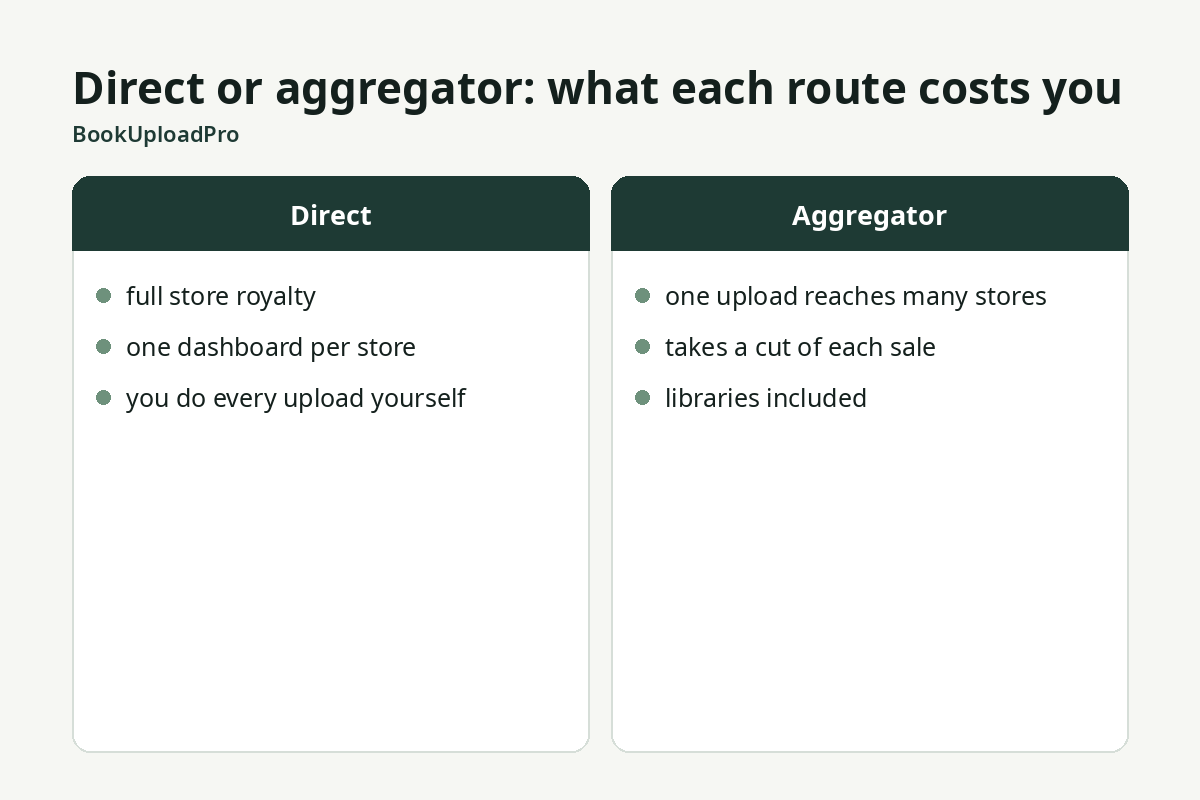
Book distribution in 2026 comes down to three routes: publish direct to each store, use an aggregator that uploads once and reaches many stores, or mix both. Direct keeps the full store royalty but means one dashboard per store. An aggregator saves time but takes a cut. For most working authors, the mix is the usual answer: go direct where your sales are biggest, and use an aggregator for the long tail and libraries.
Key takeaways:
- Direct means one dashboard per store, and you keep the full royalty that store pays.
- An aggregator uploads once and reaches many stores and libraries, but takes a cut of sales.
- Draft2Digital takes about 10 percent of the list price on sales through its distribution, so check the current figure before you commit.
- IngramSpark charges about a 1.875 percent market access fee, with free setup and free revisions as of the November 2026 checks.
- KDP Select exclusivity blocks wide distribution for the ebook during each 90 day term.
- The mix is the usual answer: direct where sales are biggest, aggregator for the rest.
- Metadata must match across every store: title, author name, series order, and price.
What does a book aggregator do?
An aggregator is a single service that distributes your book to many stores and libraries from one upload. You upload your EPUB and cover once, set your price and metadata once, and the aggregator sends the book to its partner stores, collects the royalties, and pays you in one place. Draft2Digital and IngramSpark are the two aggregators most self published authors use, and they reach different places: Draft2Digital reaches ebook stores and libraries, while IngramSpark reaches bookstores, libraries, and print distribution as well as ebooks.
The trade off is the cut. Draft2Digital takes about 10 percent of the list price on sales through its distribution, so check the current figure before you commit, since fees change. IngramSpark charges about a 1.875 percent market access fee, with free setup and free revisions as of the November 2026 checks, so confirm the current figure on its pricing page before you publish. Both fees are small beside the time saved, but they are real, and they apply to every sale through the aggregator, including sales on stores where you could have gone direct and kept the full royalty. An aggregator also handles the tedious parts: formatting your EPUB for each store and managing metadata across dozens of outlets. What it does not do is market your book. No aggregator puts your book in front of readers by itself.
Is it cheaper to publish direct or use an aggregator?
Direct is cheaper per sale, because you keep the full royalty the store pays. If KDP pays 70 percent on a $4.99 ebook, you get the full 70 percent, less the delivery fee. Through an aggregator that takes about 10 percent of the list price, the same sale pays less, because the cut comes off before or beside the store royalty, depending on the aggregator. On a single sale the difference is small, often a few dozen cents. Over hundreds of sales on your biggest store, it adds up, and that is why authors go direct where their sales are biggest.
But direct is not free in time. Each store has its own dashboard, its own tax forms, its own metadata fields, its own file requirements, and its own payment schedule. Setting up on five stores direct means five accounts, five uploads, five price settings, and five places to update when you change a price or fix a typo. An aggregator collapses that into one upload and one update, and for a store that sells a handful of copies a year, the time saved is worth far more than the cut. The honest calculation is not which route is cheaper per sale, but which route is cheaper per hour of your time. The store by store fee comparison puts the numbers side by side.
KDP Select and the exclusivity trap
The one rule that shapes every distribution decision is KDP Select. Enrolling an ebook in KDP Select, which is required for Kindle Unlimited, means 90 days of exclusivity to Amazon for that ebook: you cannot sell it on any other store, or give it away elsewhere, during each 90 day term. That blocks wide distribution entirely for the enrolled ebook, and it is the most common reason authors end up Amazon only without meaning to.
The common sequence is an exclusive launch followed by a wide backlist. Launch the ebook in KDP Select for one 90 day term, use Kindle Unlimited page reads and the Select promotion tools to build reviews and momentum, then leave Select when the term ends and distribute wide. The print edition is not affected by Select exclusivity, so a paperback can be wide from day one, even while the ebook is exclusive. What you must not do is enroll in Select and then distribute the same ebook through an aggregator: that breaches the exclusivity term and can cost you the Select enrollment or the account. If you publish for free and want the widest reach from the start, the free publishing route is here.
Can I go direct on some stores and use an aggregator for the rest?
Yes, and this is what most working authors do. The mix is the usual answer because it takes the best of both routes. Go direct on KDP, because Amazon is usually the biggest store, and the full royalty on your biggest sales matters most. Go direct on Kobo too, if Kobo earns enough to justify its own dashboard: Kobo has its own promotions and its own readers, and direct access to them is worth it when sales are steady. Then use an aggregator, usually Draft2Digital, for the long tail of smaller ebook stores and libraries, where the sales are thin and the time cost of going direct would exceed the cut. Use IngramSpark for print distribution to bookstores and libraries, which is a channel KDP does not reach in the same way.
The rule that makes the mix work is to never distribute the same book to the same store twice. If you go direct on Kobo, do not also let Draft2Digital send the book to Kobo, or you will have two listings of the same book on the same store, with split sales and confused metadata. Every aggregator lets you choose which stores it distributes to, so turn off the stores you cover direct, and keep a list of which route serves which store. Check the list every time you publish a new book, because the default is usually to distribute everywhere, and a forgotten toggle is how duplicates happen.
Keeping metadata consistent, and choosing your route
Whatever route you choose, your metadata must match across every store. The title, author name, series name and order, description, categories, keywords, and price should be identical everywhere, or as close as each store allows. Readers who find a different price on Kobo than on Amazon will buy the cheaper one and wonder why, and a series listed as book 2 on one store and book 1 on another will confuse new readers and cost you sales. Keep a single metadata sheet for each book, update the sheet first, then update every store from it, whether direct or through an aggregator.
FAQ
Book distribution in 2026: publish direct, use an aggregator, or mix both?
For most working authors, mix both. Go direct where your sales are biggest, usually KDP and Kobo if it earns, and use an aggregator for the long tail and libraries. Direct keeps the full store royalty but means one dashboard per store, while an aggregator uploads once and reaches many stores but takes a cut. For the full case for going wide, see the wide distribution guide.
What does a book aggregator do?
An aggregator distributes your book to many stores and libraries from one upload. You upload your EPUB and cover once, set the price and metadata once, and it sends the book to its partner stores, collects the royalties, and pays you in one place. Draft2Digital reaches ebook stores and libraries, and IngramSpark reaches bookstores, libraries, and print distribution as well as ebooks.
Is it cheaper to publish direct or use an aggregator?
Direct is cheaper per sale, because you keep the full royalty the store pays. An aggregator takes a cut: Draft2Digital takes about 10 percent of the list price on sales through its distribution, and IngramSpark charges about a 1.875 percent market access fee, with free setup and free revisions as of the November 2026 checks. Confirm both current figures before you commit, since fees change.
Can I go direct on some stores and use an aggregator for the rest?
Yes, and most working authors do. Go direct on KDP and on Kobo if it earns, and use an aggregator for the smaller stores and libraries. Never distribute the same book to the same store twice: turn off the stores you cover direct in the aggregator settings, and keep a list of which route serves which store.