
In this guide
- The order, step by step
- Who pays for printing, exactly
- What print on demand does not do
- When print on demand is the right call
- FAQ
- Print on demand for authors: how it works, what it costs, and who pays for printing.
- How does print on demand work for authors?
- Who pays for printing in print on demand?
- Is print on demand free to set up?
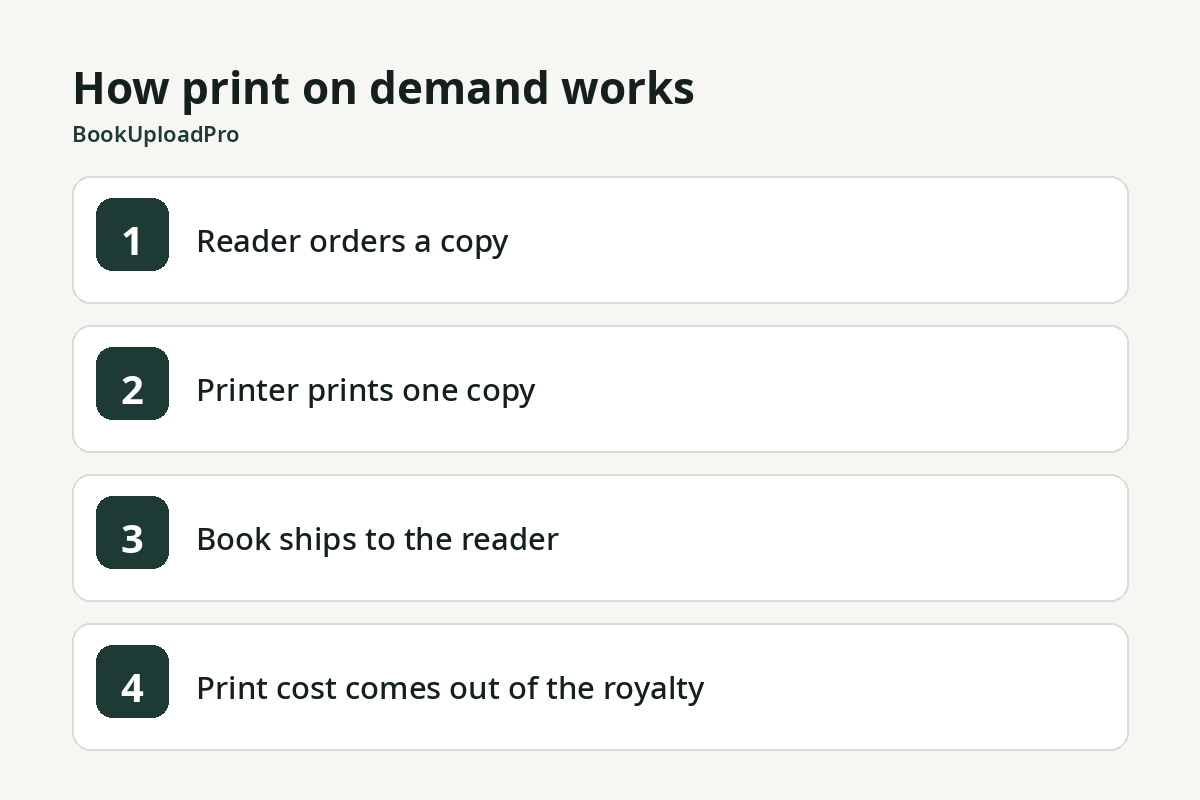
Print on demand means nobody prints your book until a reader orders it. You upload a print ready interior file and a cover, set a list price, and the book sits as a listing, not as a stack of copies in a warehouse. When an order comes in, the printer makes one copy, binds it, ships it to the buyer, and deducts the printing cost from your royalty. You never pay a print bill upfront, you never hold stock, and you never pulped unsold copies. The trade off is a higher cost per copy than a bulk print run, which is why the maths matters before you price: https://blog.bookuploadpro.com/how-much-does-it-cost-to-self-publish-a-book/
Key takeaways:
- A copy is printed only after a reader orders it, so there is no inventory, no warehouse, and no upfront printing bill.
- The printing cost comes out of each sale, not out of your pocket: KDP charges about $4.60 to print a 300 page 6 by 9 black and white paperback on Amazon.com.
- Setting up a print on demand title is free on KDP and IngramSpark, and revising the files is free on both in 2026.
- The reader pays the list price, the printer takes the print cost, and you keep the royalty that remains.
The order, step by step
The chain has four links. First, you prepare two files: an interior PDF sized to your trim, and a wraparound cover PDF built from the printer’s cover calculator. Second, you upload them to a print on demand service, Amazon KDP Print or IngramSpark, and set your list price and distribution. Third, a reader orders the book from a store, and the printer produces a single copy at the facility nearest the buyer. Fourth, the printer ships it and the money settles: the store takes its share, the printer takes the print cost, and the rest is your royalty. KDP pays 60 percent of the list price minus printing cost on paperbacks listed at $9.99 and above on Amazon.com, and 50 percent below that. IngramSpark pays on wholesale economics instead, with a discount you set and a 1.875 percent market access fee on distributed sales: https://blog.bookuploadpro.com/pricing-and-getting-paid/
Who pays for printing, exactly
Nobody writes a cheque to the printer. The print cost is deducted from the royalty of each sale, so a book that sells zero copies costs you nothing in printing. Take a 300 page 6 by 9 black and white paperback listed at $14.99 on KDP: the print cost is about $4.60, from KDP’s formula of a $1.00 fixed cost plus $0.012 a page, and your royalty is 60 percent of $14.99, about $8.99, minus $4.60, or about $4.39 a copy. The same book through IngramSpark costs about $5.71 to print, from $1.33 plus $0.0146 a page, and the earnings work on the wholesale price instead. Author copies are the one place you do pay directly: you order them at print cost plus shipping, which is how most authors get copies for signings and reviews: https://blog.bookuploadpro.com/royalty-mechanics-explained/
What print on demand does not do
Print on demand does not put your book on a bookstore shelf by itself. KDP Print sells on Amazon, and KDP Expanded Distribution reaches some other channels, but bookstores order through Ingram’s catalogue, which is why many authors run IngramSpark alongside KDP. Print on demand also does not solve returns: KDP handles Amazon returns itself, while IngramSpark asks you to choose a returns policy, and allowing returns is what persuades stores to stock you. Quality is consistent but not artisanal: standard paper, standard binding, and colour that costs far more per page than black and white, so a photo heavy book needs a different budget: https://blog.bookuploadpro.com/ingramspark-paperback-distribution-cost/
When print on demand is the right call
Print on demand fits almost every self published author: a first book with unknown demand, a backlist that sells a few copies a month, a book that needs to stay available in every store without reprints. It also fits authors who publish wide, because the same files can feed KDP for Amazon and IngramSpark for stores, with each platform’s print cost coming out of its own sales. The moment to look past it is when you know, from real orders, that you will sell hundreds of copies in one place, such as a launch event or a school order, and a bulk run beats the per copy price. Until then, print on demand is the lowest risk way to have a paperback at all: https://blog.bookuploadpro.com/print-specs-answered/
FAQ
Print on demand for authors: how it works, what it costs, and who pays for printing.
You upload files and set a price, a copy is printed only when a reader orders, and the print cost is deducted from your royalty. Setting up is free, and a 300 page black and white paperback costs about $4.60 to print on KDP.
How does print on demand work for authors?
You supply a print ready interior PDF and a cover, the service lists the book, and each order triggers a single copy being printed, bound, and shipped. There is no print run, no warehouse, and no stock to manage.
Who pays for printing in print on demand?
The printing cost is taken out of each sale before your royalty is calculated, so the sale itself funds the printing. You pay directly only for author copies you order for yourself, at print cost plus shipping.
Is print on demand free to set up?
Yes, on the two main services. KDP charges nothing to set up or revise a paperback, and IngramSpark charges nothing to set up a title and nothing to revise one since 1 February 2026.