
In this guide
- Polly vs ElevenLabs, for a beginner
- Murf, NaturalReader, and the long chapter test
- FAQ
- Amazon Polly vs ElevenLabs for a budget audiobook, which is more practical for a beginner?
- ElevenLabs vs Murf AI for audiobook narration, which sounds better over long chapters?
- Murf AI vs NaturalReader for nonfiction narration, which handles pacing and emphasis better?
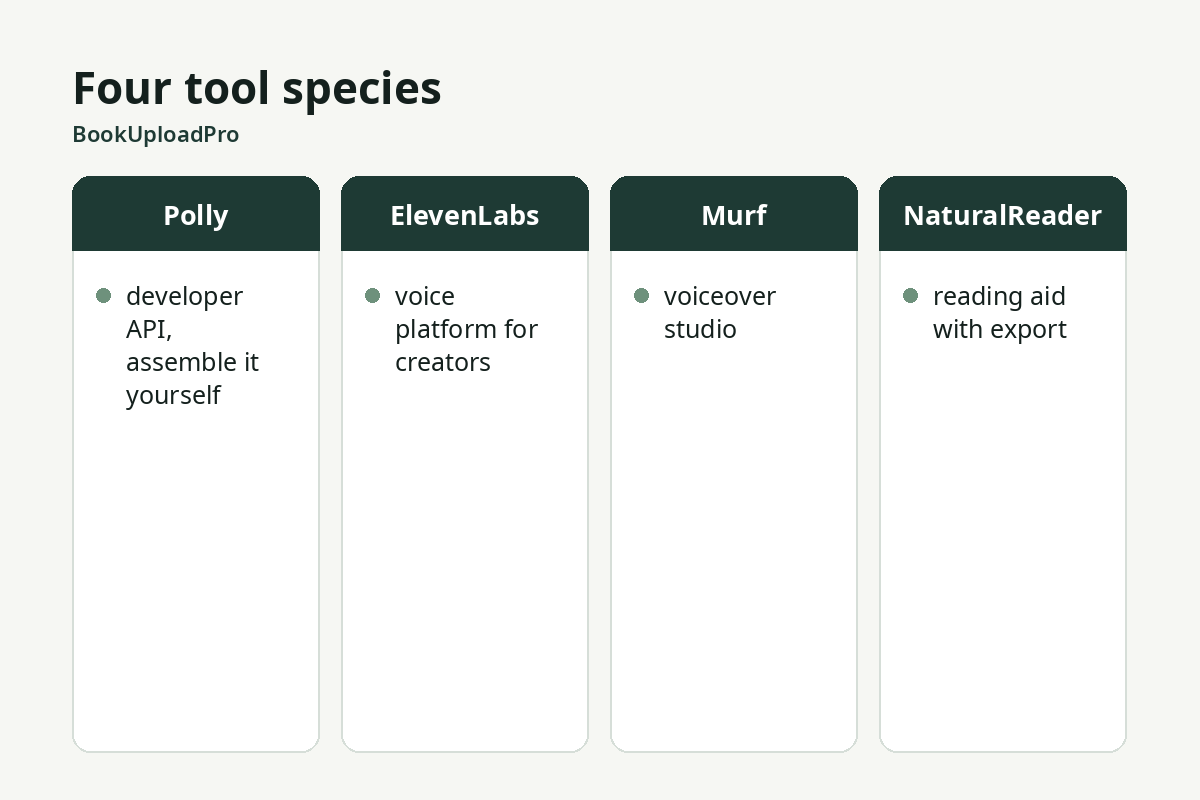
These four tools get compared as if they were rivals, but they are different species, and choosing well starts there. Amazon Polly is a developer text to speech service inside AWS: you pay per character and assemble everything yourself. ElevenLabs is a voice AI platform with long form projects, a large voice library, and editing aimed at creators producing finished audio. Murf AI is a voiceover studio, built around short form narration, presentations, and video voiceovers, with a friendly editor. NaturalReader began as a reading aid that speaks documents aloud, with commercial tiers that add export. Only some of these are audiobook production tools in any complete sense; the rest are voices you would have to build a production process around.
Key takeaways:
- Beginner practicality ranking for a budget audiobook: ElevenLabs first, because it is a self contained product a non technical author can finish a book in. Polly is cheapest per word and the least practical, powerful and cheap for developers, a wiring project for everyone else.
- Over long chapters, the deciding factors are voice stamina, pronunciation control, and chapter scale editing, where ElevenLabs’ long form orientation generally serves audiobooks better than a voiceover studio’s clip workflow.
- Pacing and emphasis in nonfiction are controlled less by the voice engine than by your text preparation and the editor’s tools for pauses, emphasis, and regeneration, whichever tool you pick.
Polly vs ElevenLabs, for a beginner
Polly’s voices are respectable and its per character pricing is tiny, but practicality is the question, and Polly asks you to bring the entire studio: chunking the manuscript, managing files, applying pronunciation through markup, assembling chapters, and mastering to store loudness specifications yourself. ElevenLabs wraps the same basic act, text to voice, in a product: projects that hold a book, voices auditioned on your text, regeneration where a passage fails. A beginner finishes a book in ElevenLabs; a beginner starts a hobby in Polly. Neither, note, is a dedicated audiobook service with chapter review workflows, credits assembly, and store ready packaging built in, which is the category above both.
Murf, NaturalReader, and the long chapter test
Murf’s strengths are a clean studio and voices tuned for narration and presentation; its natural unit of work is the scene or segment, which suits courses and explainers and makes a ten hour book a long assembly job. NaturalReader is the most approachable of the four and the least production oriented: excellent for hearing your book read back, which is a genuine editing use, with export on commercial plans, but pacing control is limited because the tool’s job is reading, not directing a performance. For pacing and emphasis specifically, judge all of them the same way: take your hardest page, dense, with a list, a quotation, and a name you invented, produce it in each, and listen for where the emphasis lands wrong and whether the tool lets you fix that spot without redoing the chapter. That test, not the demo reel, predicts your book. And keep the end in view: whichever tool voices the book, it must still pass store specifications and rules.
FAQ
Amazon Polly vs ElevenLabs for a budget audiobook, which is more practical for a beginner?
ElevenLabs, by a wide margin in practicality. Polly is cheaper per character but is a developer API: you assemble chunking, pronunciation, files, and mastering yourself. ElevenLabs is a finished product where a beginner can produce a complete book without building a pipeline.
ElevenLabs vs Murf AI for audiobook narration, which sounds better over long chapters?
Voices on both can sound strong in samples. Over long chapters, ElevenLabs’ long form project structure, larger narration oriented library, and regeneration workflow generally hold up better for books, while Murf’s studio is optimized for shorter voiceover work. Test both on your hardest chapter before deciding.
Murf AI vs NaturalReader for nonfiction narration, which handles pacing and emphasis better?
Murf, because it is built as a production studio with controls for the delivery, while NaturalReader is built to read documents aloud with limited direction. For a sellable nonfiction audiobook, Murf gives you more to work with; NaturalReader’s best use is hearing drafts read back during your own editing.