
In this guide
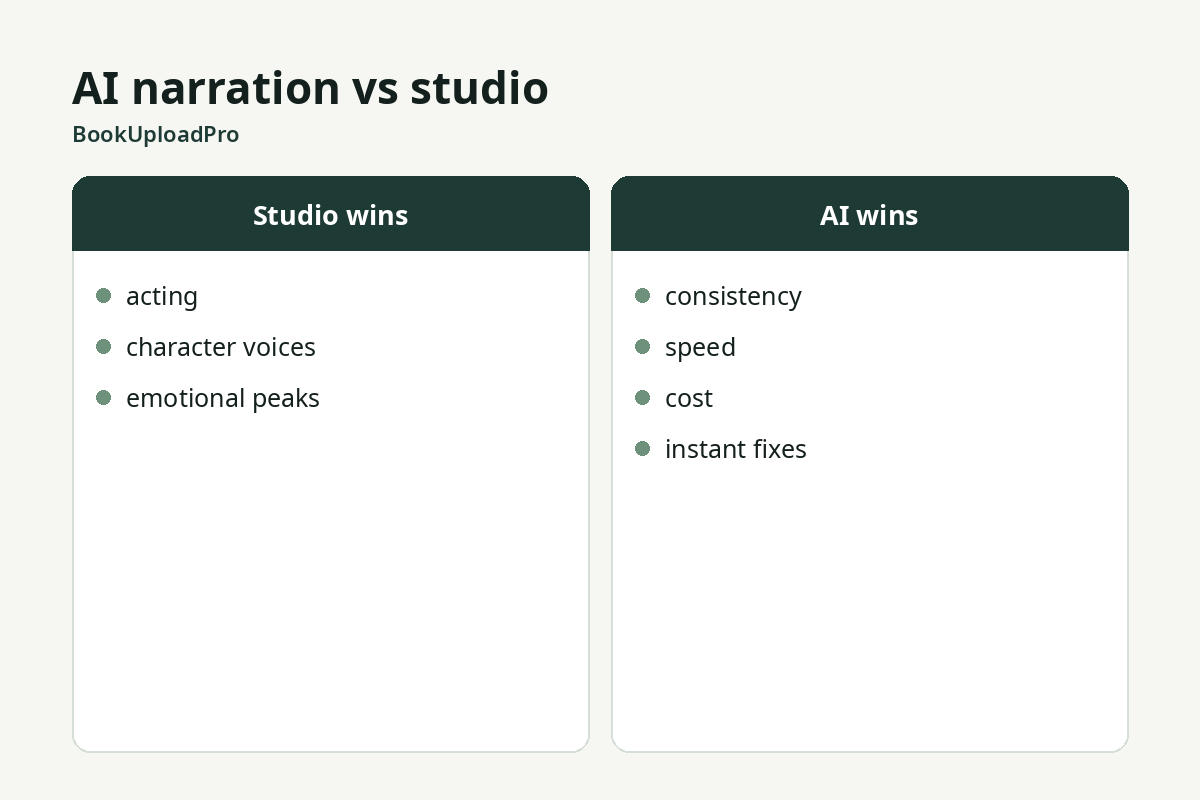
Compared honestly, a studio recording by a good human narrator is still the better performance, and AI narration is the better production for most informational books at most budgets. The gap lives in specific places: acting, emotional range, character voices, and the judgment to lean into a moment. On the ground listeners actually occupy, clarity, even pacing, comfortable sound over hours, accurate pronunciation, an AI production that was properly reviewed matches a mid range studio job for nonfiction, business, memoir, and how to content. Whether it is good enough for full price is therefore a genre and execution question, not a technology question.
Key takeaways:
- Judge quality on the listener’s criteria: can I follow this for six hours comfortably, does it sound cared for, does anything jar me out of the book. AI passes those tests when the review pass is done properly.
- The studio keeps its crown where performance is the product: fiction with distinct character voices, comedy timing, grief, drama.
- Full price is a promise. Disclosed AI narration sells at full price today on the stores that accept it; what draws returns and one star reviews is sloppy production, not the disclosure.
Where each one wins
A studio narrator brings interpretation: they know which sentence the chapter turns on, they voice a roomful of characters distinctly, and their tired takes get redone because a producer is listening. AI brings consistency and control: the voice never has a cold, chapter nine sounds like chapter one, a mispronounced name is fixed in minutes rather than a rebooking, and the whole book exists in days at a subscription’s cost instead of weeks at per hour rates. For a listener, the experienced difference in a well made AI nonfiction title is small: slightly more even energy, fewer dramatic peaks. In a badly made one, from any route, the difference is large: mispronunciations, volume jumps, and mistakes no one proof listened for. Our explainer covers the sound itself.
The full price question
Listeners paying full price are buying the book first and the narration second; they feel cheated when the production disrespects their time, whichever voice produced it. The practical standard for an AI title at full price: a full human review listen with every mispronunciation fixed, loudness and specs inside the store windows, a retail sample that honestly represents the book, and the disclosure the store requires, because hiding AI narration and being discovered reads as a scam even when the audio is fine. Price against length the same way human titles are priced. Do those things and the market’s own answer is visible daily: disclosed AI titles sell, get finished, and get reviewed on their content. Skip them, and no voice, human or synthetic, saves the listing.
FAQ
Does AI narration sound good enough for listeners who pay full price?
For most nonfiction and informational books, yes, provided the production is done properly: full review listen, pronunciation fixed, levels to spec, honest sample, required disclosure. Listeners judge comfort, clarity, and care over hours. Where it is not yet good enough at any price is performance driven fiction that lives on character acting.
How good is AI audiobook narration quality compared to a studio recording?
A good studio performance still leads on emotion, character voices, and interpretive judgment. AI matches or approaches a competent studio read on clarity, pacing consistency, and comfort for informational content, and wins on speed, cost, and ease of correction. The honest summary: different strengths, and for many books the difference listeners can hear is small.