
In this guide
Open the top ten books in your category and treat each listing as a filed report on what the market rewards. From an ASIN’s page you can read its exact category paths in the product details, which tells you which races the winners entered; its title and subtitle construction, which reveals the keyword phrases the market clicks; its price and format mix, its review count and velocity implied by rank, its cover at thumbnail size against yours, and its one star reviews, which are your product brief. What you cannot see is a competitor’s backend keywords, and anyone selling you that sight is guessing; the visible metadata plus search autocomplete reconstructs most of it honestly:
Key takeaways:
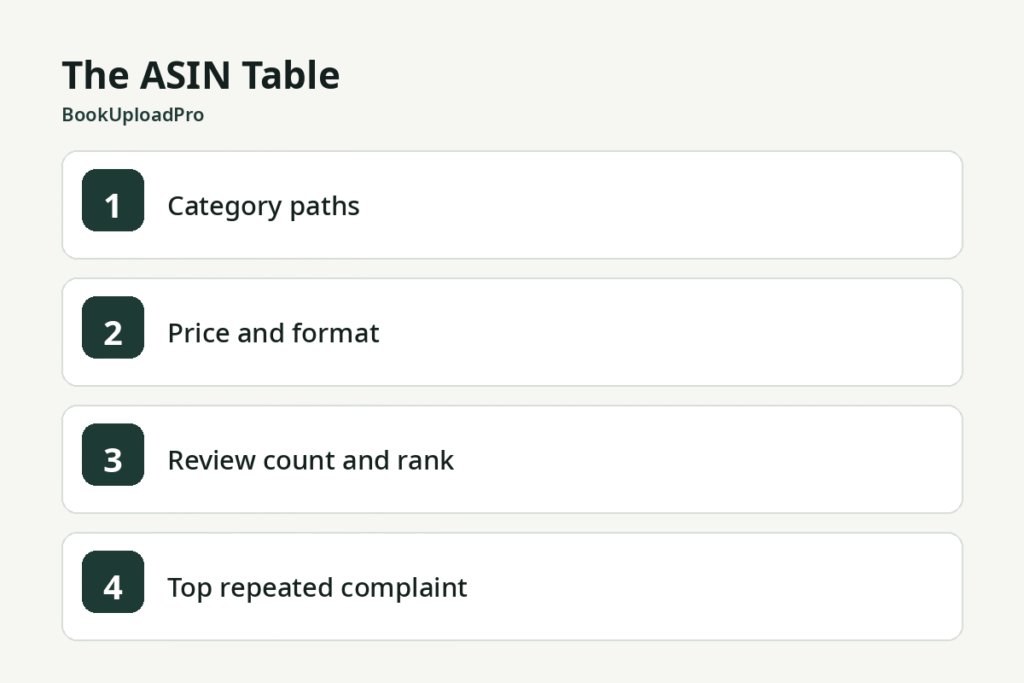
- Work ASINs into a table: category paths, price, page count, review count, rank, and the top repeated complaint. Patterns across ten rows are strategy; one row is gossip:
- Cookbook keyword research in a crowded topic fails when it chases the category’s biggest words (keto cookbook, air fryer recipes) where thousand review incumbents own the clicks. The winnable layer is the modifier: the audience, the constraint, the occasion, the equipment size:
- Judge a keyword by the results page, not a volume number: if the first page mixes in books unlike yours, the searcher intent is not yours, whatever the tool says.
The cookbook angle finder
List your book’s true constraints and assets: diet variant, cuisine, time limit, equipment, household size, skill level, ingredient budget. Cross two of them and test the phrase in Amazon’s search bar for autocomplete life and a results page of beatable books (modest review counts, weak covers, dated editions). “Slow cooker suppers for two” is a smaller promise than “slow cooker cookbook” and a bigger business, because the buyer sees their exact kitchen in it. That is the micro niche logic applied to keywords:
Turning research into the listing
Let the top ten set your floor, not your ceiling: match their category discipline and price band sanity, then differentiate where their one star reviews complain, portion sizes, no index, photos missing, and say so in your subtitle and description. A listing built from competitor evidence reads as the answer to the category’s own complaints:
FAQ
What can I learn from the ASINs of the top ten books in my category?
Their category paths, title and keyword construction, prices, formats, review counts, rank health, cover standards, and through their one star reviews, the unmet needs your book can answer. Tabulate all ten; patterns are strategy.
How do I research keywords for a cookbook in a crowded topic?
Skip the giant generic terms the incumbents own. Cross your book’s true modifiers (audience, constraint, occasion, equipment) into specific phrases, then validate each on the live results page for intent fit and beatable competition.