
In this guide
- How deep, in practice
- The trademark wall, plainly
- FAQ
- What are micro niches and why do small specific topics sometimes outsell big broad ones?
- What is a sub niche and how deep should I go when narrowing down a topic?
- Can I build a niche around a brand name, a celebrity, or a popular TV show?
- Is journal too broad a keyword to target, and how would I narrow it to a specific buyer?
A micro niche is a topic narrowed until the buyer recognizes themselves in it instantly: not journal, not gratitude journal, but a gratitude journal for nurses on night shift. Small topics sometimes outsell big ones for a mechanical reason: in a broad category your book is one of ten thousand and the algorithm has no reason to surface it, while in a micro niche the book can become the obvious answer for a specific search, earn the clicks and conversions that search generates, and accumulate reviews at a rate the broad book cannot match. Specificity also sharpens the product itself: the prompts, examples, and cover all speak one reader’s language:
Key takeaways:
- Depth has a floor: narrow until the audience is still big enough to sustain sales (a real community, a recurring search, an existing shelf of neighbors), and stop one level before the audience becomes a handful of people:
- You cannot build a commercial niche on someone else’s brand, celebrity, or show: trademark and publicity rights make the name itself the infringement, and platforms remove such books and sometimes accounts. Fan enthusiasm is not a license.
- Journal is the textbook too broad keyword: it names a format, not a buyer. Narrowing means adding the who and the job: who keeps it, for what purpose, in which season of life.
How deep, in practice
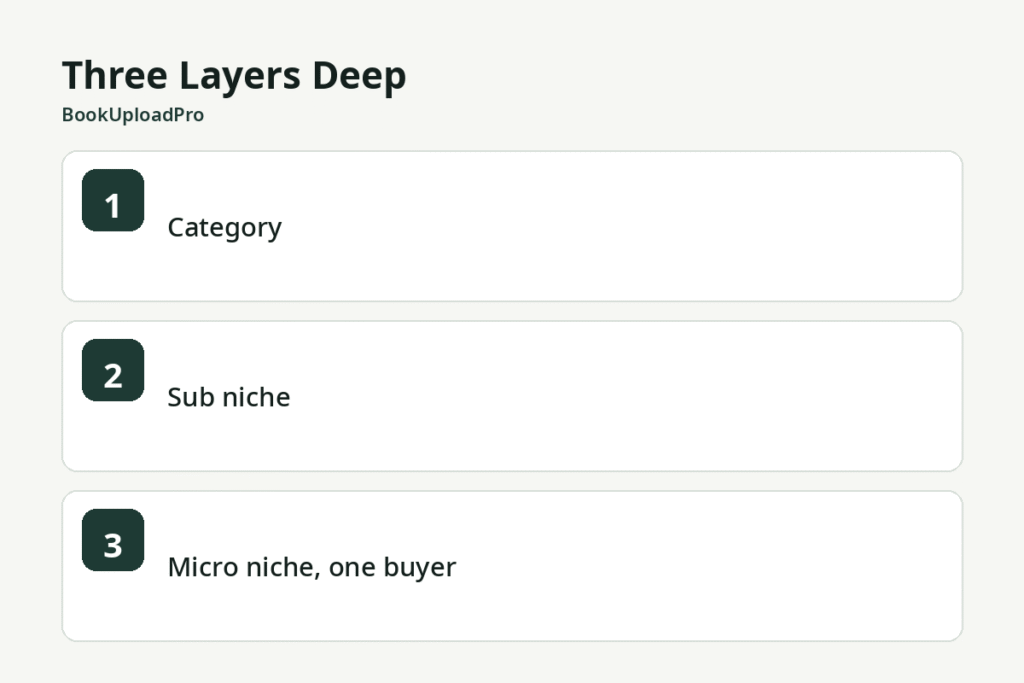
Use the three layer test. Layer one, the category (journals). Layer two, the sub niche (guided journals for wellbeing). Layer three, the micro niche (a 90 day reflection journal for first year teachers). Publish at layer three, get found, and let the series expand sideways into adjacent micro niches rather than upward into breadth. Check each layer for life: existing books with reviews prove buyers; a layer with no books at all is usually empty because nobody is buying, not because nobody thought of it:
The trademark wall, plainly
An unofficial guide about a show is a legal risk the moment the show’s name sells the book in title or cover; a celebrity’s name or face in your metadata trades on their publicity rights; a brand’s product names in your keywords imply an affiliation that does not exist. There are narrow editorial exceptions in some jurisdictions for genuine commentary, and none of them are a business plan for a KDP catalog. Build on the audience’s needs instead: fans of a genre need journals, planners, and guides that name the need, not the franchise:
FAQ
What are micro niches and why do small specific topics sometimes outsell big broad ones?
A micro niche is a topic narrowed to one recognizable buyer. It can outsell broad topics because the book becomes the obvious answer to a specific search, converts better, and gathers reviews faster than a generic book lost among ten thousand.
What is a sub niche and how deep should I go when narrowing down a topic?
A sub niche is one level of narrowing inside a category. Go about three layers deep (category, sub niche, micro niche), checking each layer still has proven buyers, and stop before the audience shrinks to a handful.
Can I build a niche around a brand name, a celebrity, or a popular TV show?
No. The name, face, and brand are protected by trademark and publicity rights, and using them to sell books risks takedowns and account trouble. Sell to the audience’s needs in your own words instead.
Is journal too broad a keyword to target, and how would I narrow it to a specific buyer?
Yes, journal names a format, not a buyer. Add the who and the job: a guided journal for new widows, a training journal for marathon beginners, a prompt journal for nurses. The buyer should see themselves in the phrase.