
In this guide
- Picking launch categories you can rank in
- Tiny number one vs big mid list
- FAQ
- How many sales does it take to reach number one in a small category?
- I am launching next month, how do I pick launch categories I can realistically rank in?
- Is it better to be number one in a tiny category or mid list in a big one?
There is no fixed sales number for category number one, because the bar is set by the current number one book in that category, in that store, this week. In a large category that bar can be hundreds of sales a day; in a small, quiet subcategory it can be a handful of sales in a day, occasionally fewer, which is why unknown books appear at the top of odd little charts. The skill is not finding a magic number; it is reading the actual bar in each category you are considering before launch, and choosing where your realistic launch sales make you a contender rather than a footnote.
Key takeaways:
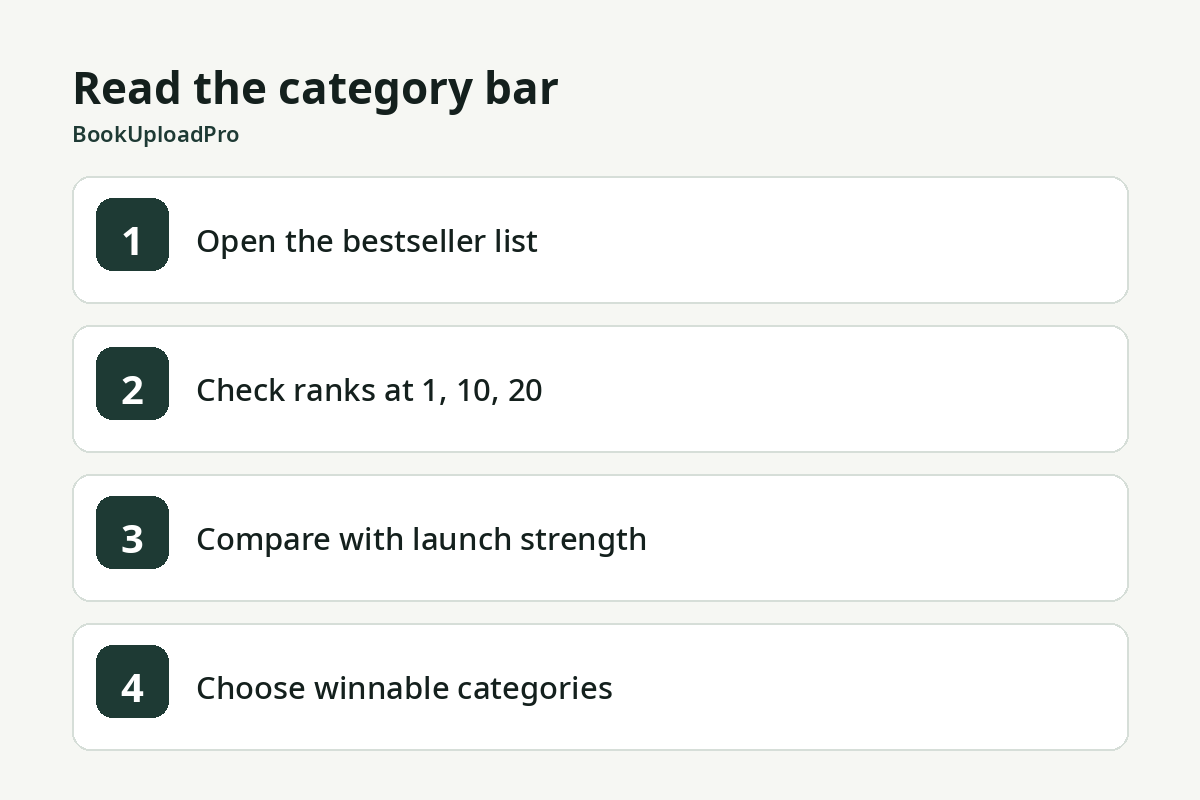
- Read the bar directly: open the category’s bestseller list, check the store ranks of the books at positions 1, 10, and 20, and translate those ranks into rough daily sales. If number 20 barely sells, the category is winnable.
- KDP lets you choose categories for your book (with additional category placement influenced by your keywords), so choose deliberately: one or two aspirational large categories, anchored by categories your launch can genuinely contest.
- The tiny category badge is marketing, not income: number one anywhere earns a bestseller flag and social proof you can use forever, but mid list in a big category usually sells more books. Take both if the category fits honestly.
Picking launch categories you can rank in
Work backwards from your realistic launch: the sales your list, ads, and network can plausibly deliver in the first days. Shortlist categories where your book honestly belongs, because Amazon can remove miscategorized books and readers punish a mismatch, then inspect each list’s depth. The sweet spot is a category whose tenth best book sells about what your launch can sell on a good day, and whose top book is within a small multiple of that. Check the same category in the store you are actually launching in; competitiveness differs sharply by country store. Remember the categories also shape your also bought neighbors and browse traffic long after launch, so a winnable category full of your real readers beats a winnable category full of strangers, a fit question like keyword choice itself.
Tiny number one vs big mid list
Do the arithmetic honestly. Tiny category number one might mean three sales a day and a badge; page two of a big category might mean thirty sales a day and no badge. Income follows sales; credibility follows the badge; and your career probably wants the badge once, early, for covers and copy, and sales every month after. The strategies combine: launch where you can top a legitimate small chart to earn the flag, while your keywords and main category keep you discoverable in the larger pond, then work on holding position with the steady system rather than launch spikes. What never works is the fake version: irrelevant micro categories stuffed for an easy flag, which Amazon polices and readers see through on the product page.
FAQ
How many sales does it take to reach number one in a small category?
It depends entirely on the category’s current top book. In genuinely quiet subcategories, a handful of sales within a short window has been enough; in active ones, far more. Read the actual bar by checking the store ranks of the books currently at the top of the list you want.
I am launching next month, how do I pick launch categories I can realistically rank in?
Start from your plausible launch sales, list categories where the book honestly fits, then inspect each bestseller list’s depth, especially around position 10. Choose categories where that depth matches your launch strength, verify in your launch store, and keep at least one larger category for long term discoverability.
Is it better to be number one in a tiny category or mid list in a big one?
For income, mid list in a big category usually wins, because it sells more books. For credibility, the number one badge is a permanent marketing asset. The smart play is sequential: earn the badge in a legitimate small category at launch, and build your steady sales in the bigger one.