
In this guide
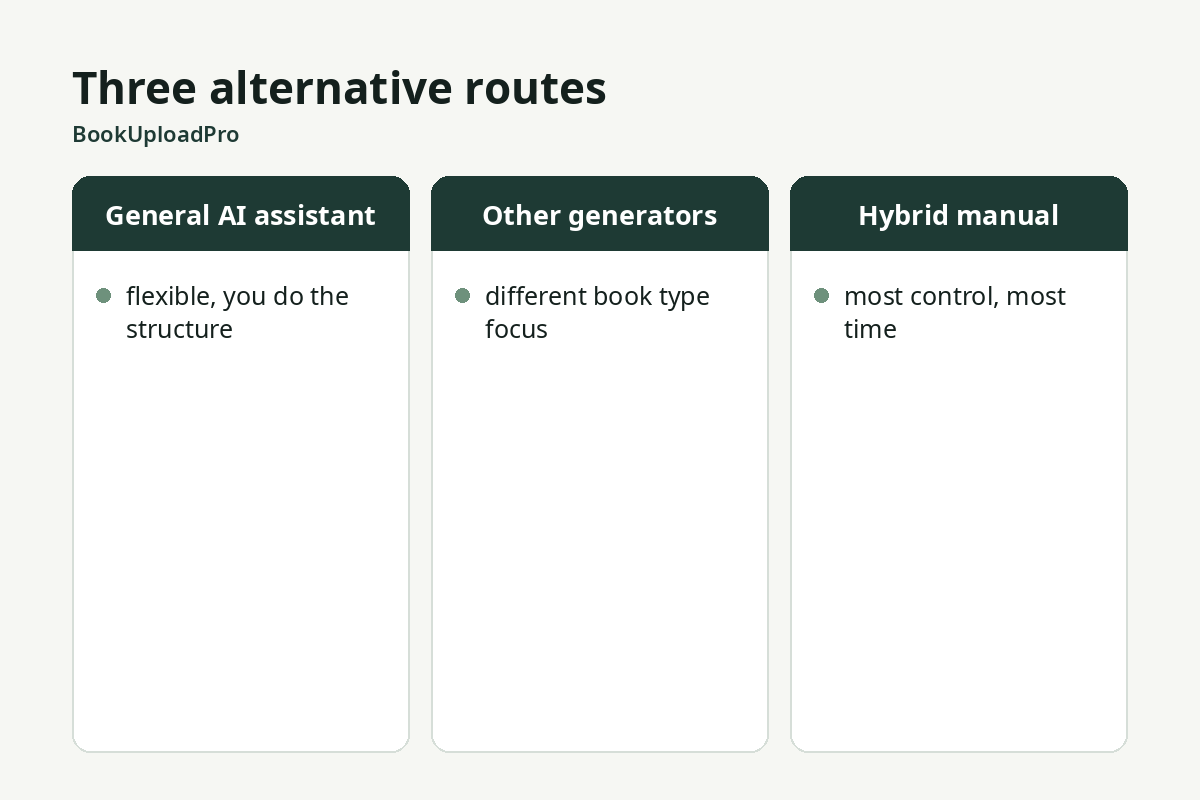
The real alternatives to BookAutoAI are not only other products; they are three different ways of working. One: a general AI assistant, ChatGPT, Claude, or Gemini, driven by you chapter by chapter, cheapest and most flexible, with all structure, formatting, and consistency work on your desk. Two: another dedicated book generator, tools in the Squibler mold, which trade BookAutoAI’s nonfiction, cookbook, and illustrated guide specialization for their own focuses, often fiction friendly. Three: hybrid and manual routes, dictating and drafting yourself with AI as editor, or hiring human help, slowest and most expensive, with the deepest authorial control. Which is best depends on what you write and how much of the production work you want to own.
Key takeaways:
- Judge every option on the same five tests: book types it is actually built for, outline control, what the export really includes (EPUB, print PDF, cover, or just text), rights in writing, and the true cost of finishing one of your books on it.
- For fiction, BookAutoAI is the wrong tool by its own design; a fiction oriented generator or a general assistant is the honest alternative. For nonfiction, cookbooks, and illustrated guides, it is the specialist the others are compared against.
- The free outline test settles arguments: run your real book idea through each candidate’s free tier or preview and compare the structures before any subscription.
Applying the five tests
Book types: BookAutoAI covers nonfiction, full color cookbooks with recipe images, and illustrated guides, and says plainly it does not do novels; general assistants will attempt anything, which is freedom and risk in one package; dedicated rivals vary, so read their book type pages rather than their homepages. Outline control: a book length work lives or dies on structure, and the difference between a tool that plans the book first and a chat window that improvises is the difference between editing and rescuing. Exports: text is not a book; price in the formatting, cover, and file preparation each option leaves to you, the ground our explainer covers. Rights: insist on commercial use rights to paid output in the terms, a no royalty share position, and clarity that rights survive cancellation. Cost: count credits or messages for your actual book, including images and revisions, not the headline plan price. The workflow discipline matters as much as the tool inside any of these routes.
A fair verdict
If your book is nonfiction or a cookbook and you want the production handled inside one workspace, BookAutoAI is built for exactly that and its alternatives mostly ask you to assemble the same result from parts. If you are writing fiction, experimenting across many forms, or happy directing every chapter yourself, a general assistant is the better buy. If your name and voice are the product and the budget exists, human led hybrid work still sets the quality ceiling. There is no dishonor in any lane; the only losing move is choosing by headline price and discovering the exports, rights, or book types at the end. Whatever you generate, the editing duties that follow are identical.
FAQ
What are the best alternatives to BookAutoAI for generating nonfiction and cookbook manuscripts?
A general AI assistant such as ChatGPT or Claude, directed chapter by chapter by you, is the most flexible alternative and the most work. Other dedicated generators, such as Squibler style tools, suit authors whose books fall outside BookAutoAI’s nonfiction, cookbook, and illustrated guide focus, particularly fiction. A hybrid route, your own drafting with AI editing help, maximizes control at the highest time cost. Compare all of them on book types, outline control, exports, written rights, and the true cost of your book.