
In this guide
- The break even comparison, honestly
- What the saving actually buys
- FAQ
- AI narration vs a human narrator, which is the smarter choice for a nonfiction audiobook on a budget?
- Is it better to release an AI narrated audiobook now or wait until I can afford a human narrator?
- How does AI narration quality in 2026 compare with mid range human narrators for educational books?
- Human narrator through ACX royalty share vs paying for AI narration upfront, which breaks even faster?
- How much do I actually save with AI narration compared with a $250 per finished hour narrator?
Run the numbers first, because they are stark. A human narrator at $250 per finished hour makes an eight hour nonfiction audiobook cost about $2,000 before editing, mastering, and proofing, which typically push the real total higher. An AI narration service produces the same book for a small fraction of that, often inside a single month’s subscription, so the saving on one book is roughly the entire human fee. Against that, the human buys things AI does not: genuine performance, the only route onto Audible through ACX today, and no disclosure label. The smarter choice on a budget is therefore rarely either or forever; it is sequencing. Release the AI edition now where AI narration is accepted, learn what the book earns, and let proven earners fund human editions later.
Key takeaways:
- Break even divides the two models cleanly: royalty share costs nothing upfront but halves your audio royalties for the term, commonly seven years on ACX; AI upfront costs a little once and keeps 100 percent of your royalty share everywhere it sells.
- For educational and instructional nonfiction, modern AI narration is closest to mid range human work: clear, even, accurate delivery is exactly its strength. Performance driven books, memoir, humor, drama in dialogue, are where mid range humans still pull away.
- Waiting has a price nobody quotes: the months with no audiobook at all, in the fastest growing format, while a competitor’s version collects your readers.
The break even comparison, honestly
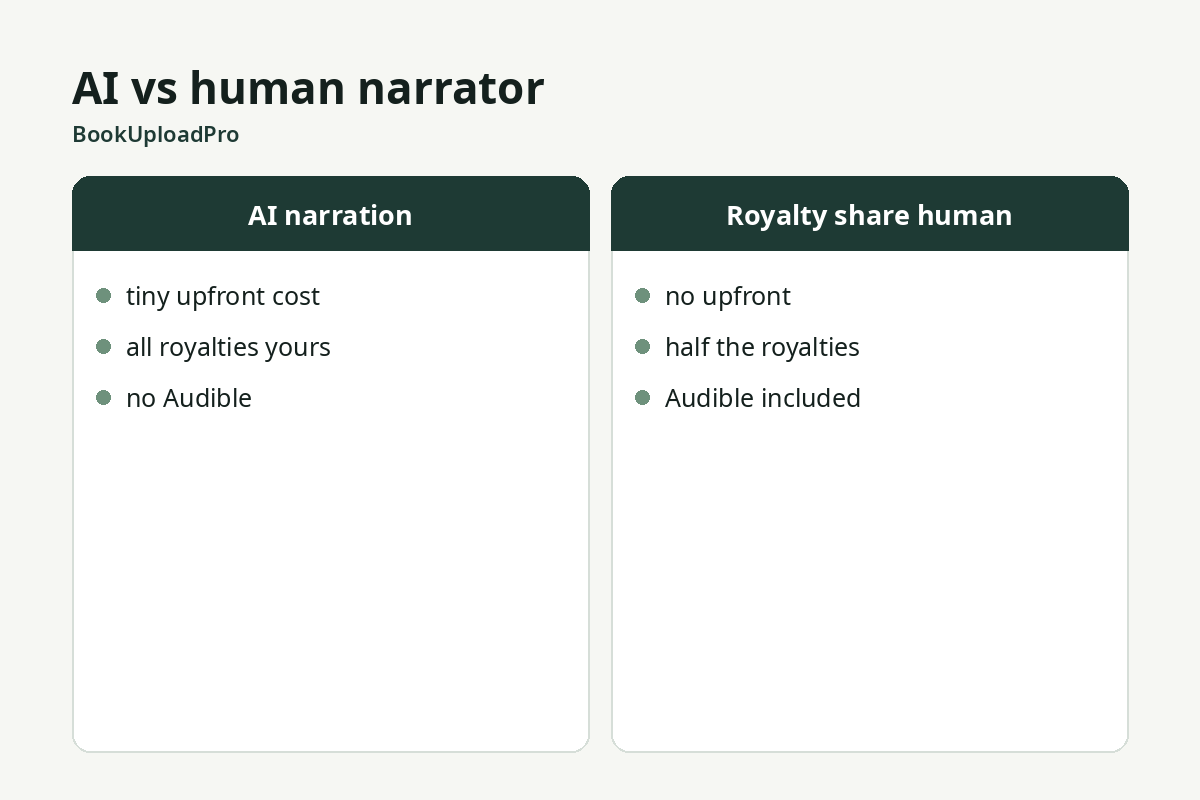
Royalty share through ACX: zero upfront, a professional narrator, Audible distribution, and your royalty percentage cut in half for the contract term, with exclusivity conditions attached. If the book sells strongly for years, that half is the most expensive money you ever saved. AI upfront: a modest one time cost, all royalties yours, but no Audible, because outside AI narration is not accepted there, so the comparison is not the same income at different costs; it is different stores entirely. The practical ruling: a book with proven ebook sales and a long expected life justifies waiting or saving for the human and the full Audible market; an unproven book, a backlist title, or a fast moving topic justifies the AI edition now, with the human upgrade as a later decision the sales data will make for you. Quality expectations for each route are calibrated here.
What the saving actually buys
Price the decision in books, not dollars: at $250 per finished hour, the human fee for one eight hour book roughly equals AI production for a shelf of titles. For a catalog author, AI narration converts a backlist that would never have justified $2,000 a book into audio editions earning something in every store that accepts them, while the flagship title gets the human budget. That portfolio logic, not any single book’s comparison, is how most working publishers now answer this question. And where the book’s whole value is the author’s presence, teaching, testimony, a known voice, spend on the human, or narrate it yourself.
FAQ
AI narration vs a human narrator, which is the smarter choice for a nonfiction audiobook on a budget?
For most budget constrained nonfiction: AI now. The cost difference is roughly the entire human fee, AI quality suits informational delivery, and an earning audiobook today beats a perfect one next year. Reserve human narration for proven sellers and performance driven books.
Is it better to release an AI narrated audiobook now or wait until I can afford a human narrator?
Release now if your book sells in the stores that accept AI narration, and upgrade later if earnings justify it. Wait only when Audible is the whole strategy or the book depends on performance, because waiting means earning nothing from audio in the meantime.
How does AI narration quality in 2026 compare with mid range human narrators for educational books?
Closely, for this genre. Educational listening rewards clarity, pacing, and correct emphasis over drama, and current AI voices deliver that reliably. Mid range humans still win on warmth, judgment in ambiguous passages, and character in quoted dialogue, which matters less in a textbook than in a memoir.
Human narrator through ACX royalty share vs paying for AI narration upfront, which breaks even faster?
AI upfront breaks even almost immediately because the cost is so low, but it cannot sell on Audible. Royalty share has no cost to break even on, though it halves your royalties for years and requires the book to be accepted by a narrator willing to share risk. They solve different problems: cash flow to Audible, versus ownership everywhere else.
How much do I actually save with AI narration compared with a $250 per finished hour narrator?
On an eight hour book, the narrator’s fee alone is about $2,000, before production costs. A subscription AI service typically produces the book for the price of a month or less of its plan, so the saving is on the order of 90 percent or more of the full human production cost.