
In this guide
- Dialogue, honestly assessed
- Directing the performance
- FAQ
- Should I choose a male or female AI voice for my audiobook?
- Can I use different AI voices for different chapters or characters?
- Can AI narration do accents and other languages for international listeners?
- Can AI narration handle books with dialogue between several characters?
- Do AI narration services let me change the reading speed and pauses?
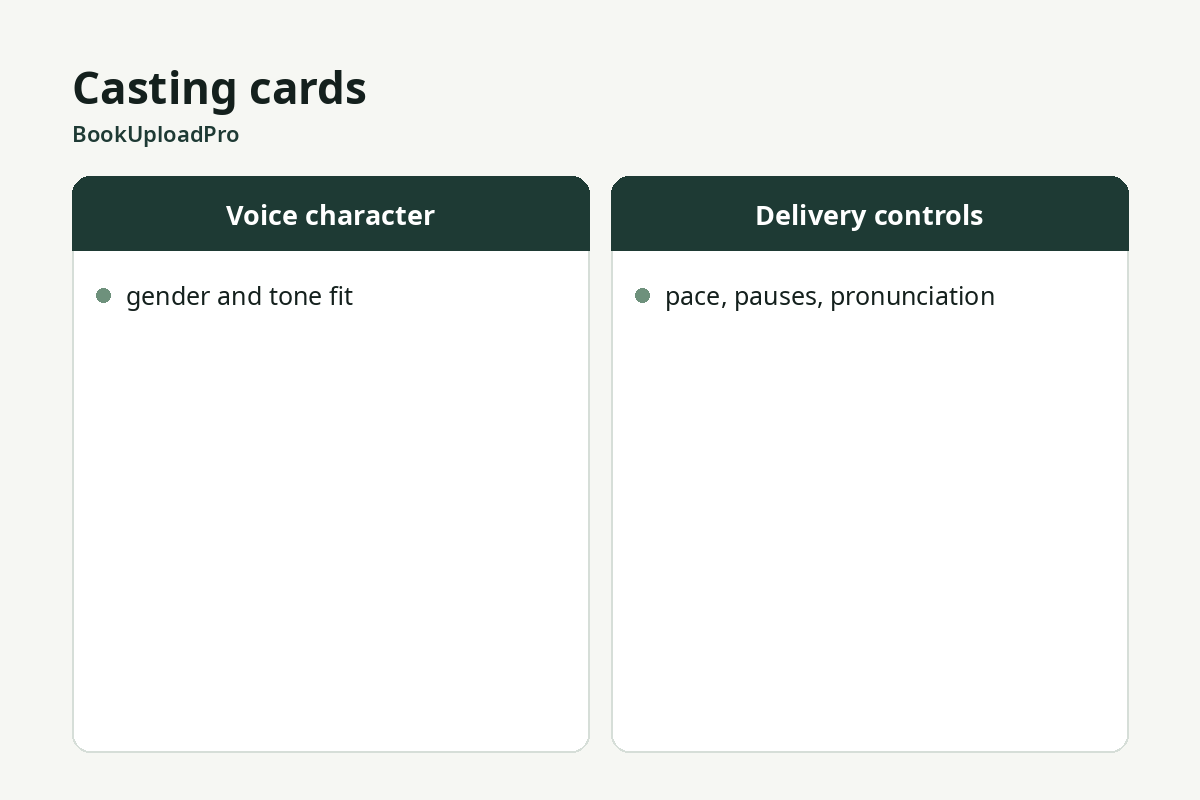
Casting an AI voice follows the same logic as casting a human, with one extra dimension: control. On gender, there is no universal winner; match the voice to the book’s promise and audience. A business book read in the voice your readers already hear in their heads when they read you, often your own gender for memoir and personal development, a neutral professional tone for reference and how to, wins more than any abstract preference study. Most AI services offer catalogs spanning genders, ages, and tones (the service we document most closely offers 20 plus voices), and every serious workflow lets you hear a sample of your own text before committing, which is the real test. Cast by sample chapter, never by voice name.
Key takeaways:
- Multiple voices are possible on many platforms, assigning different voices to chapters or sections, which suits multi author books, interviews, and alternating viewpoints. Full character by character casting inside one chapter is where AI is weakest, because dialogue attribution and emotional turns are acting, not reading.
- Accents and languages are a genuine AI strength in breadth and a weakness in depth: major services cover many languages with native sounding voices, while regional accents inside a language can sound generic or occasionally wrong to native ears.
- Pace control exists on most services in some form, overall speed plus pause shaping through punctuation, paragraph structure, and on some platforms explicit controls. Direct it at the passage level, not just globally.
Dialogue, honestly assessed
A single AI voice reading dialogue between several characters will keep the words accurate and the speakers distinguishable only by context, which works for nonfiction with quoted exchanges and struggles in fiction scenes. The workarounds in ascending order of effort: choose a voice with strong natural inflection and let context carry attribution, add dialogue tags your print edition did not need, split voices by chapter where viewpoints alternate, or, for dialogue heavy fiction, treat it as the known case where a human cast earns its fee. For nonfiction authors, whose dialogue is usually quotation rather than drama, AI handles it well enough that listeners rarely name it as a problem.
Directing the performance
Think like a director with a limited rehearsal budget. Set the global pace slightly slower than feels natural on headphones at your desk; listeners in cars and kitchens thank you. Mark emphasis by sentence structure rather than markup tricks, since short sentences land harder than italicized ones read flat. Use chapter samples to lock the pronunciation of names and terms before the full run, because fixing pronunciation across a finished book is the AI equivalent of re recording: possible on good platforms at passage level, tedious everywhere. And keep a casting note for the series: same voice, same pace settings, same credit wording, so book three sounds like book one.
FAQ
Should I choose a male or female AI voice for my audiobook?
Match the book, not a stereotype: your own gender for personal and memoir adjacent nonfiction, the tone your category’s successful audiobooks use for instructional work, and always decide from a sample of your own chapter rather than the voice’s demo script.
Can I use different AI voices for different chapters or characters?
Different voices per chapter or section, yes on many services, which suits alternating viewpoints and multi contributor books. Character level casting within a chapter is limited; dialogue heavy fiction remains the hardest case for AI narration.
Can AI narration do accents and other languages for international listeners?
Most major services offer voices in many languages, which makes foreign language editions practical in a way human casting rarely is for independents. Accents within a language vary in authenticity; have a native listener check samples before publishing an accented performance.
Can AI narration handle books with dialogue between several characters?
For nonfiction quotation, yes. For sustained dramatic dialogue, one voice cannot act multiple characters the way a narrator or cast does; use dialogue tags, viewpoint chapter splits, or a human narrator for dialogue driven books.
Do AI narration services let me change the reading speed and pauses?
Generally yes: overall pace controls are common, and pauses respond to punctuation, paragraph breaks, and passage level direction on better platforms. Set pace from a full chapter sample heard away from your desk, and fix problems at passage level rather than re running the book.