
In this guide

Publishers with 50 or more titles keep up with uploads by treating the catalog as one system instead of 50 separate books: one metadata record per title, one file routine, one tracker for every store, and one repeatable sequence run title by title. A catalog of 200 titles is not 200 uploads done by hand in a panic. It is the same upload done 200 times, and the system is what makes that survivable without hiring more staff.
Key takeaways:
- At 50 titles, the system is the product. Hand uploads work for one book, not for a catalog.
- One metadata record per title, prepared once, feeds every store. Retyping is where catalogs break.
- New editions are the real test: the system that handles a new edition cleanly is the one worth keeping.
What changes at catalog scale
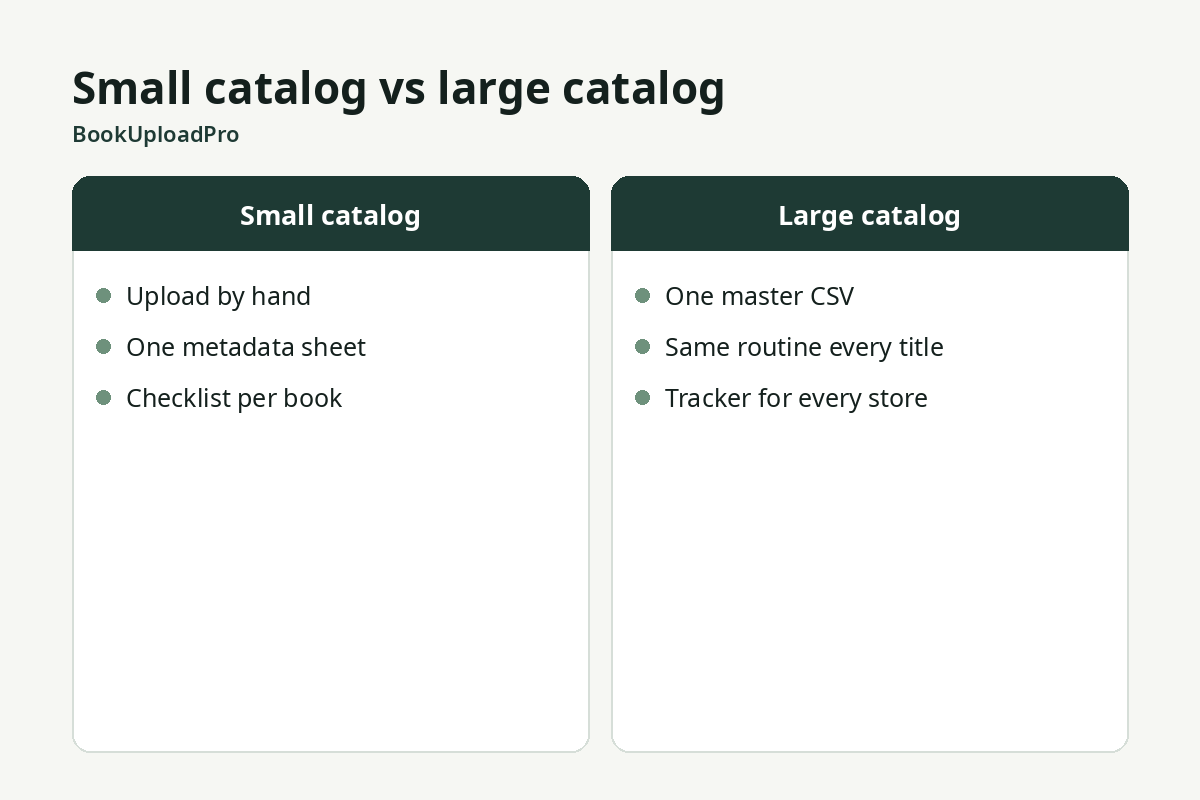
Below about ten titles, an author can hold the catalog in their head. Above 50, nobody can. The failure modes change: the price updated on Amazon but not on Kobo, the corrected file uploaded to four stores out of five, the new edition that went live at one store while the old edition still sells at another. These are not upload problems. They are record keeping problems, and they grow with the catalog. The fix is a single source of truth: one spreadsheet with one row per title and format, holding the metadata, the file versions, the prices, and the live status at every store. Our tracking post shows that grid in detail.
The routine that scales
Work in batches, not in heroics. Pick a batch of titles, prepare their metadata and files from the master records, upload them in the same sequence at each store, and log each one in the tracker as it goes live. New editions follow the same routine: fix the master file, re-export, replace the file at each store, and log the date. When the routine is the same every time, a new team member can run it, and the publisher does not depend on one person’s memory. That is the honest answer to the staffing question: the system does the remembering, so the staff can do the work.
When a tool earns its place
At catalog scale, the honest math from our post on when to stop uploading by hand flips hard. Retyping the same details into five dashboards for 200 titles is not a chore, it is a full time job with a high error rate. A preparation tool that fills each store’s own form from your single metadata record, one store at a time, saving drafts for your review, removes the retyping step where catalog errors are born, while you stay the publisher. An aggregator can play the same role for the stores you do not want accounts at, accepting its cut per sale. Either way, the decision is the same: pay for the system, or pay for the mistakes.
FAQ
How do publishers with 50 or more titles keep up with uploading new editions to every platform?
With one system: a single metadata record per title, one file routine, one tracker for every store, and uploads run in batches in the same sequence every time. New editions are fixed in the master file, re-exported, and replaced at each store in the same routine.
We are a small publisher with 200 titles, how do we distribute wide without hiring more staff?
Build the system before you hire. One spreadsheet as the source of truth, one repeatable upload routine, one tracker, and a preparation tool that fills each store’s form from the same record. The system replaces the remembering, which is the part that would otherwise need more people. Our pre upload checklist is the starting point for that record.