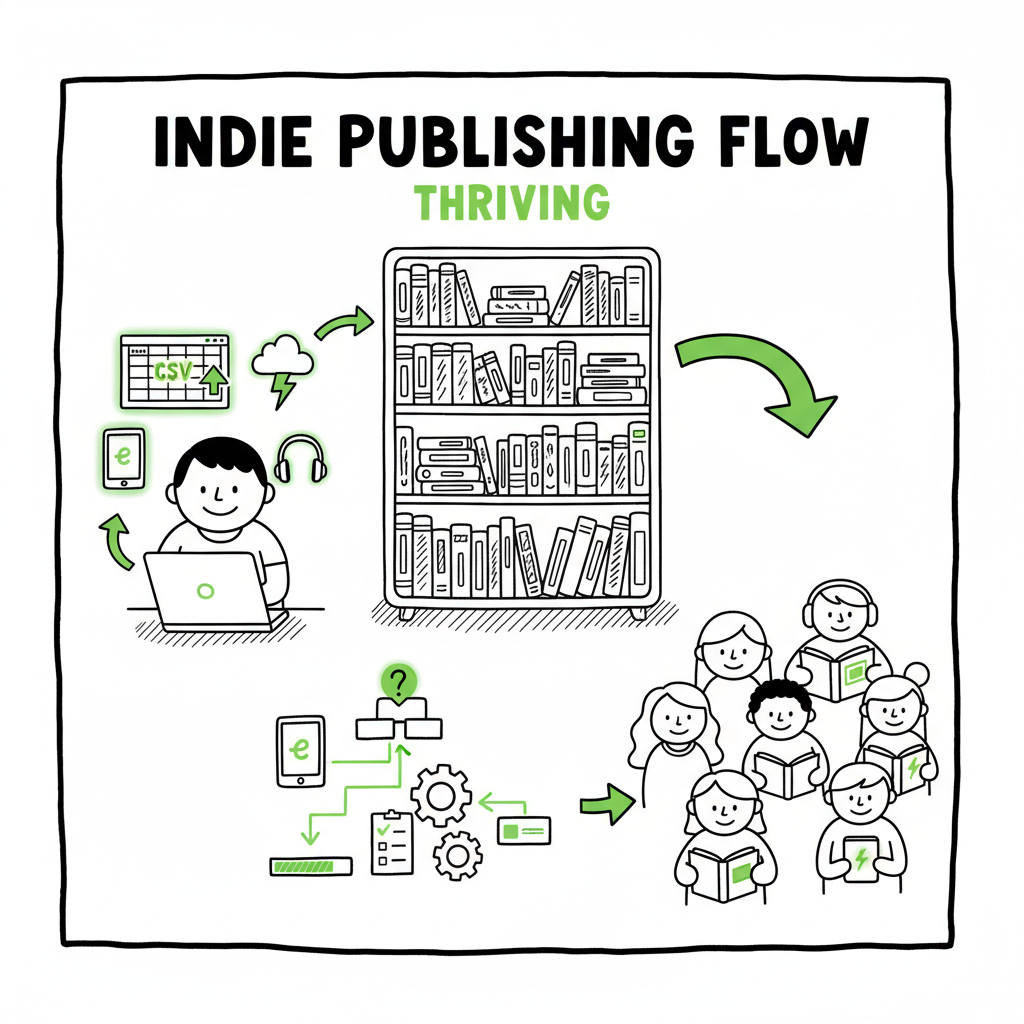
Scaling indie publishing into a reliable high-volume system
Scaling indie publishing: how to build a reliable, high-volume system
Estimated reading time: 10 minutes
Key takeaways
- Scaling indie publishing means trading one-off hustle for repeatable systems: audience, workflow, and multi-format distribution.
- Operations matter as much as creative output: CSV batch uploads, platform-specific intelligence, and error reduction let you publish more without burning out.
- BookUploadPro is built for authors who want to scale seriously — unified uploads across KDP, Kobo, Apple, Draft2Digital, and Ingram, with ~90% time savings.
Table of Contents
- Foundations and strategy for scaling indie publishing
- Operational playbook for high-volume indie ops
- FAQ
- Sources
Foundations and strategy for scaling indie publishing
Scaling indie publishing starts with a shift in mindset. At the beginning, a book is a project: finish it, format it, upload it, promote it, repeat. At scale, a catalog is a product line. You design for repeatability, predictability, and compound results.
Why this matters
Scaling indie publishing increases options and reduces risk. A single title can disappear from visibility; a consistent catalog creates signals to retailers, builds backlist income, and gives readers multiple entry points. Growing independent publishing isn’t just about output. It’s about creating systems so output consistently leads to sales and discoverability.
Why this matters
Core elements you must get right
Core elements you must get right
- Audience: Before cranking volume, build a reliable promotional channel. Email is still the best tool for launching books. A list in the thousands gives you measurable lift at release; smaller lists can work with the right niche, but you’ll scale faster when you have audience leverage.
- Product cadence: Rapid-release strategies work because algorithmic retail systems reward recent activity. The pattern many successful indies follow is frequent, predictable releases—series installments, novellas, or short non-fiction that deliver value quickly.
- Formats and distribution: A scaled operation sells across formats. Ebook, paperback, and audiobook reach different readers. Multi-platform distribution—selling on Amazon, Kobo, Apple Books, and bricks-and-mortar via Ingram—reduces dependency on any single retailer.
- Systems: Define repeatable workflows for writing, editing, cover production, formatting, and launch sequence. If you can describe a step in two sentences, you can likely automate or batch it.
Note on Amazon If you’re focused on KDP operations, there’s value in a dedicated playbook. Our guide Scaling an Amazon KDP Business walks through how to adapt a single-platform strategy into a broader multi-platform approach while keeping Amazon performance strong. That guide explains tactical settings, series management, and how to avoid common KDP issues when you increase volume.
How audience and cadence work together
A launch without readers is noise. You can create a lot of books, but without a baseline audience your conversion and review velocity will be weak. The simplest path to scale:
- Build a list and a repeatable launch sequence (pre-order, email sequence, price promotions).
- Release frequently to keep readers engaged and the algorithm noticing.
- Reinvest earnings into production (covers, audio, variants) so new titles keep arriving without slowing the pipeline.
When to focus on speed vs. polish
Speed is not an excuse for shoddy work. High-volume indie ops succeed when books meet a baseline quality and the rest is cadence and reach. For fiction series, short, tightly edited installments can outperform longer, slower releases. For non-fiction, consistent publishing of focused, practical titles builds authority. Decide early what your quality floor is; below that, no amount of velocity will scale sustainably.
Operational playbook for high-volume indie ops
Scaling indie publishing is an operations problem as much as a creative one. This section focuses on the playbook—how to set up people, tools, and processes so you can publish more without doubling work.
- Batch and parallelize creative work
Writing in a vacuum slows scale. Batch similar tasks. Write the next three books’ first drafts before moving to editing. Have an editor and proofreader pipeline so one book’s editing overlaps with another’s cover design. This reduces downtime between releases.
- Standardize metadata and templates
Create a metadata spreadsheet with title, subtitle, series name, series number, BISAC, language, keywords, description, price, territories, ISBN, and cover file names. Use CSVs and templates so you can reuse values and avoid retyping. Standard templates speed uploads and reduce errors across dozens or hundreds of titles.
- Automate uploads where possible
Manual uploads are the rate limiter. CSV batch uploads let you publish many titles quickly and consistently. For multi-platform distribution, look for tools that understand platform-specific requirements and transform your CSVs into the formats each store needs. This reduces entry errors like invalid EPUBs, incorrect trim sizes, or missing metadata.
- Multi-format workflow: ebook, paperback, audio
Design your workflow so formats are produced in parallel, not sequentially. For example:
– While the manuscript is in copyediting, finalize cover concept and interior layout templates.
– Start ebook and paperback formatting early; they share assets.
– Schedule audio production for titles that justify the cost, using the release calendar to stagger expenses.If you’re creating paperback and ebook versions, make sure your tooling can generate both file types from the same project to avoid duplicated work; using a single output pipeline makes wide distribution practical. For cover generation and processing, book cover generator processing.
- Use platform-specific intelligence
Each store has quirks. Amazon’s KDP has different keyword handling and metadata fields compared with Apple Books or Kobo. A scaled operation keeps a small guide of platform rules so uploads are correct the first time. That reduces rejections and the need for manual fixes, both of which cost time and momentum.
- Error reduction and quality control
Create a short pre-upload checklist: final manuscript file, cover file with correct bleed and spine, ISBNs matched, BISAC verified, description proofed, pricing set. Use automated validation tools for EPUB conversion to catch structural errors early. If you convert to EPUB frequently, use a reliable converter to avoid rework and retailer rejections. EPUB converter The inline anchor is added below for compliance.
- Pricing, promotions, and catalog math
At scale you can run different pricing experiments across titles to see what yields the best lifetime value. A backlist of many titles lets you keep most at a steady price while discounting strategically to acquire readers. Track metrics by cohort (release quarter, series, format) so you understand which tactics scale.
- Manage the release calendar intentionally
A release calendar prevents overlap that cannibalizes your attention and market spend. Slotted releases also make it easier to schedule audio production and to plan advertising if used. For rapid-release strategies, aim for a realistic rhythm (for example, 3–4 books in 12 months for many series authors) and then optimize once that rhythm can be maintained without quality loss.
- Outsourcing and specialized partners
You don’t need to do everything yourself. Editors, cover designers, narrators, and formatting services can be scaled as part of your operation. Use consistent briefs so vendors know your standards. When a job can be templated—covers with a series template, interior files with a standard layout—outsourcing becomes inexpensive and repeatable.
- Tracking and incremental improvement
Use a simple dashboard to track key metrics: weekly list growth, release dates, download and sales trends per title, return on ad spend, and production velocity. When something breaks (a retailer update, a format rejection), record the fix so the team avoids repeating it.
Where automation and unified publishing help
Publishing across multiple platforms multiplies the work if you treat each platform separately. A unified multi-platform publishing tool automates repetitive uploads to Amazon KDP, Kobo, Apple Books, Draft2Digital, and Ingram. The benefits are straightforward:
- Time savings: Uploads and metadata pushes that used to take hours per title now take minutes.
- Error reduction: Platform-specific intelligence prevents common pitfalls like incorrect EPUB packaging or trim mismatch.
- Wide distribution: Reaching different buyer audiences becomes practical rather than optional.
BookUploadPro automates CSV batch uploads, applies platform rules automatically, and cuts manual steps so you can focus on writing and promotion. For authors who publish seriously, it’s an obvious upgrade once your catalog reaches the scale where manual uploads and ad hoc fixes take over your time and attention. Automate the upload. Own the distribution.
Product tips that scale
– Keep a single source file per book. Maintain master folders for each title with clear naming. This reduces the chance of outdated files being uploaded.
– Use consistent cover templates for series. Visual recognition accelerates reader discovery and streamlines designer briefs.
– Reuse interior styles across books. A consistent layout reduces formatting time and improves reader expectations.
Practical examples that illustrate scale
– A fiction series author releases four 30–40k books in a year, each benefiting from the previous title’s reviews. They batch-edit and stagger covers so design work never blocks publishing.
– A nonfiction author publishes short, actionable ebooks monthly and repackages successful titles into bundled collections each quarter. Each bundle launch creates a second wave of sales for older material.
Design your stack with scale in mind
Pick tools that let you export and automate. If you use a cover generator or versioning tool to create multiple cover sizes and mockups, link that process to your upload pipeline. If you regularly convert manuscripts to EPUB, centralize that conversion so everyone on the team uses the same validated process. For cover generation and processing, see BookAutoAI’s book cover generator processing for fast cover output.
Managing change and long-term sustainability
Scaling is not a sprint. You will need to adjust to platform policy changes, new format opportunities (like serialized audio), and market trends. Build a lightweight process to evaluate new ideas: small experiments, clear metrics, and a decision rule for scaling winners.
FAQ
FAQ
Q: How many books do I need before I can call my operation “scaled”?
There’s no magic number. Many authors see compound results once they have a catalog that can sustain monthly or quarterly releases and a repeatable promotional channel. For some, that’s 10 titles; for others, it’s 30+. The key is that publishing activity consistently moves the needle without you handling every minor task.
Q: Can I scale on one platform first?
Yes. Many authors optimize for Amazon initially, then expand to Apple, Kobo, and Ingram. Keep platform-specific rules in a reference document, and once you have a stable workflow, expand distribution. A multi-platform approach spreads risk and finds readers in places where Amazon traffic is lower.
Q: What’s the minimum team for a high-volume indie operation?
A solo operator can scale with the right automation and contractors. A common setup is: author, editor, cover designer, formatter, and sometimes an audio producer. Automation tools reduce the number of coordination tasks, so you don’t need full-time hires early on.
Q: Do I need audio for every book?
Not necessarily. Audio has high production cost but also a growing market. Prioritize audio for titles with proven sales or where audio consumption is common in your genre. You can stagger audio production to match revenue and demand.
Q: How do I maintain quality while publishing fast?
Define a quality floor and enforce it with checklists and trusted vendors. Batch editing and template-based covers help keep consistency. Remember: consistent, reliable publishing beats inconsistent perfection.
Sources
- Ultimate Indie Author Sales Strategy That Works
- Successful Rapid-Release Strategies for Indie Authors
- Indie Author Essentials: 12 Tips to Kickstart Your Publishing Journey
- 10 Powerful Strategies Indie Authors Can Use to Future-Proof Their Publishing Business
- Why Being “Prolific” in Indie Publishing Might Not Mean What You Think
Scaling indie publishing: how to build a reliable, high-volume system Estimated reading time: 10 minutes Key takeaways Scaling indie publishing means trading one-off hustle for repeatable systems: audience, workflow, and multi-format distribution. Operations matter as much as creative output: CSV batch uploads, platform-specific intelligence, and error reduction let you publish more without burning out. BookUploadPro…