
In this guide
- What changed in 2026
- What KDP pushes back on
- What counts as low content, and what does not
- What still sells
- What to do with an existing catalog
- FAQ
- Low content books in 2026: what still sells, and what KDP pushes back on
- Can you still make money with low content books in 2026?
- How many low content books can I publish on KDP per week?
- Why did KDP remove my low content book?
Low content books still sell in 2026, but the business changed. The volume game, dozens of near identical notebooks with a new cover each week, is what KDP now pushes back on hardest. What still works is the opposite: a small number of well made books, each built for a specific person and a specific use, published slowly enough to survive review. If your plan needs fifty titles a month to work, it no longer works. If your plan needs five good titles a year, it does.
Key takeaways:
- KDP now limits new title creation to 2 titles per format per week, down from 10, with the counter resetting each Sunday.
- The most common removal trigger is near identical interiors across listings, with only the cover swapped.
- Low content reviews can take 3 to 4 weeks, so plan launches a month ahead.
- Low content books get no free KDP ISBN, no Expanded Distribution, and no series pages.
- What still sells: journals, planners, and logbooks built for one defined audience and one real use.
What changed in 2026
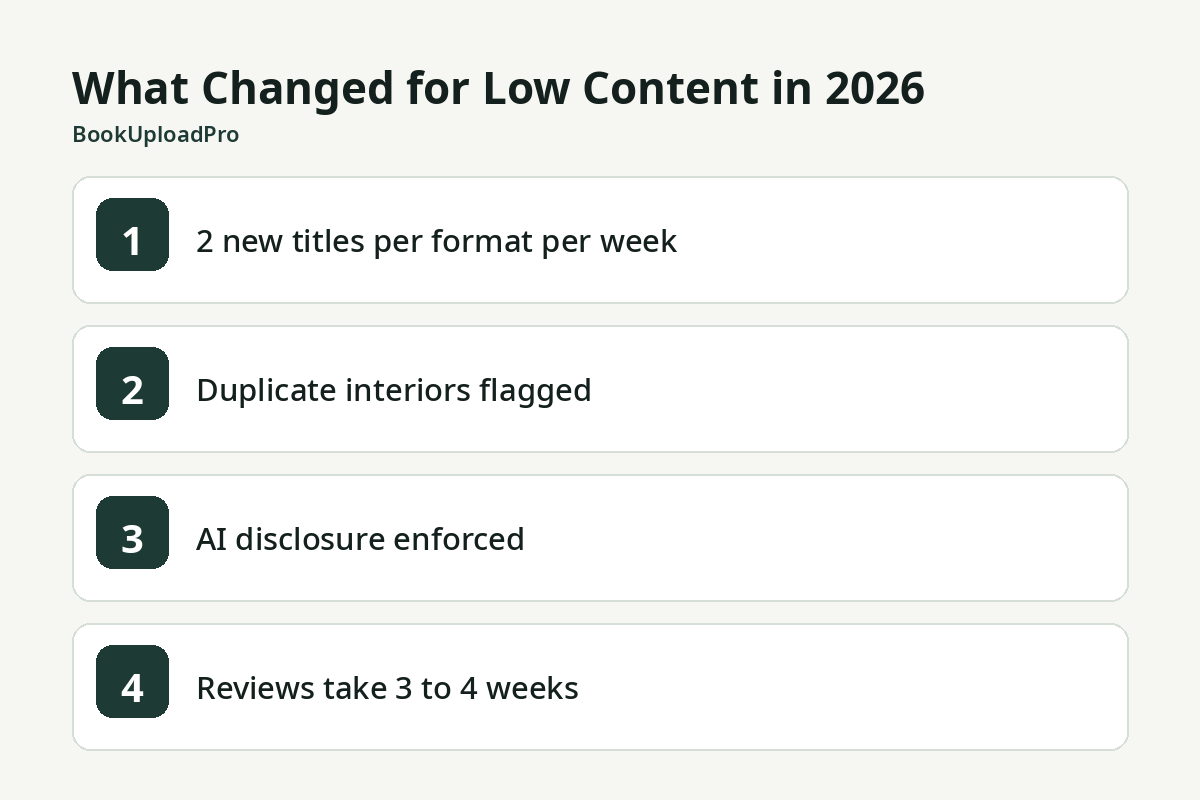
Two enforcement shifts drive most of what authors are seeing this year. First, the weekly limit. As of September 2026, KDP allows creating 2 new titles per format per week, down from 10, and the same limit applies to publication submissions. The counter resets every Sunday at 00:00 UTC, formats are counted separately, and updates to titles already submitted do not consume quota. Second, duplicate interiors are now actively flagged. Amazon’s content quality rules disallow content that is not significantly different from content in another book, and content excessively reused or repeated within or across books. Publishing the same lined interior under forty different covers is exactly that pattern, and bulk publishing patterns in a short window read as a spam signal even if each individual book would pass on its own. Our guide to the upload stage explains the longer review clocks low content books face: https://blog.bookuploadpro.com/kdp-upload-stuck-on-processing/
What KDP pushes back on
The removals cluster around five triggers. Near identical interiors across listings, the single most common trigger. Undisclosed AI generated content, including text, cover art, or translations, with Amazon now reviewing previously published titles retroactively, not just new submissions. Misleading titles, subtitles, or keywords, including repeating generic words like notebook, journal, or gifts in the title. Bulk publishing patterns, many similar titles uploaded in a short window. And trademark or copyright problems, brand names, sports team logos, film characters, and song lyrics on covers or interiors. None of this is a ban on low content publishing. What is being penalised is volume without differentiation, and content without honest labelling.
What counts as low content, and what does not
KDP’s own help page draws the line. Notebooks, planners, journals, and log books are low content. Puzzle books, coloring books, and children’s books generally are not, because they do not feature repetitive content on each page. That label changes what you can use: low content books are not eligible for the free KDP ISBN, cannot use Expanded Distribution, cannot form a series, and lose the Look Inside sample if published without an ISBN. You must also tick the Low-content box during setup, or KDP says the book will be rejected. Coloring books are the common mistake here, and our step by step coloring book guide explains why they are treated as standard paperbacks: https://blog.bookuploadpro.com/how-to-publish-a-coloring-book-on-kdp/
What still sells
The books that still earn share three traits. They serve one defined audience, not everyone who writes things down: a shift log for night nurses, a training log for marathon beginners, a prayer journal for new mothers. They solve one real use, with columns, prompts, or trackers designed for that use, not a generic lined page with a niche word on the cover. And they are finished properly: a real cover, a clean interior, honest metadata, and a price that reflects the page count. Our guide to low content formats covers the page counts and economics that make these books work: https://blog.bookuploadpro.com/low-content-formats-that-sell/ Generic notebooks with a pretty cover and nothing inside are the books most likely to be flagged, removed, or simply ignored by buyers.
What to do with an existing catalog
If you already have a catalog of similar titles, do not bulk upload more of them. Audit what exists: keep the titles with distinct interiors and real sales, and consider unpublishing near duplicates that share an interior, because they are the ones most likely to be flagged and they dilute the titles worth keeping. Check the AI disclosure answer on every older title, since Amazon is reviewing previously published books retroactively. And spread new titles across weeks inside the 2 per format limit, instead of spending a whole week of quota on variations of one interior. Two genuinely different books a week is 104 a year, which is more than enough for a catalog built on differentiation.
FAQ
Low content books in 2026: what still sells, and what KDP pushes back on
Low content still sells when each book is built for one defined audience and one real use, with a distinct interior. KDP pushes back on volume without differentiation: near identical interiors, bulk uploads, misleading metadata, and undisclosed AI content. The 2 new titles per format per week limit makes the old volume strategy impossible.
Can you still make money with low content books in 2026?
Yes, with a different model than the volume years. A small catalog of well made journals, planners, and logbooks for specific audiences can earn steadily, because each title is a real product a buyer can judge. Generic notebooks with a swapped cover rarely earn much and are the books most likely to be removed.
How many low content books can I publish on KDP per week?
Two new titles per format per week, as of September 2026, down from 10. The counter resets every Sunday at 00:00 UTC, formats are counted separately, and updates to titles already submitted do not use quota. Low content reviews can take 3 to 4 weeks on top of that.
Why did KDP remove my low content book?
The most common reason is a near identical interior shared with another listing, with only the cover changed. Other common reasons are undisclosed AI generated content, misleading titles or keywords, trademarked material on the cover or inside, and failing to tick the Low-content box during setup. Check KDP’s email for the exact reason, fix exactly what it names, and resubmit.