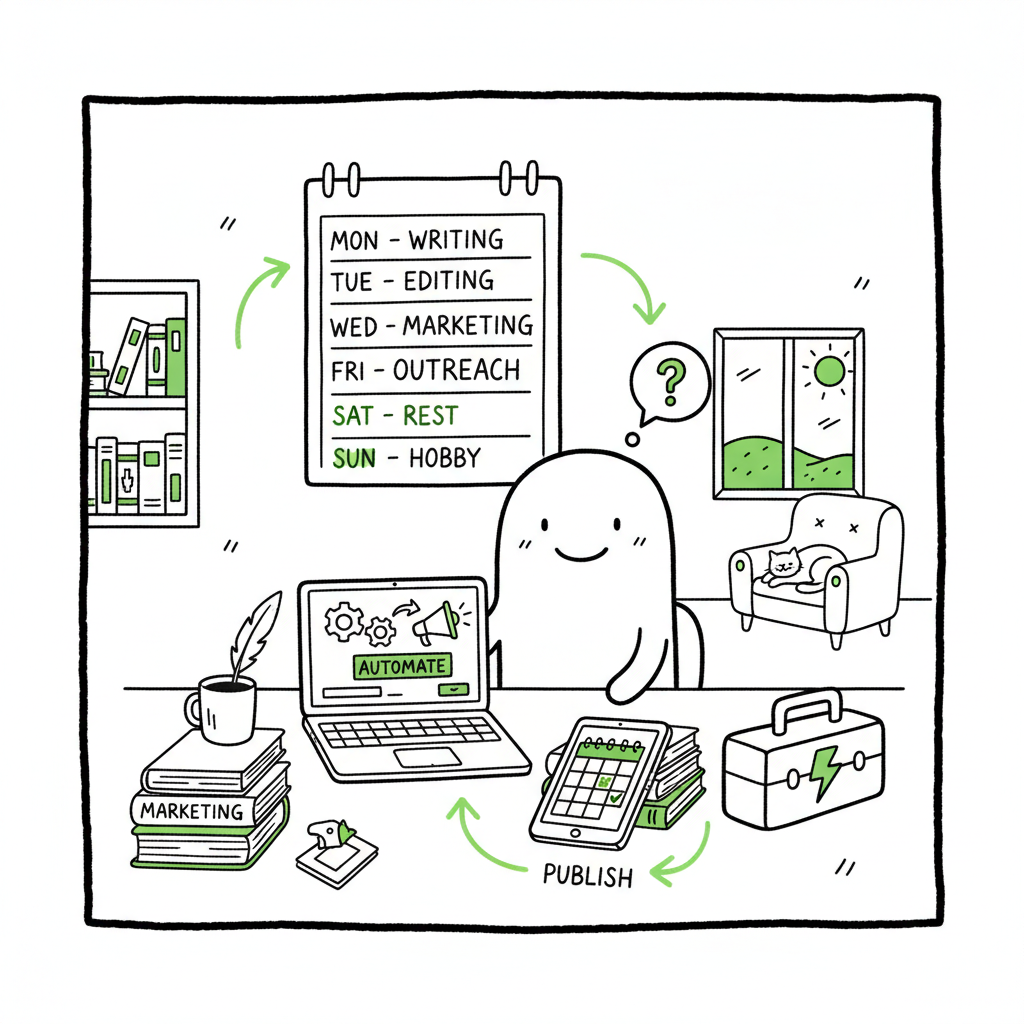
Launch Burnout Prevention for Self-Publishing Authors
Launch Burnout Prevention for Self-Publishing Authors
Estimated reading time: 9 minutes
Key takeaways
- Launch burnout prevention starts with honest assessment, clear priorities, and a plan that includes rest, delegation, and automation.
- Break launches into small, repeatable pieces: batch uploads, templates, and scheduled promotion windows reduce last-minute crunch.
- Tools that automate multi-platform publishing and file preparation turn launch work into predictable, low-friction steps—making sustainable publishing possible.
Table of Contents
- Why launch burnout hits authors
- A practical prevention framework
- Workflows and tools for multi-platform publishing
- When to scale or pause
- FAQ
Why launch burnout hits authors
Authors launch repeatedly and often alone. A single book launch includes editing, cover decisions, formatting, metadata, pricing strategy, ad setup, newsletter work, and platform uploads. If you publish on multiple stores, those tasks multiply.
Stressors that lead to burnout during launches:
- Tight deadlines and last-minute corrections.
- Repeating the same manual uploads across Amazon KDP, Apple, Kobo, Draft2Digital, and Ingram.
- Juggling marketing while fixing files and chasing platform-specific rules.
- Losing sleep and foregoing routines in the name of “one more task.”
Launch burnout prevention begins before the panic. Put systems in place so launch tasks are predictable, not emergency-only. That reduces emotional tax and improves outcomes.
For a practical, step-by-step resource, see the Book Launch Strategy Practical Guide.
A practical prevention framework
This framework fits a single-author operation and small teams. It’s operational: assess, simplify, automate, and recover.
- Assess: map the launch work. Write down every task you do for a launch, from final proofread to promotional tweets. Count time and frequency. Measure what consistently drains you: which tasks take the most time, cause the most stress, or require repeated fixes.
- Simplify: cut, defer, and standardize
- Cut non-essential activities. Not every title needs a big paid ad push.
- Defer extras to a second wave (post-launch updates, expanded ads).
- Standardize metadata, descriptions, and pricing strategies with templates so you only tweak instead of rewriting.
- Automate and delegate: Automation doesn’t eliminate decisions; it removes repetitive labor. For example:
- Batch uploads and CSV metadata reduce repeated form-filling.
- Use EPUB conversion tools when preparing ebooks to avoid reformatting headaches.
- If you still design covers by hand, consider a book cover generator to speed iterations.
- Schedule energy, not just tasks: Use blocks that respect human attention: 60–90 minute focused sessions, then a deliberate break. Apply Pomodoro or time-blocking during pre-launch weeks. Plan lighter marketing the week after launch to allow recovery.
- Build support: Peer feedback, a launch buddy, or a small VA for routine checks prevents last-minute firefighting. Mentors and peers provide a reality check and can flag issues before they become crises.
- Measure recovery: Track simple metrics: hours worked per day, sleep hours, and a short daily rating of energy or stress. If stress scores climb, pause a non-essential activity. Small, consistent adjustments keep burnout from escalating.
Workflows and tools for multi-platform publishing
The technical work of publishing multiple formats and stores is a common burnout source. Good workflows convert many manual steps into a few reliable actions.
Batch and template strategy
- Maintain a master CSV with title, subtitle, keywords, categories, and pricing.
- Keep one folder per book with final interior, final cover, and final metadata files.
- Use the same launch checklist every time and treat it as non-negotiable.
File preparation
- Convert once, reuse everywhere. Converting your manuscript into a clean EPUB instead of wrestling with platform upload quirks saves hours; use an EPUB converter early in your workflow so stores share the same base file.
- Produce a single paperback PDF and a single ebook file—then let platform tools handle minor differences.
Covers and assets
- Rapidly iterate covers with a book cover generator when you need variations or mockups for ads. That keeps design decisions from derailing launch timelines.
Multi-platform uploads
Manually uploading to each store is a top burnout driver. Services that support CSV batch uploads and platform-specific rules let you push one dataset to many stores. This reduces error and repetition, and shortens launch windows.
Automation matters for prevention
Automation turns unpredictable weekend marathons into scheduled work: prepare the materials, queue the uploads, and use the saved time for rest or higher-value promotional work. Tools that include platform-specific intelligence reduce platform rejections that force late-night fixes.
BookUploadPro solves the mechanical side of launches: unified multi-platform publishing, CSV batch uploads, and platform-aware checks. Authors report up to ~90% time savings on repetitive tasks. When you stop fighting forms and file quirks, you keep mental energy for writing and marketing. Automate the upload. Own the distribution.
Helpful tool notes (editorial links)
- If covers slow you down, a fast book cover generator will get you clean, consistent art for test audiences.
- For ebooks, an EPUB converter early in the process removes a common point of failure.
- If you need to create a paperback or ebook quickly, generate the files in a single workflow to avoid last-minute format fixes.
When to scale or pause
Not every launch requires scaling up. Decide with data and energy.
Scale when:
- You’re publishing multiple titles per year and repetitive tasks consume your time.
- Revenue and audience size justify automation or hiring a VA.
- You consistently want to run parallel promotions on several platforms.
Pause when:
- Your stress metrics are trending up over multiple launches.
- Health, family, or major life events reduce your capacity.
- A launch is unlikely to reach key goals and is consuming time better spent on a stronger project.
If you choose to scale, do it incrementally. Start with batch uploads and automated file conversion. Add cover iteration tools and platform checks next. Each step reduces friction and preserves your energy for creative work.
Final thoughts
Sustainable publishing is operational. Preventing launch burnout means shifting work from unpredictable bursts to predictable systems: assess what breaks you, simplify tasks, automate the repetitive, and schedule recovery. When repetitive uploads become a routine instead of a crisis, publishing scales without burning out the person behind it.
FAQ
Q:
How soon should I start automating?
Start when manual uploads take more than a couple of hours per book or when you plan to publish multiple books per year. Early automation yields compounding time savings.
Q: Can automation reduce creative control?
No. Automation handles repetitive steps—metadata uploads, file conversions, and publisher forms—so you spend more time on creative decisions, not their execution.
Q: What simple first step prevents launch burnout?
Create a launch checklist and a single master folder for each book. The checklist forces consistency; the folder keeps final assets ready. From there, add batching and conversion tools.
Q: How can I measure recovery during a launch cycle?
Track hours worked per day, sleep hours, and a short daily rating of energy or stress. If numbers trend upward, pause non-essential tasks and adjust expectations.
Q: When should I scale a launch?
Scale when you have enough bandwidth, a clear path to automation or delegation, and a proven demand across multiple platforms. Start with small, controlled increases to preserve your creative energy.
Sources
- 5 Ways to Prevent and Overcome Burnout – NHSA
- 6 Workplace Burnout Prevention Strategies Every HR Manager …
- Burnout to Breakthrough: How to Recharge and Reignite Your Drive
- Burnout Prevention Tips To Protect Your Mental And Emotional Health
- Steps To Launch A Burnout Program In Hospitals – Gail Gazelle
- 7 Employee Engagement Strategies for Burnout Prevention
- Burnout Prevention Strategies For Federal Managers
- Burnout: Symptoms, Treatment, and Coping Strategy Tips
- Interventions to reduce stress and prevent burnout in healthcare
Launch Burnout Prevention for Self-Publishing Authors Estimated reading time: 9 minutes Key takeaways Launch burnout prevention starts with honest assessment, clear priorities, and a plan that includes rest, delegation, and automation. Break launches into small, repeatable pieces: batch uploads, templates, and scheduled promotion windows reduce last-minute crunch. Tools that automate multi-platform publishing and file preparation…