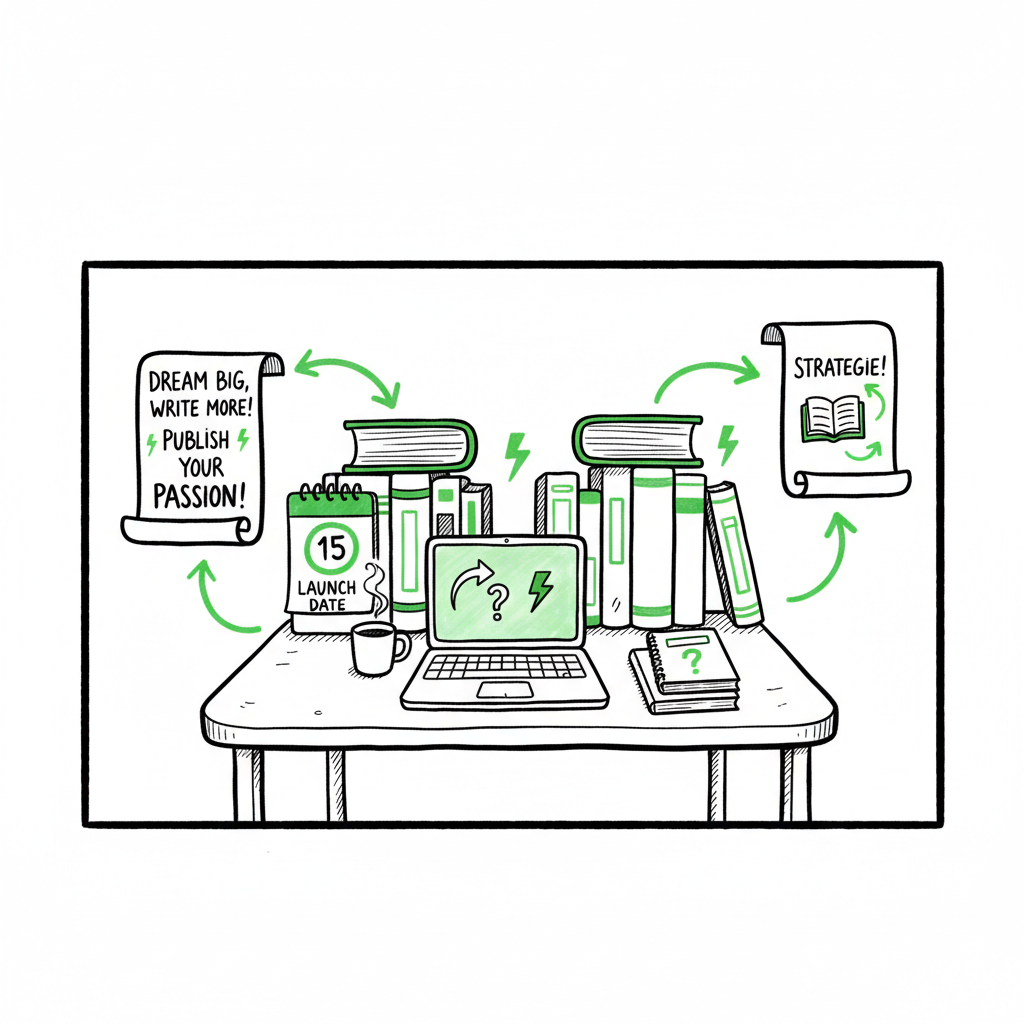
Practical Book Launch Strategy for Self-Publishing
Book Launch Strategy: A Practical Guide for Self-Publishing Authors
Estimated reading time: 9 minutes
Table of Contents
- Why a clear book launch strategy matters
- Build a practical launch timeline
- Distribute widely without extra work
- Marketing that matches your scale
- Final thoughts and FAQ
- FAQ
- Sources
Why a clear book launch strategy matters
A book launch strategy is the blueprint that turns a finished manuscript into sales, reviews, and long-term discovery. For self-publishing authors, a good strategy keeps deadlines realistic, reduces last-minute errors, and protects the one thing you can’t get back: time. Use the strategy to decide what you do yourself, what you batch, and what you automate.
Starting with that clarity lets you treat each book like a product: clear goals, tests you can run, and processes you can reuse. That mindset pays off fast when you publish more than one title.
Build a practical launch timeline
A launch timeline should be practical, not aspirational. Aim for reproducible steps you can run again and again.
12–8 weeks before launch
Finalize the manuscript and metadata. Lock the title, subtitle, author name, and categories. Metadata is search fuel; treat it as a priority, not a last-minute task.
8–4 weeks before launch
Prepare assets. That includes the interior file, ebook formats, and a print-ready PDF if you plan a paperback. If you need fast, reliable ebook or print conversions, consider a dedicated tool for generating files and converting to EPUB to avoid format setbacks.
4–2 weeks before launch
Upload to platforms and check proofs. Do this early to catch platform-specific errors. If you’re producing a paperback, order a proof copy and expect a small round of corrections.
2–0 weeks before launch
Execute the marketing plan—email, ads, and promotions. Coordinate a short promotional window for maximum visibility.
If you’re producing both ebook and paperback, make sure the cover and interior files are aligned. For a rapid process that handles cover generation and processing, use a purpose-built cover tool to keep sizes, bleed, and spine math correct. Automating these repetitive steps removes friction and reduces mistakes.
Distribute widely without extra work
Wide distribution is a strategic lever. The more places your book is available, the more discovery channels you open. But listing to every platform manually is slow and error-prone. That’s where automation pays.
A modern multi-platform publishing process should include:
- Unified uploads: A single source of truth for metadata and files that pushes to Amazon KDP, Kobo, Apple Books, Draft2Digital, and Ingram without re-keying data.
- CSV batch uploads: When you publish several titles or editions, a CSV-based process scales hundreds of uploads with consistent metadata.
- Platform-specific intelligence: The system applies platform rules (file naming, image sizes, category mappings) so you don’t have to memorize differences.
- Error reduction and proof checks: Automated checks catch common problems—missing ISBNs, incorrect file types, or image issues—before they block a listing.
When distribution is automated, wide release becomes an obvious choice, not a logistical headache. If you create an ebook or paperback frequently, consider tools that centralize that work and push it out. That makes changes and updates consistent across channels and keeps your catalog coherent.
Marketing that matches your scale
Marketing should reflect the resources you have and the size of your audience. Treat launch marketing like an experiment that you can measure.
Audience-first activities
- Email list: Clean, segmented lists outperform one-off promotions. Share behind-the-scenes notes and a clear launch timeline.
- Reader magnets and lead gen: A short free story or checklist can convert casual readers into subscribers.
- Pre-orders: Use a pre-order window to build momentum and collect early orders that count on release day.
Paid channels and promotions
- Early reviews: Reach out to ARC readers and use a simple process for collecting honest reviews without buying them.
- Paid ads: Start small, measure click-through and cost per click, and focus on audiences that match your genre.
- Promotional services: Time-limited promotions and book promotion sites can spike visibility but are best used with an optimized product page.
Testing and iteration: Track what matters: page reads, units sold, conversion from ad clicks, and email open rates. Use those metrics to improve the next launch. A repeatable launch strategy gets better with every book because you can reuse what worked and drop what didn’t.
Practical notes on assets and files: Covers, interiors, and ebook files are not creative extras—they are operational items. Getting them right once allows you to reuse templates and speed future launches.
- If you need a fast, reliable cover processing, use a cover processing tool that ensures the file meets platform specs.
- Convert manuscripts to EPUB early to test reflow and internal links; fix issues before upload by using a dedicated EPUB converter.
- When building paperbacks and hardcovers, use templates and check spine calculations to avoid proof rework.
Final thoughts and FAQ
Final thoughts
A book launch strategy should save you time, reduce errors, and make wide distribution practical. When you publish seriously, automation becomes an obvious upgrade: it cuts repetitive work, scales uploads across platforms, and lets you focus on writing and marketing. Automate the upload. Own the distribution.
FAQ
Q: How early should I set up distribution channels?
Set up distribution and upload proofs at least 4–6 weeks before launch to catch platform issues. If you have complex files or need print proofs, allow extra time.
Q: Can I automate uploads to Amazon KDP and other stores?
Yes. Use a publishing automation tool that supports KDP, Kobo, Apple Books, Draft2Digital, and Ingram. It should handle CSV batch uploads and platform-specific checks to save time and reduce errors.
Q: What files do I need for a smooth launch?
At minimum: a finalized manuscript file, an EPUB or reflowable ebook, a print-ready PDF for paperback, a high-resolution cover image (with spine if printing), and clean metadata including ISBNs or platform-specific identifiers.
Q: How should I handle covers and formatting?
Use tools specialized for cover processing and EPUB conversion to avoid common format issues. Those tools enforce platform specs so you don’t waste time on trial-and-error.
Q: Does wide distribution hurt Amazon ranking?
Wide distribution and Amazon ranking serve different goals. Wide distribution improves discoverability across other stores and reaches readers who don’t use Amazon. Use pricing and exclusivity decisions intentionally based on your goals.
Sources
- BookUploadPro product documentation and feature summaries
- Industry best practices for self-publishing and ebook distribution
- Publishing workflow resources for covers, EPUB conversion, and print preparation
Book Launch Strategy: A Practical Guide for Self-Publishing Authors Estimated reading time: 9 minutes Table of Contents Why a clear book launch strategy matters Build a practical launch timeline Distribute widely without extra work Marketing that matches your scale Final thoughts and FAQ FAQ Sources Why a clear book launch strategy matters A book launch…