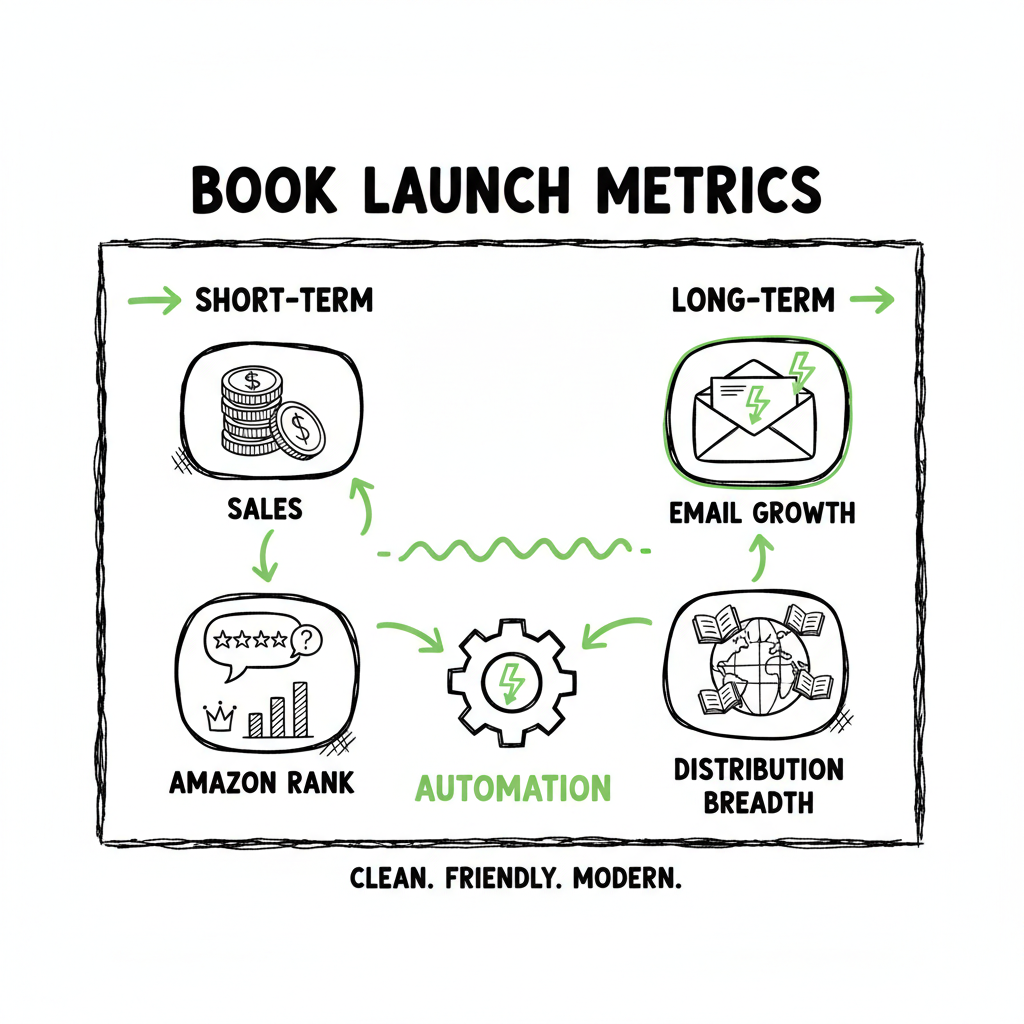
Book Launch Metrics That Matter for Self-Publishers
Book launch metrics that matter
Estimated reading time: 7 minutes
Key takeaways
- Track a small set of outcomes that connect directly to your goals: sales, visibility, and repeatability.
- Measure both short-term launch indicators (sales, reviews, Amazon rank) and long-term levers (email growth, distribution breadth, preorders).
- Use automation to remove busywork—batch uploads, platform-specific checks, and consistent metadata reduce errors and free time for marketing.
Table of Contents
- Why these metrics matter
- Key metrics to track
- How to measure and benchmark launches
- Automating the workflow so metrics become repeatable
- FAQ
- Sources
Why these metrics matter
When you say “book launch,” what outcome do you mean? Immediate sales? Long-term discoverability? Payment milestones? That clarity decides which book launch metrics that matter for you.
A focused launch prioritizes a few measurable signals that tie back to those outcomes. Short-term indicators—first-week sales, category rank, and paid ads ROI—tell you whether a campaign moved readers to buy. Long-term indicators—email list growth, review velocity, and distribution reach—tell you whether the title will keep working after launch. Measuring both gives you a real picture of launch quality and what to repeat.
If you need a launch plan to align those metrics with tactics, see the Book Launch Strategy Practical Guide — it shows how to map goals to actions and metrics so your data doesn’t lie to you.
Key metrics to track
Sales velocity (first 7–30 days)
Why it matters: First-week and first-month sales set algorithmic momentum on stores. They affect search rank, category placements, and visibility in recommendation engines.
How to use it: Compare to your pre-launch targets. A low early velocity can mean your preorder funnel or audience reach needs work.
Net revenue and ROI
Why it matters: Gross sales are noise unless you subtract promo costs, production, and paid ads.
How to use it: Track ad spend and promo costs in the same sheet as sales. If you can’t break even by sustained promotion budgets, adjust pricing or marketing channels.
Preorder and prelaunch engagement
Why it matters: Preorders concentrate purchases and improve launch-day rank.
How to use it: Measure preorders, giveaway signups, and ARC requests. Those are predictors of first-day sales spikes.
Reviews and review velocity
Why it matters: Reviews influence conversions and are a proxy for reader satisfaction.
How to use it: Track quality and quantity separately. A steady flow of 3–5 star reviews is better than a single burst followed by silence.
Email list growth and conversion
Why it matters: A responsive email list is the most reliable repeatable channel you control.
How to use it: Count subscribers driven by the launch, and measure open and click-to-buy rates during launch sequences.
Platform reach and distribution
Why it matters: Wide distribution increases discoverability and long-tail sales.
How to use it: Track which platforms (Amazon KDP, Kobo, Apple Books, Ingram) are converting. If a channel underperforms, check metadata, categories, and file quality.
Category rank and visibility signals
Why it matters: Rank moves are a downstream effect of sales and can create more sales.
How to use it: Don’t chase tiny category changes; track significant moves that affect home pages, lists, or “also bought” placements.
Return readers and series lift
Why it matters: Authors with multiple titles should watch how a new book affects backlist sales.
How to use it: Compare backlist sales before and after launch; a good launch will create ripple sales.
Production and metadata health
Why it matters: A small error in cover size, EPUB formatting, or metadata can block distribution or reduce conversions.
How to use it: Track rejections, delivery errors, and correction cycles as operating metrics.
Note on formats: producing clean EPUBs and consistent covers cuts distribution friction. If you’re handling multiple formats, tools like an EPUB converter can simplify this step and reduce rework.
Automating the workflow so metrics become repeatable
A lot of time spent around launches is avoidable busywork: manual uploads, reformatting files, and fixing platform-specific errors. Automation compresses those tasks so you can focus on the measurements that matter.
Batch uploads and metadata templates
Use CSV batch uploads and templates so each title gets consistent metadata and category choices. This reduces user error and speeds multi-platform distribution.
Platform-specific intelligence
Each store expects slightly different cover sizes, EPUB quirks, and metadata fields. Automation that applies platform-specific checks prevents rejections and preserves launch timing.
Error reduction and time savings
Automated checks for file validity and metadata completeness cut the back-and-forth that delays publish dates. For authors publishing multiple titles, this is the difference between a hobby and a scalable business.
Practical tools
For EPUB conversion, a reliable EPUB converter makes generating clean ebook files fast and repeatable. EPUB converter
For covers, a book cover generator can standardize sizes and export options for different platforms. Cover generator
For overall book creation and distribution, a single book creation workflow that exports files and metadata reduces manual steps. Book creation workflow
When your process is automated, your metrics become comparable. You stop troubleshooting uploads and start improving conversion rates, review velocity, and email performance. For many authors publishing seriously, automation is the obvious upgrade: it unlocks ~90% time savings on repetitive tasks, applies platform-specific intelligence, and makes wide distribution practical through CSV batch uploads and consistent checks.
Final thoughts
Measuring a launch is less about collecting every possible number and more about choosing the metrics that answer your questions: did the launch accomplish the goal you set? Keep the list short, track it consistently, and tie every metric back to a decision you might make next time.
If you publish across multiple stores or plan to scale output, investing in automation pays for itself. Automate the upload. Own the distribution.
FAQ
Q: Which metrics should I track first for a debut title?
A: Focus on first-week sales, email list conversions, and review counts. Those show whether your outreach converted into purchases and social proof.
Q: How many reviews do I need to affect conversions?
A: There’s no one number, but a steady stream of 20–50 substantive reviews over the first few months is meaningful in most categories. Quality matters: reader-focused reviews influence other buyers.
Q: How often should I benchmark my launch data?
A: Daily during launch week, weekly for the first month, then monthly. The cadence helps catch problems early without drowning in noise.
Q: Can automation hurt discovery?
A: No—automation removes friction and human error. It doesn’t replace marketing and audience-building; it makes those activities more efficient by keeping files consistent and distribution reliable.
Q: Where should I put my energy if I can only improve one thing?
A: Improve the channels that give you repeatable reach—primarily your email list and reliable distribution. Those compound across multiple titles.
Sources
- https://blog.bookuploadpro.com/book-launch-strategy-practical-guide
- https://www.bookautoai.com/book-cover-generator-processing
- https://www.bookautoai.com/epub-converter
- https://www.bookautoai.com
- https://bookuploadpro.com
Book launch metrics that matter Estimated reading time: 7 minutes Key takeaways Track a small set of outcomes that connect directly to your goals: sales, visibility, and repeatability. Measure both short-term launch indicators (sales, reviews, Amazon rank) and long-term levers (email growth, distribution breadth, preorders). Use automation to remove busywork—batch uploads, platform-specific checks, and consistent…