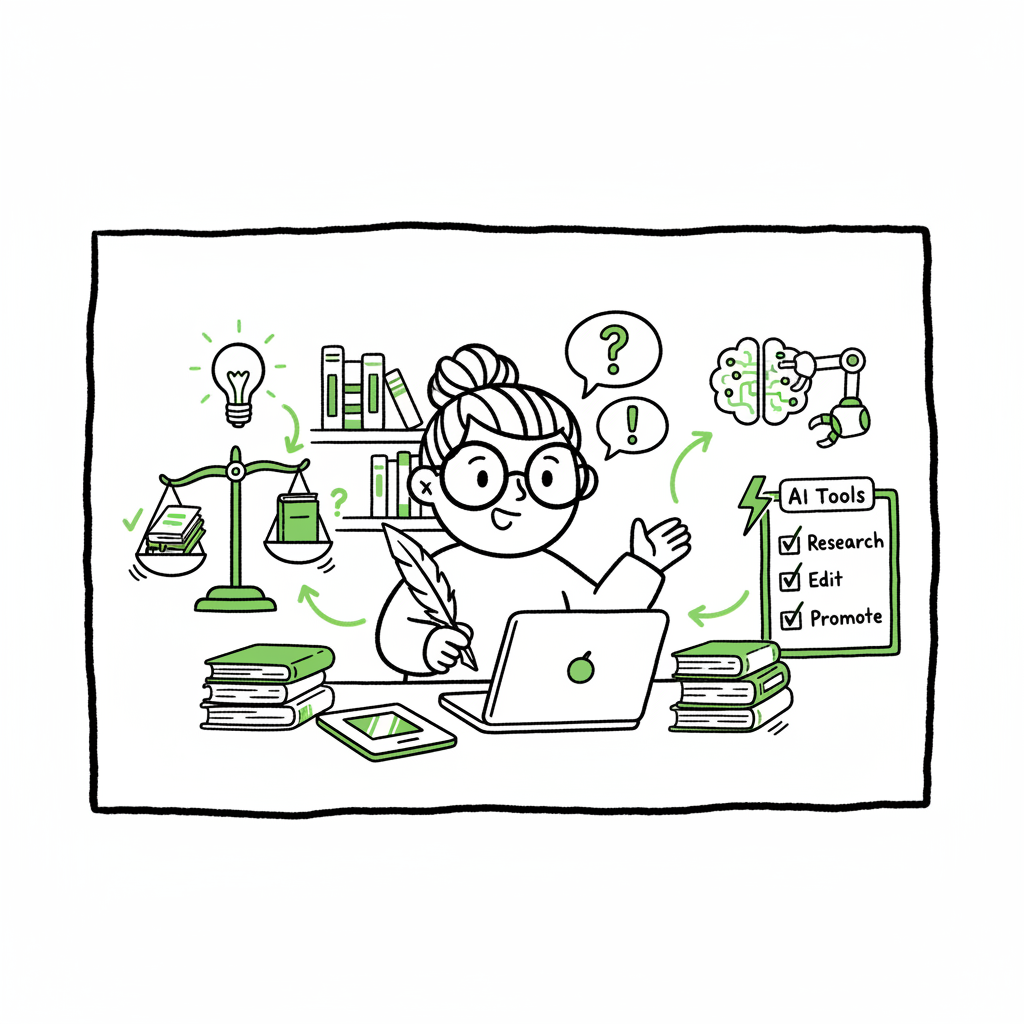
Ethics of AI in Publishing Practical Guide for Authors
Ethics of AI in Publishing: A Practical Guide for Self-Publishing Authors
Estimated reading time: 9 minutes
Key takeaways
- Transparency and human responsibility are non-negotiable: disclose AI use and verify everything.
- Treat AI as an assistant, not an author — maintain control of facts, citations, and creative choices.
- Use platform-aware processes and automation to scale responsibly; tools like BookUploadPro reduce repetitive risk.
- Practical checks (bias review, source audits, version records) protect reputation and reader trust.
- When producing ebook, paperback, covers, or conversions, pick reliable tools and document the process.
Table of Contents
- Why the ethics of AI in publishing matter
- Practical rules for responsible AI book publishing
- Platform guidance for self-publishers
- Automation, tools, and the role of BookUploadPro
- FAQ
- Sources
- Key takeaways
Why the ethics of AI in publishing matter
The ethics of AI in publishing are not an abstract debate for labs and journals. For self-publishing authors, these are everyday choices that affect credibility, discoverability, and legal risk. Authors are expected to know when they used AI, explain what it did, and ensure the final manuscript is accurate and original. Major publishers and professional bodies now require disclosure of AI assistance and emphasize human accountability. That shifts how independent authors should work: be transparent, keep records, and apply the same checks editors use in traditional publishing.
If you publish fast and worry about quality, reading resources like AI Self Publishing Speed Burnout shows how speed without guardrails creates repeated errors and reputational risk. The pressure to produce more titles can make shortcuts tempting, but consistent disclosure and verification prevent small errors from becoming large problems.
For context on speed without guardrails, see AI Self Publishing Speed Burnout.
Why this matters practically
- Trust: Readers expect honest representation. If a book claims original research or a true memoir, undisclosed AI fabrication undermines trust.
- Platform rules: Retailers and distributors are updating policies. Some require authors to vouch for originality and disclose AI use when asked.
- Legal exposure: Passing off AI-generated proprietary text, or relying on AI to invent facts about people, companies, or events can lead to takedowns or liability.
- Quality at scale: AI can speed drafting and formatting, but scaling without checks multiplies errors. Systems that automate uploads must include verification steps.
Practical rules for responsible AI book publishing
This section gives operating rules you can use in every project. The tone here is practical: do these steps and your risk goes down.
1) Always disclose AI assistance in a clear place
Put a short statement in the front matter or acknowledgments that describes how AI was used (drafting, editing, research checks, formatting). Keep it factual — one or two sentences is enough. Example: “Parts of the early drafts were generated with AI assistance and edited by the author. The author is responsible for all final content and sources.” This meets the expectations of many publishers and keeps readers informed.
2) Keep a simple provenance log
For every manuscript, maintain a small log: date, tool name and version, prompts or templates used, and the author’s verification note. This does not need to be public, but it helps if an editor or platform asks for details. A CSV or a short document works fine. This is how you prove you audited sources and corrected hallucinations.
3) Verify facts and citations manually
Never let AI handle citations without checks. If the text cites a study, book, person, or statistic, verify the source directly. AI can invent plausible-sounding citations. Treat every citation as a manual task: open the paper, confirm the authors, year, and findings. If you mention legal or medical advice, add a clear human-authored disclaimer and consult a qualified professional.
4) Maintain human authorship and creative control
AI is a writing companion, not a credited author. The author must retain full responsibility for shaping arguments, deciding structure, and confirming originality. If large sections are AI-generated, rework them so your voice and judgement are primary.
5) Run bias and sensitivity checks
AI reflects biases in its training data. For nonfiction especially, run a simple sensitivity review: look for stereotyped language, unbalanced perspectives, or cultural insensitivity. Fix those problems consciously. For fiction, examine portrayals of real groups to avoid harmful tropes.
6) Use detection and audit tools wisely
Detection tools can help spot clear-cut issues, but they are imperfect. Use them as one input among many, not as a final judgement. If a detection tool flags text, review the flagged passages and document what you changed.
7) Keep templates and reuse safe parts
When you scale, standardize trusted boilerplate: author bio formats, copyright statements, back matter. Use AI to fill templates but manually review every insertion. Standardized templates reduce errors and speed production.
8) Protect reader data and respect privacy
If you use AI to process reader feedback, interviews, or private messages, remove personal data or get consent. Do not feed proprietary or sensitive information into public AI tools without clearance.
9) License and rights checks
Ensure the tools you use do not claim ownership of your input. Read terms of service for AI platforms and avoid tools that demand exclusive rights over generated content.
10) Document the final editorial decision
Before uploading, add a final line in your provenance log: “Final edit and publication decision made by [Author Name] on [Date].” This simple sentence makes responsibility explicit.
Platform guidance for self-publishers
Different platforms and distributors have different expectations. The best approach is conservative: disclose, verify, and document. Below are platform-specific considerations that apply to most self-publishing workflows.
Amazon KDP and ebook stores
- Metadata honesty: If you use AI to generate descriptions, blurbs, or keywords, check them for factual accuracy and suitability. Misleading metadata can trigger removals.
- Reviews and endorsements: Do not use AI to generate fake reviews or endorsements. Platforms penalize manipulative behavior.
- Rights and content: If you include third-party material or images created by image-generation AI, confirm usage rights. Some image models may have restrictions.
Library and print distribution (Ingram, wholesale)
- Quality standards: Libraries and bookstores expect reliable metadata and ISBN management. Use consistent identifiers and avoid last-minute title changes that break distribution feeds.
- Physical formatting: For paperback interiors, check pagination, margins, and images carefully. If you’re converting files to print-ready PDFs or printing through a service, validate proofs.
Journal-like or academic content
Even in self-publishing contexts that are research-like, apply publisher standards: disclose AI use, verify citations, and avoid claiming AI as an author. Major publishers require detailed disclosure for manuscripts and professionally produced reports.
Formatting and production tools
When converting manuscripts to ebook or print, choose reliable converters. If you need to convert to EPUB, use a tested tool like an EPUB converter to avoid formatting errors and compatibility problems. For covers, a dedicated book cover generator reduces iteration time while producing print-ready files. If you produce paperback or ebook files, rely on a structured book creation process that exports clean files and validated metadata.
Automation, tools, and the role of BookUploadPro
Responsible use of automation is central to ethical scaling. BookUploadPro automates repetitive uploads across Amazon KDP, Kobo, Apple Books, Draft2Digital, and Ingram, cutting routine work while leaving critical verification in human hands. The goals are simple: speed without sacrificing checks, reduce manual errors, and make wide distribution practical.
How automation helps ethical publishing
- Avoids repetitive errors: Manual uploads lead to copy-paste mistakes. Automation uses the same validated source for each platform and preserves metadata consistency.
- Preserves audit trails: Batch uploads using CSVs and structured fields create a traceable record of what was uploaded and when. That supports provenance logs and disclosure.
- Platform-specific intelligence: Automation that knows platform rules can prevent disallowed inputs and flag risky metadata before upload.
- Time savings free up verification: With ~90% time savings on repetitive tasks, authors can spend that time on fact-checking and sensitivity reviews.
Where automation fits and where it must yield to human judgement
Automation should handle data transfer, file formatting, and predictable mappings. Humans must handle:
– Final editorial sign-off
– Fact and citation verification
– Bias and sensitivity reviews
– Creative decisions such as cover art direction and back-cover copy tone
A practical workflow
-
Draft and revise manuscript. Use AI tools for initial drafting if you wish, but keep the provenance log.
-
Manual verification pass: facts, sources, permissions, and bias checks.
-
Formatting and conversion: generate EPUB and print files. Use a reliable EPUB converter to ensure compatibility and validate with readers.
-
Cover production: produce a cover and confirm it meets platform requirements; if you used a cover generator, store the source files and license details.
-
Prepare batch metadata (CSV) with consistent fields for each retailer.
-
Upload via BookUploadPro to all platforms. The service pushes validated files and metadata, reducing manual input errors.
-
Final quality check: spot-check each platform listing and save the proof pages.
Specific automation benefits enforced ethically
- Error reduction: Automated mappings prevent title/ISBN mismatches and misrouted files.
- Unified distribution: One source of truth avoids competing versions across stores.
- Controlled scaling: It becomes practical to publish multiple titles without multiplying risky manual tasks.
BookUploadPro is an obvious upgrade once authors start publishing seriously: automate the upload. Own the distribution.
Practical examples of tool use and link to resources
- If you convert manuscripts to EPUB, use a reliable conversion tool to avoid malformed files and reading errors; a tested EPUB converter streamlines that step without surprises.
- When you need a cover, a well-structured book cover generator will produce print-ready files and store license metadata for future proof requests.
- For creating paperback or ebook formats as part of a repeatable process, rely on a consistent book creation process that exports validated files and keeps a version history.
Handling common ethical dilemmas
Below are real decisions authors face and practical ways to resolve them.
Dilemma: AI suggested a quotation that sounds plausible but has no source.
Response: Treat the suggestion as a lead. Either find a verified source or rewrite the passage in your own words. Never invent citations.
Dilemma: AI-generated character behavior in fiction feels stereotyped.
Response: Rework the character with specific human detail. Ask sensitivity readers where applicable. AI can suggest but not replace informed creative judgment.
Dilemma: You used AI heavily on early drafts and worry about whether to disclose.
Response: Disclose briefly in the front matter. Document what the tool did. Full transparency reduces risk and aligns with publisher guidance.
Dilemma: I need to publish many short how-to guides quickly—can I rely on AI for facts?
Response: You can use AI to draft outlines and first drafts, but perform a manual fact-check for each guide. Consider a checklist for verification before upload.
Dilemma: How do I check an image generated by an AI tool for rights?
Response: Check the image model’s license and terms. Store the prompt, model name, and license permissions. If unsure, use a stock image or a licensed designer.
Dilemma: Where do I store my provenance log?
Response: A private document folder, cloud storage, or part of your project management system works. The important part is that it’s timestamped, retrievable, and easy to share if requested.
Recordkeeping and audits
Keep:
- The provenance log described earlier.
- Copies of prompts or templates used for major sections.
- Versioned files with timestamps.
- Proofs or screenshots of final store pages after upload.
If a dispute arises, these artifacts show you followed a responsible process.
FAQ
Q: Do I have to tell readers I used AI?
A: It’s best practice to disclose AI assistance in the front matter or acknowledgments. The disclosure can be concise: state the tool’s role and confirm you verified the content.
Q: Can AI be credited as a co-author?
A: No. Current standards and publisher policies treat AI as a tool, not an author. The human author must retain responsibility and authorship.
Q: What if AI invents a citation I missed?
A: Correct it immediately. Replace the invented citation with a verified source or remove the claim. Update your provenance log with the correction.
Q: Will platforms ban AI-assisted books?
A: Most platforms focus on policy violations like fraud, abuse, or copyright infringement rather than on the mere use of AI. Still, undisclosed or misleading content can trigger enforcement, so disclosure and verification reduce risk.
Q: Which parts of publishing are safe to automate?
A: Repetitive, deterministic tasks: metadata mapping, batch uploads, formatting conversions, and distribution. Human review remains necessary for editorial judgment.
Q: How do I check an image generated by an AI tool for rights?
A: Check the image model’s license and terms. Store the prompt, model name, and license permissions. If unsure, use a stock image or a licensed designer.
Q: Where do I store my provenance log?
A: A private document folder, cloud storage, or part of your project management system works. The important part is that it’s timestamped, retrievable, and easy to share if requested.
Sources
- https://authorservices.wiley.com/ethics-guidelines/index.html
- https://acsm.org/ai-ethics/
- https://scholarlykitchen.sspnet.org/2025/08/25/from-detection-to-disclosure-key-takeaways-on-copes-forum/
- https://www.elsevier.com/about/policies-and-standards/generative-ai-policies-for-journals
- https://selfpublishingadvice.org/ai-for-authors-guidelines/
- https://www.sagepub.com/journals/publication-ethics-policies/artificial-intelligence-policy
Ethics of AI in Publishing: A Practical Guide for Self-Publishing Authors Estimated reading time: 9 minutes Key takeaways Transparency and human responsibility are non-negotiable: disclose AI use and verify everything. Treat AI as an assistant, not an author — maintain control of facts, citations, and creative choices. Use platform-aware processes and automation to scale responsibly;…