Apple Books Dashboard Workflow Assistant Explained
Apple Books Dashboard Workflow Assistant Explained
Estimated reading time: 14 minutes
Key takeaways
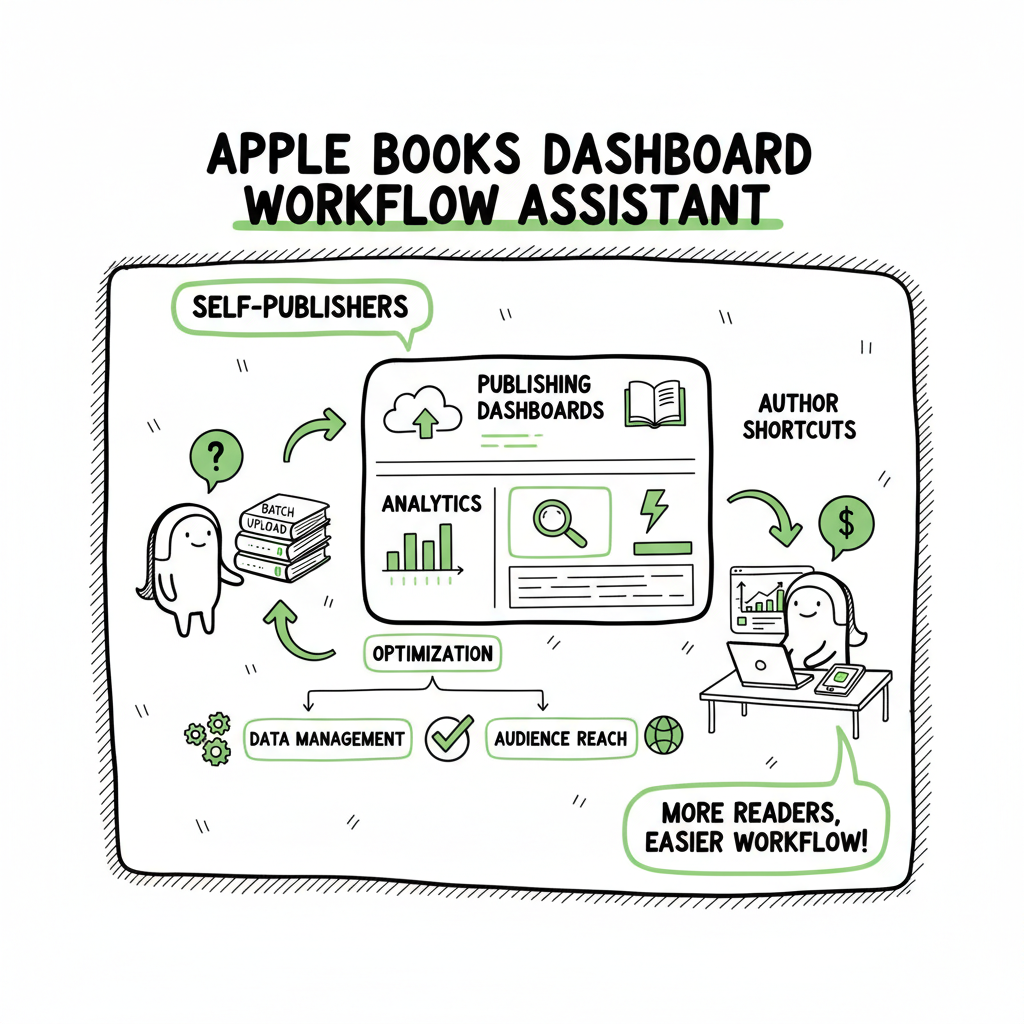
- “Apple Books Dashboard Workflow Assistant Explained” describes a practical way to use Apple’s publishing dashboards, Apple Books for Authors analytics, and author-side shortcuts together—rather than a single Apple‑branded product.
- For serious self‑publishers, layering a dedicated assistant that understands platform fields, batch uploads, and error patterns cuts repetitive work and reduces mistakes.
- BookUploadPro turns multi‑platform publishing into a repeatable process: CSV batch uploads, platform‑specific intelligence, and broad distribution that saves roughly 90% of time compared with manual uploads.
Table of Contents
- Overview — what people mean by “dashboard assistant”
- What Apple provides today — dashboards, reports, and account controls
- How BookUploadPro fits and why it matters
- Practical steps an author can take right now
- FAQ
- Sources
Overview — what people mean by “dashboard assistant”
When someone searches for Apple Books Dashboard Workflow Assistant Explained they’re usually trying to answer a simple question: does Apple sell a single helper that walks an author through every field and file step for Apple Books? The short, practical answer is no — Apple offers dashboards, reporting, and submission interfaces, plus system-level tools you can combine into an assistant. Many authors and small publishers build a predictable process around these pieces so the job becomes routine instead of a slog.
If you are managing multiple titles or start publishing at scale, you’ll quickly outgrow manual copy‑and‑paste. At that point Apple Books Publishing Automation becomes an operational need, not a feature request — you need repeatable inputs, consistent epub handling, and reliable metadata delivery across stores. A purpose-built assistant or service fills that gap by translating Apple’s fields into simple, actionable steps and by handling repetitive uploads and checks.
This article explains what Apple provides, where the “assistant” idea comes from, and how a multi‑platform upload service can be an obvious upgrade once you publish seriously. It focuses on practical actions you can take today, and on how to reduce errors and speed up distribution without adding complexity. For readers exploring a path like Apple Books Publishing Automation, consider how a layered approach can combine Apple’s dashboards with a third‑party service to speed launches.
A natural language summary for authors is that a layered approach helps when you reach catalog sizes that matter — it provides a single source of truth for metadata and files, reducing errors and speeding launches. BookUploadPro emphasizes unified multi‑platform publishing: Amazon KDP, Kobo, Apple Books, Draft2Digital, and Ingram are all supported under one process.
What Apple provides today — dashboards, reports, and account controls
Apple’s publishing tools are functional and focused. They break into a few clear areas that matter to authors:
- Account and title management: The Apple Books publisher interface (historically under iTunes Connect/App Store Connect) is where you create and edit metadata, set pricing and territories, upload assets, and manage availability. It’s the central control panel for each title.
- Analytics and reporting: Apple Books for Authors exposes sales and performance data, often with next‑day granularity. Authors can build simple dashboards that filter by title, country, format, and date range.
- File and format requirements: Apple expects well‑formed EPUBs, properly embedded fonts, cover images sized to spec, and validated metadata. If the EPUB or metadata is off, the platform returns errors that block publishing.
- Release controls: Scheduling, preorders, and regional availability are configured in the dashboard. These are straightforward but require careful attention to dates and pricing tiers.
- System‑level helpers: Apple’s Shortcuts on iOS/iPadOS and Automator actions on macOS can automate some local tasks such as renaming files, zipping assets, or moving files to a folder. These are not book‑publishing products, but they let authors automate predictable desktop steps.
What Apple does not offer is a single “wizard” that reads your manuscript, fills every field for you, ensures all formats meet each store’s subtle rules, and uploads across multiple stores automatically. Apple focuses on a stable set of controls and expects publishers to do the required preparation. That leaves space for services that bridge the gap between Apple’s screens and an author’s work patterns.
Common pain points in Apple’s dashboards include repeating the same metadata across multiple titles, exporting and interpreting reports for tax or ads, fixing EPUB validation errors that are obscure, managing cover versions or sample generation, and keeping launches synchronized across stores.
How BookUploadPro fits and why it matters
BookUploadPro is designed to sit on top of those Apple tools and make the routine parts of publishing reliable and repeatable. It’s not a replacement for Apple’s publisher interface. Instead, it’s a focused layer that understands each platform’s fields, batches updates, and prevents the common mistakes that slow down releases.
Why authors choose a layered assistant
– Scale: One or two books a year is manageable by hand. Once you publish multiple titles or formats, manual work multiplies. At scale, consistent processes win.
– Error reduction: The checksum on an EPUB, a missing cover variant, or a wrong territory can send uploads back. A system that validates inputs against platform rules prevents avoidable rejections.
– Time savings: For publishers who publish seriously, Apple Books Publishing Automation reduces repetitive tasks by roughly 90% through CSV batch uploads, standardized metadata templates, and upload protocols that map to each store. BookUploadPro emphasizes unified multi‑platform publishing: Amazon KDP, Kobo, Apple Books, Draft2Digital, and Ingram are all supported under one process.
A natural sentence for authors: when you reach a catalog size that matters, Apple Books Publishing Automation becomes the obvious upgrade. That’s because a single source of truth for metadata and files pays dividends in fewer errors and faster launches. BookUploadPro emphasizes unified multi‑platform publishing: Amazon KDP, Kobo, Apple Books, Draft2Digital, and Ingram are all supported under one process.
What BookUploadPro actually does
- CSV batch uploads: Prepare one spreadsheet with title‑level and edition‑level fields; the system iterates through each row and submits or updates titles across stores.
- Platform‑specific intelligence: The service converts CSV columns into the exact form fields each platform expects, including title variants, BISAC/CIP codes, and price mapping.
- File handling: The tool validates EPUBs and flags common errors. It also handles cover and interior file associations for paperback and ebook releases.
- Error reporting and recovery: When a store returns a rejection, BookUploadPro surfaces the specific reason and suggests fixes, cutting the back‑and‑forth time.
- Affordable pricing and free trial: Designed so that authors can test the time savings before committing.
A practical benefit: you maintain control over distribution but stop doing low‑value, repetitive work. That’s why BookUploadPro is framed as a companion—one that humanizes Apple’s dashboards and makes multi‑platform publishing practical.
How BookUploadPro reduces risk
- Standard templates reduce typos and inconsistent metadata
- Preflight checks reduce rejections and delayed launches
- Batch updates make global changes fast and auditable
If you manage multiple formats—ebook, paperback, and audiobook—the combination of file checks, standardized metadata, and batch uploads makes coordination realistic. BookUploadPro isn’t trying to replace your publisher account access; it’s making the inputs predictable and manageable.
Practical note on assets and conversions
Most rejections come from format issues. If you need a reliable tool to convert manuscripts to EPUB, use a tested EPUB converter rather than hand-editing package files; a good converter enforces required structure and reduces validation errors. For cover processing and resizing, a dedicated book cover generator reduces repeated image edits. These specialized utilities slot neatly into a batch publishing process and keep asset bumps from breaking a launch.
Links to helpful tools
- If you need a reliable EPUB converter, try a tested EPUB converter that automates conversion and validation. EPUB Converter
- For cover creation and processing, a cover generator can normalize images and generate the variants stores expect.
- When you create paperback and ebook files, a solid book creation workflow helps you manage interior and exterior exports.
Note: each of those links points to tools that handle specific technical tasks so you don’t have to rebuild them by hand.
Practical steps an author can take right now
The goal here is to move from uncertainty to a predictable, repeatable routine. Below are steps that scale whether you’re self‑publishing one title or managing a growing catalog.
- Start with a single source of truth
Create one spreadsheet that contains fields for every target store: ISBN, title, subtitle, author name, contributors, language, BISAC codes, description, keywords, price per territory, release date, and format flags. Establish a naming convention for files: title‑edition‑format.epub, title‑cover‑v1.jpg, etc. This keeps file associations clear when you run batch updates. - Validate files before they’re uploaded
An invalid EPUB or incorrect cover dimensions are the most common causes of rejected submissions. Run your EPUBs through a reliable EPUB converter that also validates the output. That removes small structural mistakes and creates clean files for upload. Use a cover generator to produce the correct image sizes and bleed for print editions. - Use templates and default mappings
Map CSV columns to platform fields once, and keep that mapping consistent. For example, map your “Primary Category” column to the BISAC code each store requires, and map “Price USD” to a price‑tiering function for other territories. When you change a global field—like a publisher name—update the source CSV and reapply instead of opening each dashboard. - Batch uploads and monitored runs
Run a dry‑run first. Upload metadata and files in a test mode (many services provide a review or staging step) so you can capture errors and warnings without publishing. When running at scale, stagger your uploads to avoid surprises: start with the largest markets, verify the live pages, then propagate changes to smaller territories. - Check analytics with a plan
Apple Books for Authors lets you build dashboards. Choose a small set of KPIs to monitor: daily sales, returns, price changes, and territorial performance. Export a weekly snapshot so you can watch trends and catch anomalies early. If a daily report shows unexpected returns, compare it to recent metadata changes; often a bad cover or wrong ISBN mapping causes dips. - Maintain an error log
When a store returns an error, copy the exact message into a log along with the file hash and the change that triggered it. That historical record reduces troubleshooting time for similar issues. - Coordinate launch windows
If you publish broadly, use one release date as the canonical launch and adjust other stores to match. That makes marketing analytics cleaner and reduces confusion with customers. - Keep a clean backup of every asset
For each edition keep: final manuscript source, final EPUB, final cover files (source PSD or layered file), and a metadata CSV snapshot. If you ever need to reupload years later, you are ready. - Use a trusted service to remove repetitive tasks
Services that support CSV batch uploads and platform‑specific intelligence free you from routine clicks. That’s where BookUploadPro is useful: it standardizes inputs, runs preflight checks, and relays store errors clearly so you can fix root causes instead of chasing symptoms. - Audit periodically
Every quarter, run a quick audit: pick 5 published titles and verify metadata accuracy, price maps, and availability settings. That prevents drift—small inconsistencies that add up across a catalog.
FAQ
Q: Is there an official Apple product called “Apple Books Dashboard Workflow Assistant”?
A: No. Apple provides a publisher dashboard and reporting tools, but it does not offer a single branded assistant with that exact name. The phrase usually describes a combination of Apple’s dashboards, analytics, and user-created shortcuts or third‑party services that streamline repeated tasks.
Q: Can I automate uploads to Apple Books?
A: You can automate parts of the process—file prep, validation, and staged uploads—by using a tool that understands Apple’s requirements and supports batch uploads. Full automation that bypasses review or policy checks is neither supported nor recommended; a service that prepares validated inputs and submits them consistently is the right balance.
Q: How does BookUploadPro reduce errors when uploading to Apple?
A: BookUploadPro uses platform‑specific rules to validate metadata and files before submission. It maps CSV fields to Apple’s expected inputs, runs preflight checks on EPUBs and covers, and surfaces errors with actionable descriptions so you fix problems quickly.
Q: Do I still need to use Apple’s dashboard?
A: Yes. BookUploadPro complements Apple’s dashboard rather than replacing it. You still maintain your Apple Books publisher account, use Apple’s analytics as the definitive sales source, and control rights and contractual details inside Apple’s system.
Q: What about EPUB conversion and cover creation?
A: Use purpose‑built tools for these tasks. A tested EPUB converter ensures structural validity, and a cover generator produces the exact sizes and bleed for each format. These tools slot into a batch publishing workflow and eliminate many common rejections.
Q: Is multi‑platform publishing worth the effort?
A: If you publish more than a few books, yes. Wider distribution increases discoverability and revenue sources. It becomes practical when you remove repetitive work and errors through batch processes and platform‑aware tooling.
Q: How does pricing typically work for services like BookUploadPro?
A: Pricing models vary. Good services offer an affordable entry point and a free trial so you can measure actual time savings before committing. The right service becomes cost‑effective as you publish more titles.
Q: What should I focus on first when starting out?
A: Start with a single source of truth, validate files before uploading, and use templates to map fields consistently. Then batch uploads with staged testing and monitor analytics to catch issues early.
Sources
- Apple Books Publisher User Guide
- Measure book sales – Apple Books for Authors
- Use Quick Action workflows on Mac – Automator
- Shortcuts User Guide
Apple Books Dashboard Workflow Assistant Explained Estimated reading time: 14 minutes Key takeaways “Apple Books Dashboard Workflow Assistant Explained” describes a practical way to use Apple’s publishing dashboards, Apple Books for Authors analytics, and author-side shortcuts together—rather than a single Apple‑branded product. For serious self‑publishers, layering a dedicated assistant that understands platform fields, batch uploads,…