
In this guide
- The print cost gap, worked out
- The royalty maths
- What the hardcover gives you, and what it does not
- When the hardcover is worth setting up
- When to skip it
- FAQ
- KDP hardcover vs paperback: when is the hardcover edition worth setting up?
- How much more does a KDP hardcover cost to print?
- What royalty does a KDP hardcover earn?
- Is a KDP hardcover worth it for a first book?
A KDP hardcover costs $4.65 more to print than the same book as a paperback, at every page count, so it needs a list price about $7.75 higher just to earn you the same royalty per copy. That single fact decides most hardcover questions. If your readers will pay the premium, a hardcover is a genuine second edition with its own buyers. If they will not, it is the same book earning you less per sale at a price fewer people pay. Most authors should launch in paperback and add the hardcover later, once the paperback proves the book has buyers.
Key takeaways:
- The royalty formula is the same for both formats: 60% of list price minus printing cost at $9.99 and up, 50% below that.
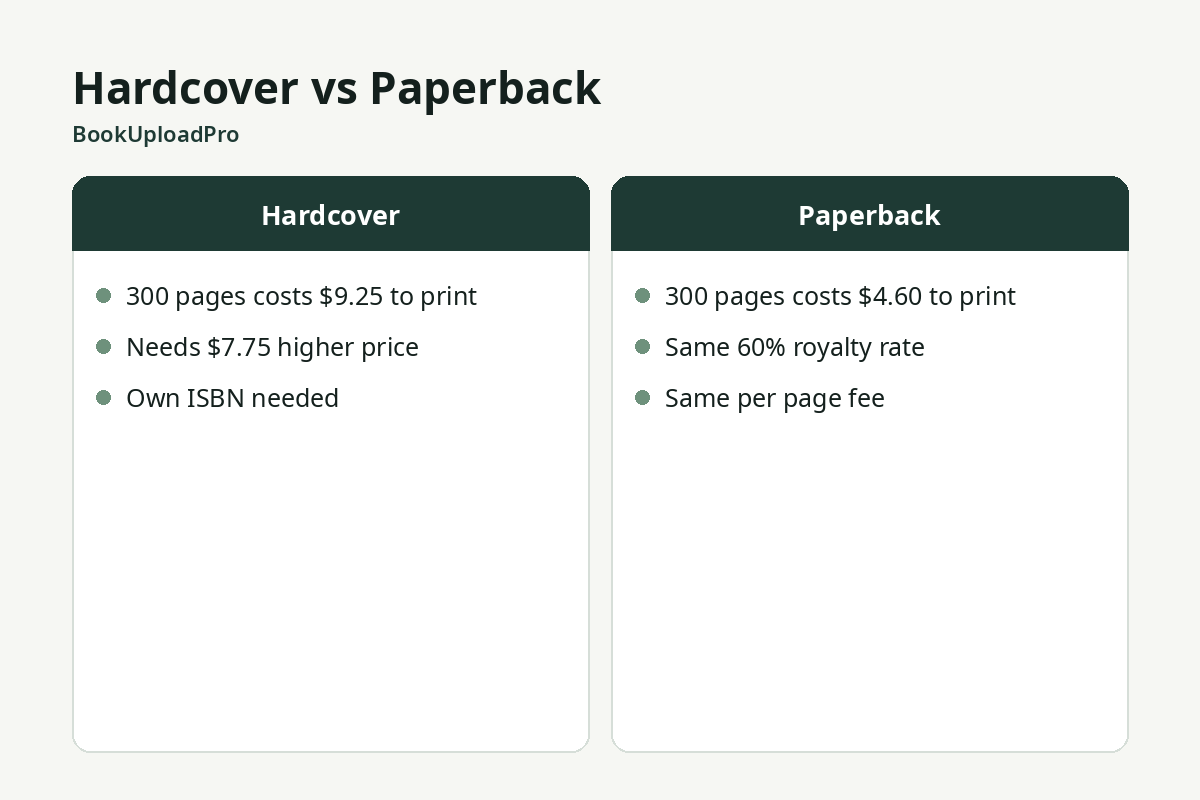
- A 300 page black ink hardcover costs $9.25 to print, against $4.60 for the paperback. The per page fee is identical, the fixed fee is $4.65 higher.
- A hardcover priced $7.75 above the paperback earns the same royalty per copy. Anything less and the paperback earns more.
- Hardcovers run 75 to 550 pages, are case laminate with no dust jacket option, and need their own ISBN.
- A hardcover pays for gift books, premium and reference editions, libraries, and collectors. It rarely pays for a first book in a price sensitive genre.
The print cost gap, worked out
KDP prices every print book with one formula: a fixed cost plus page count times a per page cost. For a black ink book in a regular trim size on Amazon.com, checked November 2026, a paperback of 110 to 828 pages costs $1.00 plus $0.012 per page, and a hardcover of 110 to 550 pages costs $5.65 plus $0.012 per page. The per page fee is identical, so the whole gap is the fixed fee: $4.65 more per copy, at every page count. KDP’s own example is a 300 page hardcover: $5.65 plus 300 times $0.012, which is $9.25. The same book as a paperback costs $1.00 plus 300 times $0.012, which is $4.60. Short books differ slightly: a hardcover of 75 to 108 pages costs a flat $6.80, against a flat $2.30 for a paperback of 24 to 110 pages. Color multiplies everything, with premium color at $0.065 per page for a hardcover, so a color hardcover needs a much higher price to work at all. Confirm the current rates in KDP’s printing cost calculator before you set a price, because Amazon changes these rates without much notice.
The royalty maths
The royalty rate is the same for both formats: 60% of list price when the US list price is $9.99 or higher, and 50% at $9.98 or below. Because each extra dollar of list price returns 60 cents, the hardcover’s extra $4.65 of print cost needs $4.65 divided by 0.60, or $7.75, of extra price just to earn what the paperback earns. A worked example makes it concrete. A 300 page hardcover priced at $24.99 earns 60% of $24.99 minus $9.25, which is about $5.74 per copy. The same book as a paperback priced at $17.99 earns 60% of $17.99 minus $4.60, which is about $6.19. The paperback at the lower price earns more per copy. A paperback $7.75 cheaper than the hardcover always pays you the same, so price the hardcover at least that far above the paperback or accept earning less per sale. Our guide to setting up a hardcover covers the files and the KDP screens: https://blog.bookuploadpro.com/kdp-hardcover-publishing-guide/
What the hardcover gives you, and what it does not
A hardcover is a case laminate book, the art printed on the board, with no dust jacket option on KDP, and it needs its own ISBN, separate from the paperback. It runs 75 to 550 pages, so very short books and very long books cannot be hardcovers on KDP. What it gives you is presence: a hardcover looks like a gift, sits better on a shelf, and suits readers who buy books as objects. What it does not give you is reach: KDP hardcovers are sold on Amazon, and they do not come with the Expanded Distribution that an IngramSpark hardcover can offer to bookshops. If bookshop stocking matters, the hardcover belongs on IngramSpark as well, which is a separate setup with its own costs. Our paperback size guide covers the trim choices the hardcover shares: https://blog.bookuploadpro.com/kdp-paperback-trim-size-rules/
When the hardcover is worth setting up
Set up the hardcover when the book’s buyers will pay for permanence. Gift books, cookbooks, illustrated guides, reference books, and premium editions of a proven title all fit. A series with committed readers fits too, because collectors buy the matching hardcover set. A hardcover also makes sense as a second edition after the paperback has proven the book: the files are mostly ready, the cover needs a new spine width and a case laminate layout, and the launch risk is gone because the book already sells. Our single budget guide includes the ISBN cost a second edition adds: https://blog.bookuploadpro.com/how-much-does-it-cost-to-self-publish-a-book/
When to skip it
Skip the hardcover for a first book in a price sensitive genre, where readers compare your $24.99 hardcover against a $16.99 paperback from the next author and buy the cheaper book. Skip it for a short book, where the flat $6.80 print cost leaves almost no royalty at any price a reader will pay. Skip it for color interiors unless the price maths works on paper first, because premium color at $0.065 per page turns a 300 page hardcover into a $25 print cost before any royalty. And skip it when the book’s sales are still unproven: a hardcover edition of a book nobody buys is the same book nobody buys, at a higher price.
FAQ
KDP hardcover vs paperback: when is the hardcover edition worth setting up?
When your readers will pay at least $7.75 more than the paperback price for permanence: gift books, premium and reference editions, libraries, and collectors. Launch in paperback first and add the hardcover once the book proves it has buyers.
How much more does a KDP hardcover cost to print?
$4.65 more per copy than the same paperback, at every page count from 110 to 550 pages, for black ink in a regular trim size. A 300 page hardcover costs $9.25 to print, against $4.60 for the paperback, because the fixed fee is $5.65 against $1.00 while the per page fee is the same $0.012.
What royalty does a KDP hardcover earn?
The same formula as a paperback: 60% of the list price minus printing cost at $9.99 and up, 50% below that. A 300 page hardcover at $24.99 earns about $5.74 per copy, while the same book as a paperback at $17.99 earns about $6.19.
Is a KDP hardcover worth it for a first book?
Usually not. A first book in a price sensitive genre sells on its paperback price, and a hardcover at $7.75 or more above it earns less per sale at a price fewer readers pay. Publish the paperback, prove the book has buyers, then add the hardcover as a second edition.