
In this guide
- The two cost structures, side by side
- The break even calculation, worked out
- The hidden costs that move the answer
- Which one should you choose
- FAQ
- Print on demand vs offset printing: the break even maths for self published authors.
- When is offset printing cheaper than print on demand?
- How many copies do I need to sell for offset to pay off?
- What does offset printing cost per book?
Print on demand wins when you sell a few hundred copies. Offset printing wins when you sell a thousand or more. The break even point sits near 300 to 500 copies for a standard black and white paperback, and the reason is simple: print on demand charges about $4.60 a copy forever with nothing upfront, while offset printing charges about $2.50 to $4.00 a copy at 1,000 units but asks for roughly $2,500 to $4,000 before the first book ships. Below the break even point, the upfront bill swallows the per copy saving. Above it, the saving compounds with every copy sold: https://blog.bookuploadpro.com/how-much-does-it-cost-to-self-publish-a-book/
Key takeaways:
- Print on demand costs about $4.60 a copy on KDP for a 300 page 6 by 9 black and white paperback, with zero upfront and zero stock.
- Offset printing at 1,000 copies costs about $2.50 to $4.00 a copy, plus $300 to $800 shipping, and you own every unsold copy.
- The break even point sits near 300 to 500 copies for a standard paperback, and higher once storage, fulfilment, and returns are counted.
- If you cannot name the buyers for the whole run, print on demand is the safer choice.
The two cost structures, side by side
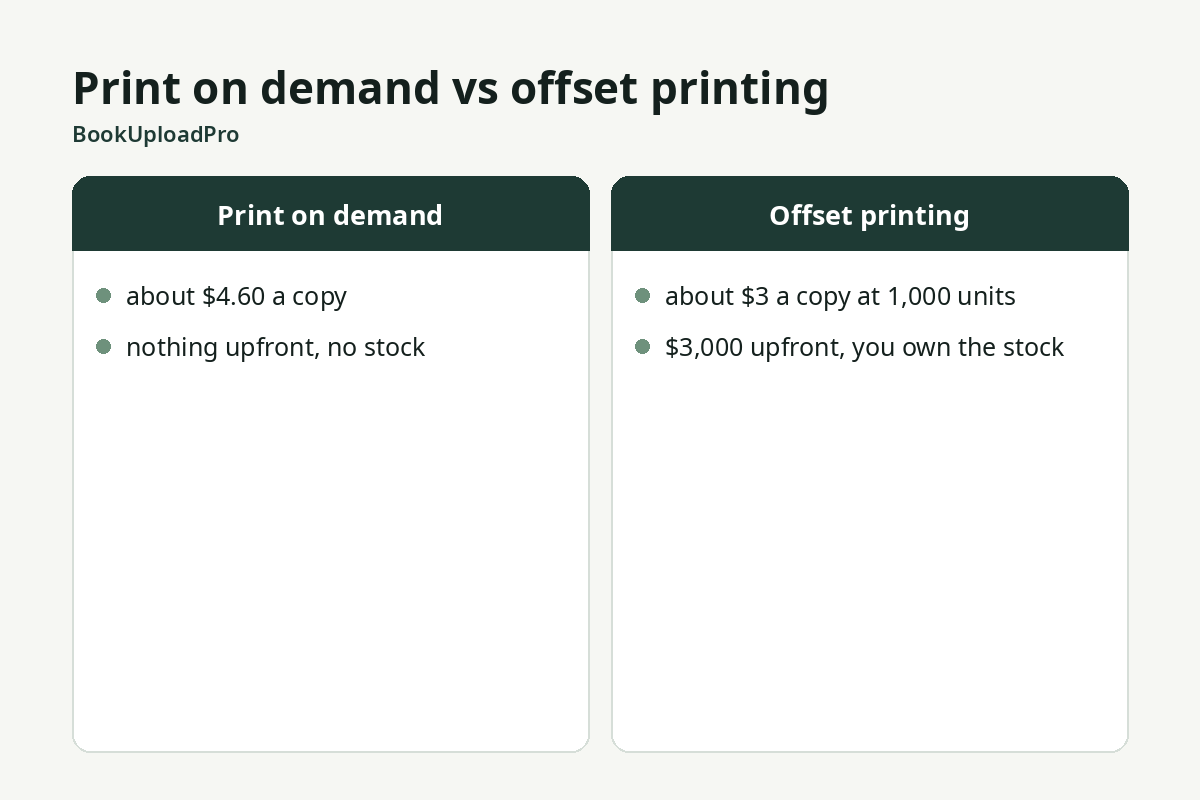
Print on demand has no fixed cost and a flat per copy cost. On KDP, a 300 page 6 by 9 black and white paperback costs $1.00 plus $0.012 a page, or about $4.60, deducted from each sale, and the same book costs about $5.71 through IngramSpark. Offset printing has a high fixed cost and a falling per copy cost: plates and setup run about $100 to $300 per title, and a 300 page paperback at 500 copies costs about $3.00 to $5.00 a unit, at 1,000 copies about $2.50 to $4.00, and at 2,000 copies about $2.00 to $3.50, all before shipping. Those offset figures are typical 2026 US printer ranges, so get a written quote before committing, because paper, binding, and colour change the answer fast: https://blog.bookuploadpro.com/pricing-and-getting-paid/
The break even calculation, worked out
Take one book: a 300 page 6 by 9 paperback listed at $14.99. Through KDP print on demand, your royalty is 60 percent of $14.99, about $8.99, minus about $4.60 in print cost, or about $4.39 a copy. Through offset, suppose you print 1,000 copies at $3.00 a unit, or $3,000 upfront, and sell them yourself at $14.99: each copy keeps about $11.99 before shipping and fulfilment, which is about $7.60 more per copy than print on demand. Divide the $3,000 upfront by that $7.60 and you need to sell about 395 copies just to recover the print bill, before shipping, storage, and the copies you give away or never sell. Add $300 to $800 in shipping and a few months of storage, and the honest break even lands near 500 copies. Sell 200 copies and print on demand leaves you about $878 ahead with nothing in the garage. Sell 2,000 and offset wins by thousands: https://blog.bookuploadpro.com/royalty-mechanics-explained/
The hidden costs that move the answer
The per copy maths flatters offset, because it leaves out everything after the press. Shipping a thousand books to your home costs about $300 to $800. Storing them costs space, and in a storage unit, rent. Fulfilling orders costs your time or a fulfilment fee per order, plus packaging and postage. Returns from bookstores come back to you, not to a printer, and unsold copies are money sitting on a shelf. Print on demand carries none of that. Offset also takes 3 to 6 weeks from file approval to delivery, while print on demand ships in days. If your launch plan cannot name the buyers, the risk in offset is not the price per book, it is the 600 books left over: https://blog.bookuploadpro.com/print-specs-answered/
Which one should you choose
Choose print on demand if you are publishing a first book, selling mostly online, or unsure of demand, which describes most self published authors. Choose offset if you have a proven audience and a concrete plan to move the run: a launch event, a school or bulk buyer, a speaking tour, or a series with steady sales you can measure. A common middle path is print on demand for the listing, plus a short offset run for events, where the buyers are in the room. Run the numbers on your own book first: your page count, your list price, and your realistic sales: https://blog.bookuploadpro.com/aggregator-vs-uploading-yourself/
FAQ
Print on demand vs offset printing: the break even maths for self published authors.
Print on demand costs about $4.60 a copy with nothing upfront, while offset costs about $2.50 to $4.00 a copy at 1,000 units but needs roughly $2,500 to $4,000 upfront. The break even point sits near 300 to 500 copies.
When is offset printing cheaper than print on demand?
Above roughly 500 copies sold, once the upfront print bill is recovered. Below that, print on demand is cheaper in total, because there is no setup cost and no unsold stock to absorb.
How many copies do I need to sell for offset to pay off?
For a 300 page paperback at $14.99, about 400 copies to recover a $3,000 print bill, and nearer 500 once shipping and storage are counted. The exact number depends on your page count, unit cost, and list price.
What does offset printing cost per book?
About $3.00 to $5.00 a copy at 500 units, $2.50 to $4.00 at 1,000 units, and $2.00 to $3.50 at 2,000 units for a standard 300 page black and white paperback, before shipping. These are typical 2026 US ranges, so get a quote for your book.