
In this guide
- Judging a writing tool for nonfiction, honestly
- Selling beyond the bookstores, without tripping rules
- FAQ
- What skills do I still need if AI does the drafting for me?
- Which AI writing tool produces the most natural sounding nonfiction?
- Can I sell AI generated books on Etsy or Gumroad without disclosure rules?
- What does Draft2Digital say about AI generated books?
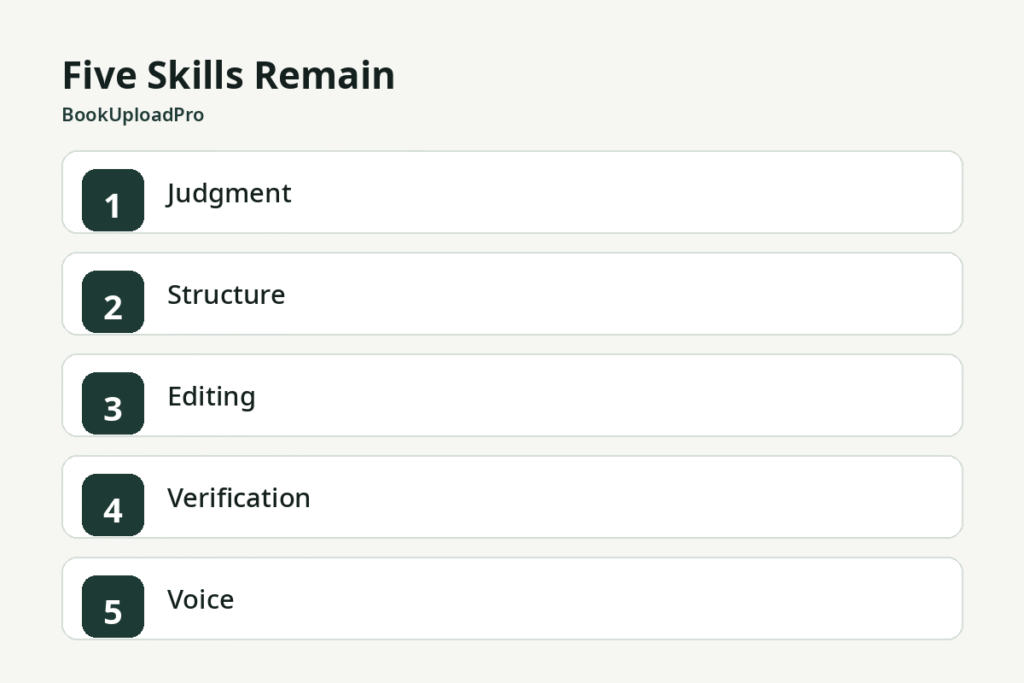
AI drafting changes which of your skills matter, not whether they matter. Typing speed and blank page stamina retire; five skills take their place at the center. Subject judgment: knowing what is true, what is trite, and what your reader actually needs, because the model will happily produce fluent wrongness. Structure: the outline and chapter map that keep a generated book coherent. Editing: the diagnosis and repair passes that turn drafts into books. Verification: the source and fact checking discipline that stands between AI confidence and your name on the cover. And voice: the stories, opinions, and phrasing that make the book yours. An author strong in those five produces excellent books with AI drafting; an author missing them produces fluent filler at unprecedented speed.
Key takeaways:
- Natural sounding is a workflow outcome more than a tool feature: the same model sounds generic from a cold prompt and personal from a brief with your stories, your anchor chapter, and a ban list. Judge tools on control (outlines, chapter memory, your material in, editing in place), not on demo paragraphs.
- Disclosure rules follow you off Amazon: Etsy’s policies require sellers to disclose AI involvement in listings, Gumroad leaves content responsibility with the seller under its general terms, and KDP requires declaring AI generated content at upload. Assume disclosure everywhere; it costs nothing and protects the account.
- Draft2Digital addresses AI content in its own terms and upload flow: it asks publishers to be transparent about AI generated content and distributes under each retailer’s rules, so a book D2D accepts still has to satisfy the stores it feeds. Check the current D2D FAQ on the day you publish, because platform AI policies are moving targets in 2026.
Judging a writing tool for nonfiction, honestly
Ask four questions of any tool. Does it hold a whole book project (outline, chapters, my material) or only chat sized pieces? Can I import my own manuscript and work on it, which the documented BookAutoAI workflow supports alongside generation? Does it produce the editions I need (EPUB, print PDF, cover) or leave me assembling files elsewhere? And what does a finished book cost in its credit or subscription math, computed on your word count, not its homepage example? The tool that wins those four for your project will sound natural, because you will be feeding it the material naturalness comes from.
Selling beyond the bookstores, without tripping rules
Etsy and Gumroad tempt authors because there is no KDP style gate, but the obligations travel with the work: copyright and trademark law applies everywhere, Etsy’s own policies expect honesty about how items were made, and buyers on both platforms can and do report undisclosed AI content, which platforms treat as a trust problem, not a technicality. The durable strategy is boring: disclose plainly, sell work you verified and edited to a standard you would defend, and keep your best catalog on the stores where books are searched for.
FAQ
What skills do I still need if AI does the drafting for me?
Subject judgment, structure, editing, verification, and voice. AI removes the typing; those five decide whether the result is a book or fluent filler, and they are exactly the skills that make AI output good when you have them.
Which AI writing tool produces the most natural sounding nonfiction?
The one that gives you control: whole book structure, your own material and stories in the brief, a reference voice to match, and editing in place. Naturalness comes from inputs and editing far more than from the model badge; judge tools on workflow and total cost per finished book, not demo text.
Can I sell AI generated books on Etsy or Gumroad without disclosure rules?
No, not safely. Etsy policy expects disclosure of AI involvement in listings, Gumroad holds sellers responsible under its general terms, and copyright law applies on both. Disclose plainly and sell verified, edited work.
What does Draft2Digital say about AI generated books?
D2D addresses AI content in its terms and upload flow, expects transparency about AI generated content, and distributes under each retailer’s own AI rules, so acceptance by D2D does not override a store’s policy. Platform AI rules change often; read the current D2D FAQ on publishing day.