
In this guide
- PublishDrive vs Draft2Digital for a small catalog
- Using more than one, without double listing
- FAQ
- Draft2Digital vs IngramSpark fees and royalties, which leaves me with more per sale?
- PublishDrive vs Draft2Digital, which aggregator is better for a small catalog?
- Smashwords vs Draft2Digital, which aggregator is better now that they have merged operations?
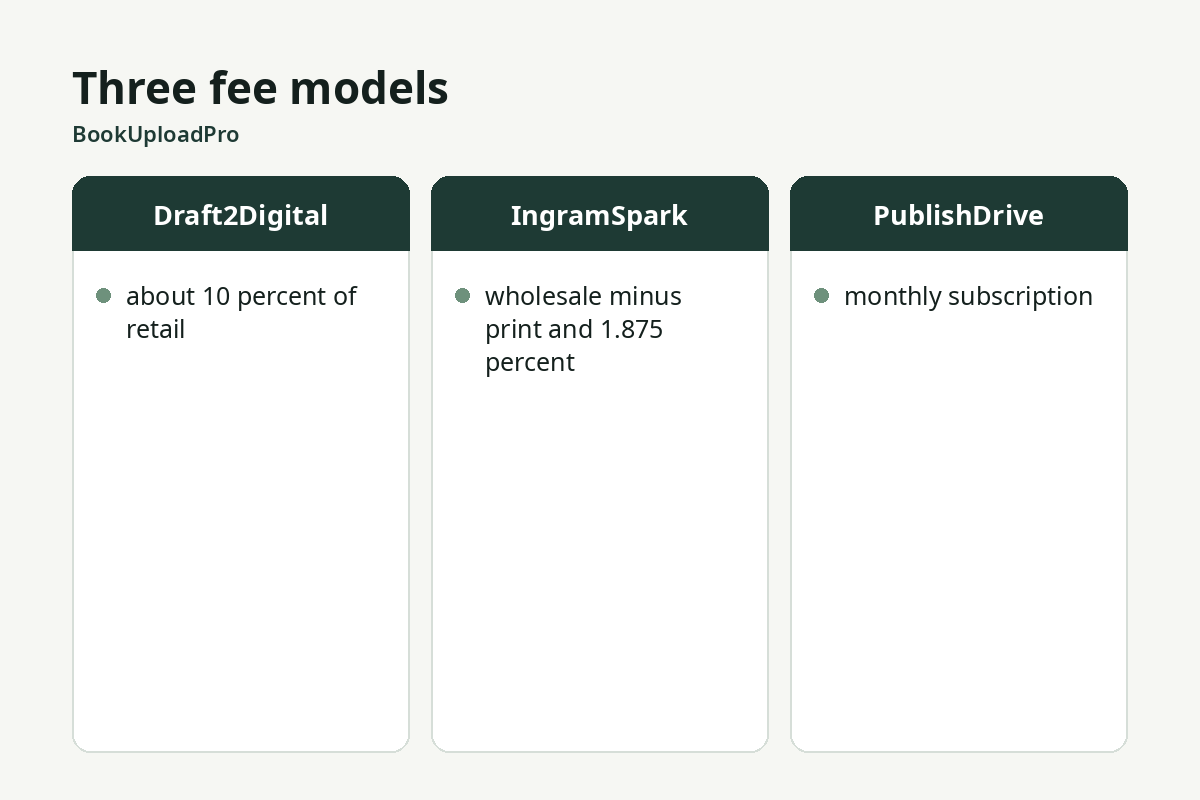
Compare aggregators on the only number that matters, what a sale leaves in your hand, and the answer splits by format. For ebooks, Draft2Digital takes approximately 10 percent of the retail price on each sale, so on a $9.99 ebook where the store pays out 70 percent, about $6.99 reaches the royalty calculation and D2D’s cut comes to roughly a dollar of the list price, leaving you near $5.99 (figures are approximate and follow D2D’s own FAQ). IngramSpark does not work that way for print, where the economics run on wholesale discount: you set a discount, commonly 55 percent, IngramSpark charges a market access fee of 1.875 percent of list price on each sale, and your publisher compensation is what remains of the wholesale price after printing costs. They are different machines for different shelves, which is why so many authors use both.
Key takeaways:
- Per ebook sale, D2D’s model is simple and cheap: about 10 percent of retail, no setup or subscription fees (a one time activation fee for new accounts and a small annual maintenance fee for low earning accounts now apply per its FAQ; check current terms).
- Per print sale through IngramSpark, your margin depends on your chosen wholesale discount and print cost, not on a percentage of retail, so a higher list price or a shorter discount changes the answer more than the platform fee does.
- Smashwords vs Draft2Digital is no longer a real contest: the companies merged, with Draft2Digital acquiring Smashwords, and distribution runs through the combined operation, so the practical choice is the D2D platform with the Smashwords Store kept as one of its channels.
PublishDrive vs Draft2Digital for a small catalog
PublishDrive’s structural difference is its business model: a subscription, where you pay monthly for distribution capacity rather than surrendering a percentage of each sale, and it reaches some channels and print options of its own. Subscription math favors volume: at high monthly sales, keeping the full royalty beats paying 10 percent forever; at small catalog sales, the subscription is a fixed cost eating thin royalties while D2D’s percentage costs you nothing in a month you sell nothing. For a small catalog, Draft2Digital is therefore the usual answer, with PublishDrive becoming interesting when your monthly royalties are large enough that 10 percent of them clearly exceeds the subscription. Recheck both pricing pages when you decide, since both adjust terms over time. The broader routing logic, aggregator versus going direct by store, is covered here.
Using more than one, without double listing
Because the machines differ, the common professional setup is direct where it pays (KDP and Kobo for most authors), Draft2Digital for the long tail of ebook channels and libraries, and IngramSpark for print reach into bookstores and libraries, with strict discipline about which channel supplies which store to avoid duplicate listings. And remember what the fees buy in each case: D2D’s percentage buys simplicity and reach per title, IngramSpark’s economics buy physical shelf access, and neither fee is wasted if the channel it opens actually fits your book. The IngramSpark cost picture in full is here.
FAQ
Draft2Digital vs IngramSpark fees and royalties, which leaves me with more per sale?
They price different formats. For ebooks, D2D takes about 10 percent of retail, leaving you the store royalty minus that cut, which is hard to beat for digital reach. For print, IngramSpark pays the wholesale price minus printing and its 1.875 percent fee, which can leave more or less per copy depending on your list price and discount. Most authors use D2D for ebook reach and IngramSpark for print, rather than choosing one.
PublishDrive vs Draft2Digital, which aggregator is better for a small catalog?
Draft2Digital, in most small catalog cases, because its percentage model costs nothing in months you sell little. PublishDrive’s subscription wins when monthly sales are consistently high enough that 10 percent of royalties exceeds the subscription. Do the arithmetic on your last three months of sales before switching.
Smashwords vs Draft2Digital, which aggregator is better now that they have merged operations?
The merger ended the comparison: Draft2Digital acquired Smashwords and runs the combined distribution, with the Smashwords Store continuing as a retail channel inside it. Authors choose the D2D platform and gain the store as one more outlet, rather than picking between the two.