KDP Select vs Wide Publishing Practical Guide for Authors
Kdp Select Vs Wide Publishing: A Practical Guide For Self-Publishing Authors
Estimated reading time: 9 minutes
Key takeaways
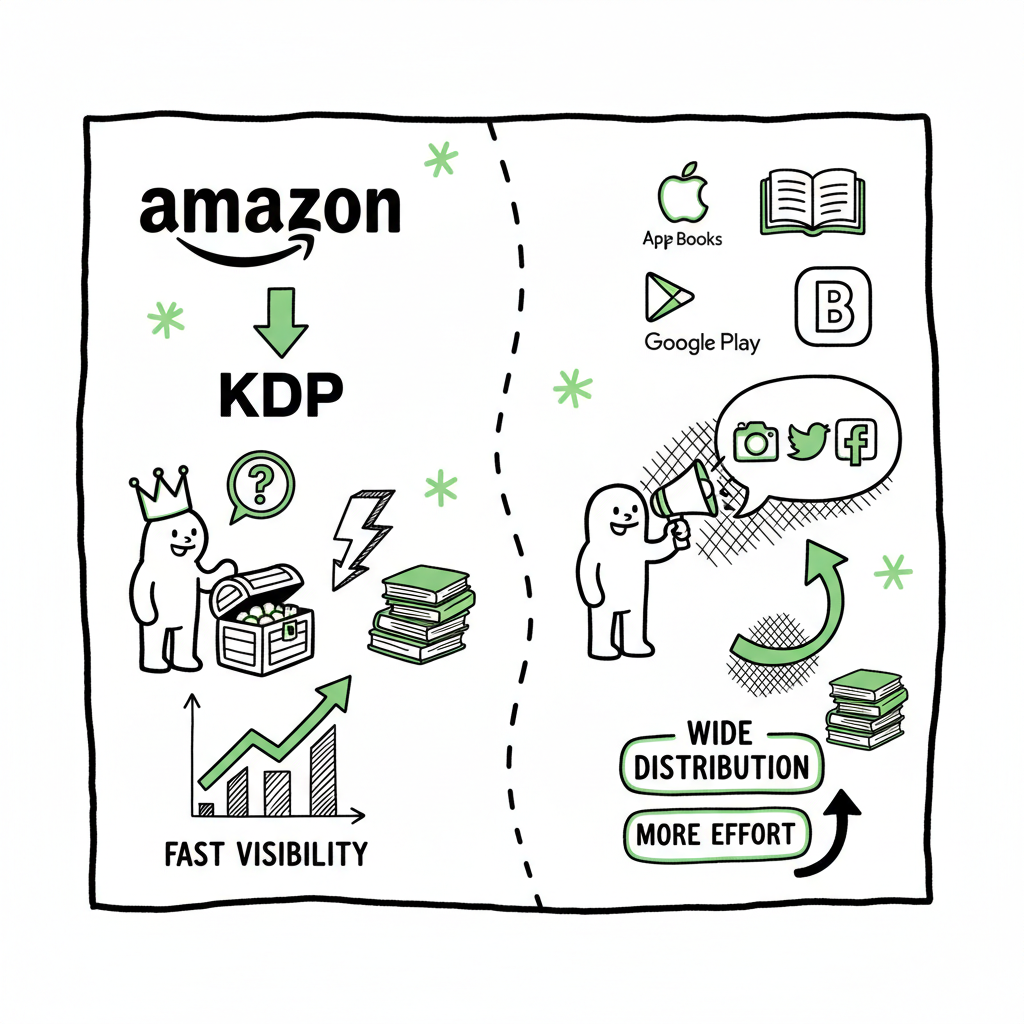
- KDP Select gives Amazon exclusivity for 90 days in exchange for Kindle Unlimited page-read income and promotional tools; wide distribution sells on many stores but needs more marketing.
- Choose KDP Select when you need fast visibility, series momentum, or KU-friendly genres; go wide when you want global reach, control, and revenue diversification.
- BookUploadPro automates multi-platform uploads, saving roughly 90% of repetitive work and making wide distribution practical once you publish seriously.
Table of Contents
- What kdp select vs wide publishing means
- Direct trade-offs: royalties, reach, and risk
- Practical decision paths for authors
- Testing hybrids and timing your moves
- Automation, distribution, and scaling with BookUploadPro
- FAQ
- Final thoughts
- Sources
What kdp select vs wide publishing means
KDP Select is Amazon’s enrollment program that asks authors to grant Amazon exclusive digital distribution for 90-day periods.
For practical guidance, Self Publish Book Amazon Kdp offers a path you can consider.
In return, books in Select can earn from Kindle Unlimited page reads, use special Amazon promotions like Countdown Deals or Free Book Promotions, and sometimes get visibility boosts on the Kindle store.
BookAutoAI can help you publish a paperback or create an ebook with consistent formatting and assets. For EPUB conversion, see EPUB converter, and for cover generation processing, see cover generator processing.
Wide publishing means you do not enroll in KDP Select and instead distribute your ebook and paperback to multiple retailers: Apple Books, Kobo, Google Play, Barnes & Noble (via partners), and aggregator channels such as Draft2Digital or PublishDrive. Wide gives you the freedom to sell everywhere but removes access to Kindle Unlimited and Amazon-exclusive promotional tools.
The core difference is exclusivity versus reach. KDP Select trades short-term exclusivity for Amazon-only perks. Wide publishing trades those perks for presence across more stores and more control over where and how your book sells.
Direct trade-offs: royalties, reach, and risk
Royalties and revenue mix
– KDP Select: You still get the standard 70% or 35% royalty options for sales on Amazon, but a major income source is the KDP Select Global Fund that pays per page read in Kindle Unlimited. For authors who can generate lots of page reads—series writers and binge-genre authors—that income stream can be significant.
– Wide: You receive sales income from multiple stores. Market shares vary by country and genre, but combined, wide stores can match or exceed Amazon income over time. Wide also lets you run direct sales or price differently across channels.
Visibility and marketing
– KDP Select: Amazon is the dominant ebook marketplace. Select gives you tools that can amplify visibility inside Amazon. If your launch is focused on Amazon discovery, Select simplifies promotional work.
– Wide: You must market on multiple platforms. That requires more setup—store assets, metadata per retailer, and outreach—but it spreads discovery beyond Amazon and helps build audiences that don’t rely on a single store.
Control and flexibility
– KDP Select: The exclusivity clause prevents selling the ebook anywhere else while enrolled. You can still sell paperbacks widely, but your ebook is bound to Amazon for that 90-day term.
– Wide: You keep full control to set prices and distribution channels. This reduces the risk from policy or algorithm changes at a single retailer.
Risk profile
– KDP Select centralizes risk with Amazon. If KU payments decline or algorithm changes reduce discoverability, income can drop quickly.
– Wide hedges that risk across stores and reader audiences. It requires more operational work but lowers single-point failure.
Practical decision paths for authors
Your goals and genre determine a sensible path. Here are realistic options and when each fits.
Start with KDP Select if:
- You are a new author seeking quick visibility.
- Your book fits binge-friendly genres (romance, cozy mysteries, serial sci-fi/fantasy) where readers consume quickly and KU reads stack up.
- You want a low-friction launch and are focused on Amazon-first momentum.
Pros: faster setup, KU page reads, built-in Amazon promotions. Cons: temporary lock-in, limited non-Amazon reach.
Go wide if:
- You already have an audience outside Amazon or plan to build one via email lists, newsletters, or direct sales.
- Your genre performs well on other stores (literary fiction often sells more off-Amazon; certain international markets favor Kobo or Apple).
- You prioritize long-term control and diversification.
Pros: broader audience, less dependence on Amazon. Cons: extra setup and ongoing marketing across stores.
Use a hybrid approach when:
- You enroll a first-in-series title in KDP Select to capture KU readers and raise series awareness, then release sequels wide or move the original wide after one or two Select terms.
- You place promotional focus on Amazon for bursts but keep backlist titles wide for steady cross-store sales.
There’s no single right answer. Many authors test KDP Select first and then go wide when they need distribution beyond Amazon. If you want a primer on uploading and Amazon specifics while deciding, Kindle Direct Publishing For Beginners provides a basic walkthrough. Kindle Direct Publishing For Beginners explains the basic workflow in plain terms.
A brief note: if you need tools to automate book building for wide distribution, you can explore BookAutoAI options; EPUB conversion and cover generation processing are available through their resources, as noted above.
How to test a hybrid strategy without losing ground
Testing a hybrid plan means thinking in cycles. KDP Select enrollments last 90 days. Many authors use that window deliberately.
A common, practical sequence
- Launch window (first 90 days): Enroll the lead book in KDP Select. Run promotion days, price experiments, and drive KU reads. Focus marketing on Amazon discovery to collect reviews and readers.
- Post-launch: If the book builds reliable momentum, consider going wide for broader sales and reader acquisition. Move sequels wide to capture non-Amazon buyers.
- Repeat and measure: Track KU page reads, direct sales from newsletters, and store revenue splits. After two or three cycles you’ll know which channel supplies the most predictable income for your books.
What to watch for
- Reader overlap: Some readers will follow you regardless of platform. Others prefer stores like Apple Books or Kobo. Observing where your readers come from helps plan where to invest marketing.
- Price parity and timing: When you go wide, ensure pricing and metadata are consistent. Readers resent price gaps.
- Legal and file control: Keep clean ebook and paperback masters. If you plan to publish wide, you’ll reuse your files across stores. BookAutoAI can help you manage EPUB conversion and cover generation processing if you choose to leverage automation.
Metrics to compare
- Page reads per KU month vs. equivalent net sales on other stores.
- Cost of running promotions and advertising across stores.
- Conversion rates from sample downloads to purchases across channels.
Automation, distribution, and scaling with BookUploadPro
When you decide to publish wide, the operational burden grows. Each retailer needs metadata, cover files, interior files for different formats, and sometimes store-specific requirements. That’s where automation matters.
BookUploadPro focuses on unified multi-platform publishing. It automates repetitive uploads across Amazon KDP, Kobo, Apple Books, Draft2Digital, and Ingram. For authors who publish multiple titles or series, the platform delivers three practical benefits:
- Time savings: Batch CSV uploads and mapped metadata cut the repetitive work. We estimate around 90% time saving on routine uploads for active publishers.
- Platform-specific intelligence: BookUploadPro applies rules so a single submission adapts to each store’s file requirements, which reduces errors and rejections.
- Error reduction and consistency: Automated validation catches common problems before they hit stores, saving revision cycles.
For authors who start taking publishing seriously, BookUploadPro is an obvious upgrade. Automate the upload. Own the distribution. If you publish a lot of titles, the time saved pays back quickly and makes going wide practical instead of overwhelming.
How automation fits common author workflows
- Single-author, small catalog: Use automation to maintain quality and reduce friction for new editions, translations, or reprints.
- Series-first authors: Batch publish sequels and box sets across stores with consistent metadata and series linking.
- Small publishing houses: Manage many ISBNs and territories with fewer manual steps.
A natural part of scaling is adopting tools that do repetitive tasks. If you’re still manually creating individual store listings, the overhead of wide distribution will be a real drag on growth. When you’re ready to automate the workload of multi-store uploads, BookUploadPro reduces friction and lets you focus on covers, content, and readers.
Mid-article resources and next steps — If you need a basic walkthrough to get your first title on Amazon before you choose a distribution strategy, Kindle Direct Publishing For Beginners covers the step-by-step of KDP setup and enrollment options in clear terms. Use that guide to make the initial launch smooth; once your book is live, you can measure Amazon traction and pivot to wide distribution if it makes sense. Kindle Direct Publishing For Beginners provides a practical primer.
If you want to explore tools that help with EPUB conversion or cover generation processing, see EPUB converter and cover generator processing on BookAutoAI.
FAQ
Q: Does enrolling in KDP Select change my paperback rights?
A: No. KDP Select applies only to the ebook. You can still publish paperbacks or hardbacks widely while your ebook is in Select.
Q: Can I move a book from KDP Select to wide?
A: Yes. You can wait until the KDP Select term ends and then un-enroll or choose not to re-enroll. Make sure your ebook files are ready and that pricing and distribution settings on other retailers are set before switching.
Q: Is Kindle Unlimited income stable?
A: KU income depends on the global fund and the number of page reads. It can be lucrative for binge genres but varies by month and author. Treat KU as one revenue channel, not a guaranteed base.
Q: Should every author publish wide eventually?
A: Not necessarily. If your books consistently perform best in KU and you prefer the Amazon-first approach, sticking with Select can work long-term. If you want to build sales across stores or protect against platform risk, wide is sensible.
Q: How do aggregators fit into wide publishing?
A: Aggregators like Draft2Digital and PublishDrive simplify delivering ebooks to multiple outlets. They handle distribution nuances and often accept a smaller fee or keep a small cut. Aggregators are practical for authors who want wide reach without managing each store directly.
Final thoughts
Choosing between kdp select vs wide publishing is a strategic decision, not a permanent moral choice. Test, measure, and change. Many authors start with KDP Select to gain early momentum, then expand wide to diversify income and reach. Others focus on wide from the start because they value control and global availability.
If you plan to publish multiple titles, series, or translations, automation makes wide distribution realistic. BookUploadPro reduces repetitive work, applies platform-specific validation, and supports CSV batch uploads that save time and reduce errors. That operational lift is what turns multi-store publishing from a heavy chore into a manageable growth strategy.
Ready to scale publishing without the manual grind? Visit BookUploadPro.com and try the free trial.
Sources
- Amazon KDP Select vs Wide: Which is Better for Authors?
- KDP Select Versus Wide Distribution? Best to Try Both!
- KDP Select Vs Wide Distribution: 5 Powerful Factors To Make The …
- Kindle Unlimited Publishing vs. Publishing Wide
- KDP Select or Wide? Decoding the Distribution Dilemma for Self …
- KDP Select vs Publishing Wide: Pros, Cons & Real Numbers (video)
- KDP Select vs Going Wide: Complete Guide for New Authors 2025
Kdp Select Vs Wide Publishing: A Practical Guide For Self-Publishing Authors Estimated reading time: 9 minutes Key takeaways KDP Select gives Amazon exclusivity for 90 days in exchange for Kindle Unlimited page-read income and promotional tools; wide distribution sells on many stores but needs more marketing. Choose KDP Select when you need fast visibility, series…