Launch Day vs Long Tail Sales Explained for Authors
Launch day vs long tail sales: What self-publishing authors need to know
Estimated reading time: 9 minutes
Key takeaways
- Launch day drives a spike; long-tail sales turn a spike into steady income.
- Plan launches to create urgency, then automate distribution to capture ongoing discoverability.
- Use platform-aware operations to save time, reduce errors, and focus on writing more books.
Table of Contents
- What “launch day vs long tail sales” means
- How to plan a launch that supports long-tail performance
- Publishing operations that preserve momentum and reduce friction
- Measuring success and next steps
- Final thoughts
- FAQ
- Sources
What “launch day vs long tail sales” means
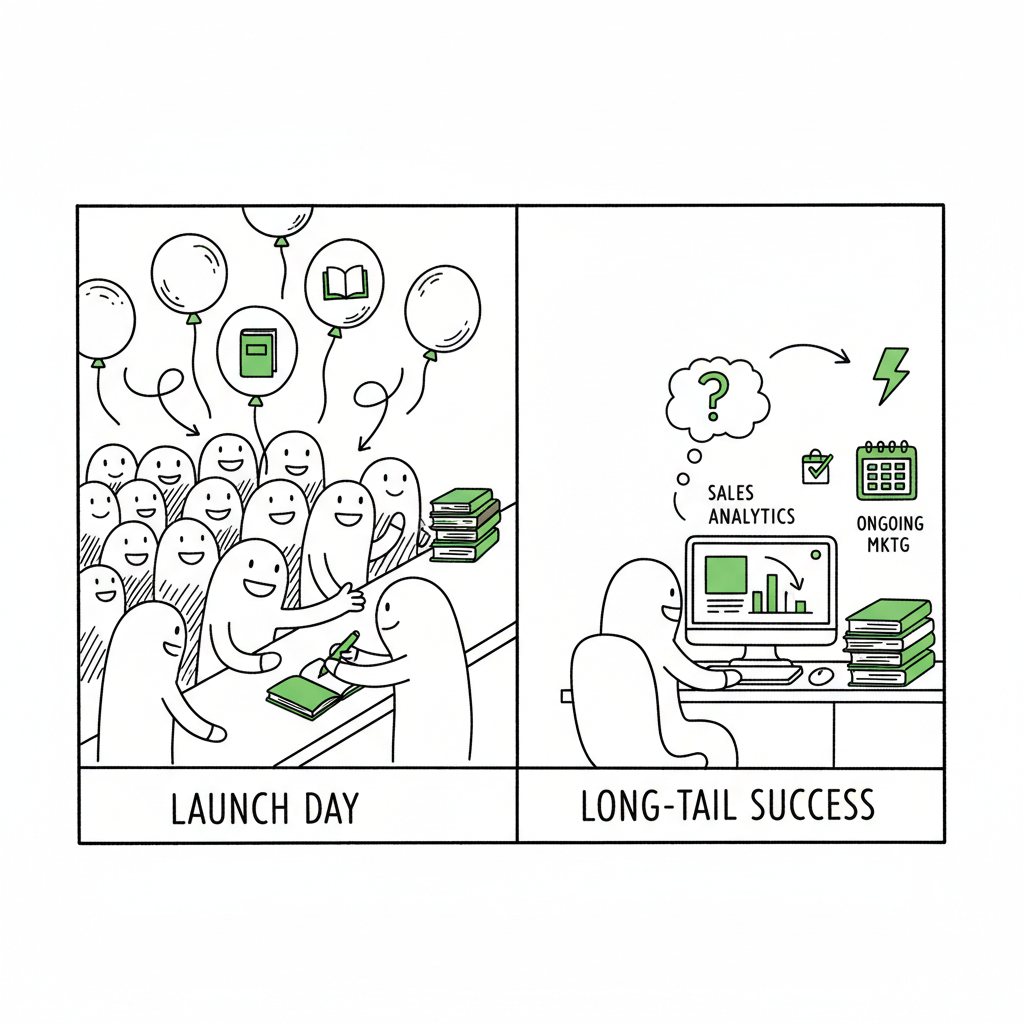
Launch day vs long tail sales is the simple split between two ways books earn money. A launch day gets attention: pre-orders, email blasts, promos, and a concentrated burst of purchases. The long tail is every sale that comes after that burst—small numbers that add up over months and years.
For a practical launch framework, see the Book Launch Strategy Practical Guide.
Both matter. Launches create visibility and reviews that fuel algorithms. Long-tail sales pay the mortgage. Research shows launches can produce outsized revenue spikes, but many products multiply their initial figures over time through steady discoverability. For authors, the smart approach is designing a launch that creates a strong opening and then building systems to keep the book available and visible for years.
How to plan a launch that supports long-tail performance
A launch should do more than hit a sales number. It should set up the conditions for long-term discovery.
Start with audience and pricing
Know who will buy on day one and who will buy later. Use launch pricing and promotions to convert immediate interest, then return the price to a long-term level that supports discoverability and royalties.
Create discoverability assets
Launches should produce content that remains useful:
- Reviews and endorsements that appear on retailer pages.
- Metadata and category choices that match long-term keywords.
- Content for ads and social posts that can be recycled later.
Operational checklist that avoids tactical overload
A launch can be operationally heavy—multiple formats, retailer requirements, and uploads. For a practical launch playbook, see the Book Launch Strategy Practical Guide, which walks through the steps that turn an initial push into lasting visibility. This guide is designed for authors who want repeatable, reliable launches without reinventing the process each time.
Multiple launches and sequenced offers
Staggered or repeated launches can increase lifetime revenue, but they are not a guaranteed multiplier. They work when each push reaches a different audience or solves a different friction point—new format, audiobook release, or a marketing partnership. Avoid repeated identical pushes that only cannibalize past momentum.
Publishing operations that preserve momentum and reduce friction
Long-tail sales depend on consistent availability and correct metadata across retailers. Mistakes in file uploads, cover files, or categories kill discoverability. Fixing those errors manually across six platforms is slow and error-prone. This is where operational tooling matters.
Automate multi-platform distribution
Automating uploads to Amazon KDP, Kobo, Apple Books, Draft2Digital, and Ingram saves time and reduces mistakes. CSV batch uploads and platform-aware intelligence let you publish multiple formats and editions without repeating the same manual steps. That cuts upload time dramatically and keeps listings accurate—so a book stays visible after launch.
Format and cover work that ships
Creating files is a technical step many authors underestimate. If you’re producing paperback and ebook editions, or converting a manuscript to EPUB, use tooling that guarantees file compliance and speed. For reliable EPUB workflows, consider an automated EPUB converter to keep formats consistent and avoid retailer rejections. If you need a fast, consistent cover—especially for multiple books or series—use a cover generator that can produce compliant files suitable for each retailer.
Wide distribution without the busywork
Long-tail sales rely on being everywhere. Distributing to multiple stores increases the chance of discovery across different reader bases and search behaviors. Unified multi-platform publishing makes wide distribution practical: less time spent on each platform means more time writing the next title. When authors publish seriously, a tool that automates the upload becomes an obvious upgrade—CSV batch uploads, platform-specific intelligence, and error reduction free you to focus on craft and marketing.
Cost, scale, and error reduction
Tools that automate distribution typically promise large time savings—often reported as around 90% for multi-book operations. That matters in two ways: it lowers the marginal cost of adding new titles to your catalog, and it reduces the human errors that break long-tail discoverability. If you intend to publish multiple books or editions, automation pays back quickly. Automate the upload. Own the distribution.
Measuring success and next steps
Track both the spike and the slope. A meaningful dashboard shows:
- Launch metrics: day-one sales, review count, and email-conversion rate.
- Long-tail metrics: weekly discoverability sources, catalog-wide sales, and durability of category rankings.
- Operational metrics: upload errors prevented, time saved per book, and number of platforms covered.
Expectations and benchmarks
Launch spikes vary by audience size and pre-launch work. Even modest launches can see meaningful long-tail growth: median products in digital markets often show several times Week 1 revenue over a year. That means a good launch is valuable, but persistence and distribution matter more for lifetime value.
Practical next steps
- Treat the launch as the start of a lifecycle, not the finish line.
- Fix metadata and formats up front so retail algorithms can do their work.
- Use automation to keep your book live, correctly formatted, and distributed across the widest practical set of stores.
- If you produce paperbacks and ebooks, use a reliable book production tool to manage formats and proofs. If you need a quick, consistent cover solution, a cover generator can speed production and keep files compliant.
Final thoughts
Launch day vs long tail sales isn’t an either/or choice. Think of a launch as the ignition and the long tail as the engine. A strong launch lights the signal flare; reliable operations and wide distribution turn that signal into steady income. For authors ready to publish at scale, automation is the operational lever that makes long tails practical: big time savings, fewer errors, and the ability to own distribution across Amazon KDP, Kobo, Apple Books, Draft2Digital, and Ingram.
FAQ
Should I discount on launch day or keep a steady price?
Use launch pricing to create urgency, then return to a long-term price optimized for discoverability and royalties. Consider permanent pricing tests later.
How many launches are too many?
Multiple launches work when each reaches a new audience or adds a new format. Avoid identical repeats that only re-target the same buyers.
Will automated tools reduce my control over listings?
No. Good tools preserve control and add platform-specific checks so you can apply consistent metadata and cover files across stores.
Sources
- https://nathanbarry.com/multiple-launches/
- https://www.saastr.com/sales-vs-the-long-tail/
- https://newsletter.gamediscover.co/p/data-deep-dive-whats-the-long-tail
- https://www.nngroup.com/articles/long-tail/
- https://www.ideagrove.com/blog/understanding-the-long-tail-theory-of-media-fragmentation
- https://www.cloutboost.com/blog/game-influencer-marketing-across-the-lifecycle-from-pre-launch-to-long-tail
Visit BookUploadPro.com to try the free trial and see how unified multi-platform publishing, CSV batch uploads, and platform-specific intelligence make wide distribution practical. Try the free trial.
Launch day vs long tail sales: What self-publishing authors need to know Estimated reading time: 9 minutes Key takeaways Launch day drives a spike; long-tail sales turn a spike into steady income. Plan launches to create urgency, then automate distribution to capture ongoing discoverability. Use platform-aware operations to save time, reduce errors, and focus on…