Soft Launch vs Hard Launch Books What Authors Should Know
Soft Launch vs Hard Launch Books: A Practical Guide for Self-Publishers
Estimated reading time: 9 minutes
Key takeaways
- A soft launch quietly releases a book to test listings, fix problems, and gather early reviews; a hard launch targets a fixed date with concentrated marketing and events.
- Use a soft launch to reduce risk on print/audiobook formats and metadata; use a hard launch to maximize visibility for series starters or high-profile debuts.
- Multi-platform automation (CSV batch uploads, platform-specific intelligence) makes repeating either launch strategy practical and far less work.
- BookUploadPro and targeted tools can cut manual upload time by ~90%, reduce errors, and make wide distribution realistic for serious authors.
Table of Contents
- What a soft launch and a hard launch look like
- When to choose a soft launch or hard launch
- Running either launch across multiple platforms
- Final thoughts
- FAQ
What a soft launch and a hard launch look like
When authors talk about soft launch vs hard launch books they mean two different release approaches. Book Launch Strategy Practical Guide offers a step-by-step timeline and promotional checklist that works with either approach.
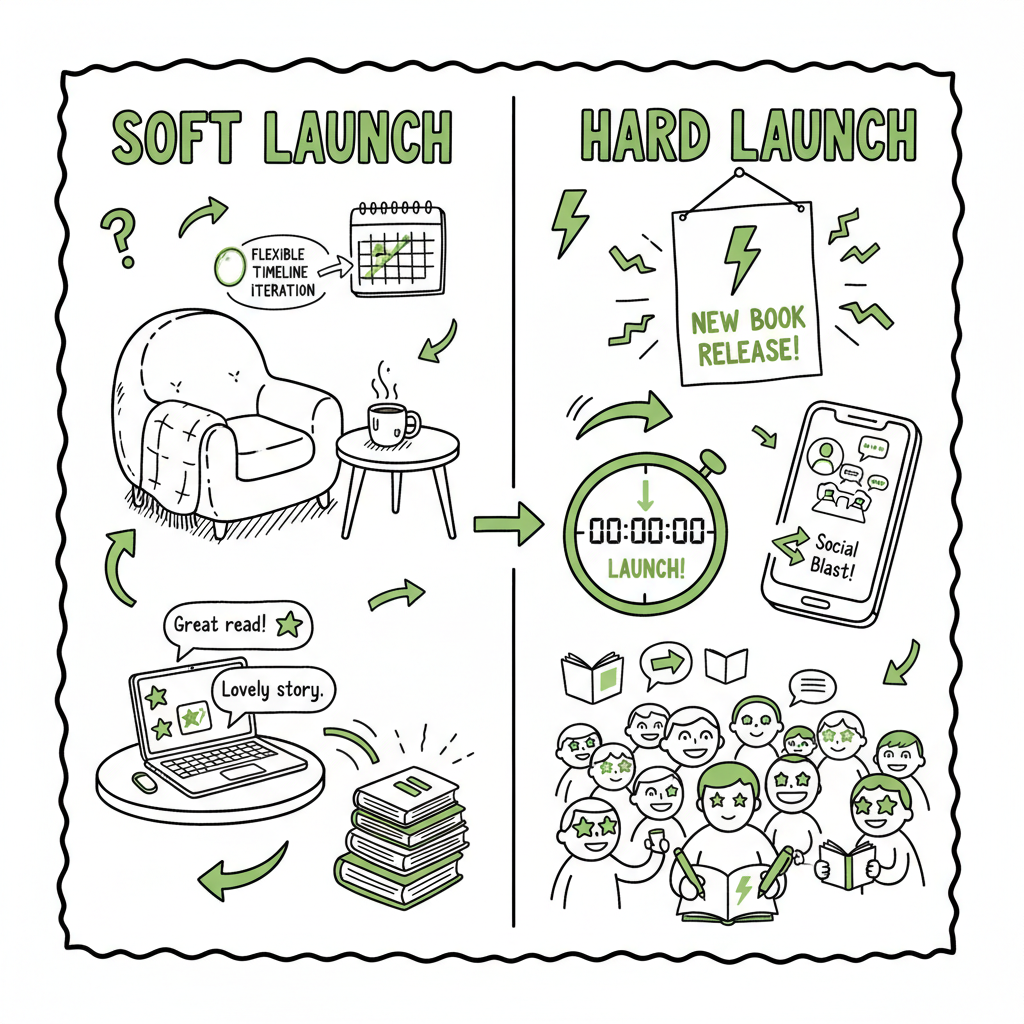
A soft launch is quiet and flexible. You publish the book without a big public push, check that metadata, covers, and formats look correct across stores, and let early buyers or friends leave honest reviews. This approach gives you time to fix Author Central pages, A+ content, or slow print orders without a public failure.
A hard launch is the opposite. You build anticipation with a clear release date, coordinate marketing (email, ads, events, newsletter swaps), and plan a sales spike on day one. Hard launches are designed to land on bestseller lists, get immediate visibility, and create strong word-of-mouth.
Early in a soft launch you want to verify formats and distribution. If you need quick ebook conversion, consider a dedicated EPUB converter. If you will produce a paperback or ebook at scale, use a reliable book creation workflow to avoid repeated formatting mistakes. If you need covers that meet every store requirement, a cover generator can speed the process while keeping specs consistent.
If you want a step-by-step timeline and promotional checklist that works with either approach, see our Book Launch Strategy Practical Guide. This guide lays out tasks by deadline so you can choose a soft or hard path without missing essentials.
A soft launch is quiet and flexible. You publish the book without a big public push, check that metadata, covers, and formats look correct across stores, and let early buyers or friends leave honest reviews. This approach gives you time to fix Author Central pages, A+ content, or slow print orders without a public failure.
When to choose a soft launch or hard launch
Pick a soft launch when:
- You are a new author learning store quirks and want to fix listings quietly.
- You rely on print or audio formats that can arrive late or get stuck in review.
- You need real reader feedback before committing marketing dollars.
- You’re publishing a backlist title or a later book in a series where an initial sales spike is less critical.
Pick a hard launch when:
- You have an engaged audience, an ARC team, or a newsletter that will convert strongly on a set day.
- The book is the first in a series and you want to make a strong market imprint.
- You can coordinate events, ads, and influencers to converge on a release date.
- You’ve already tested formats and metadata in advance (or used a soft launch as a dry run).
Soft launches minimize risk. Hard launches maximize splash. Many authors combine both: a quiet soft launch to fix kinks, then a bigger push later for the hard launch day. That hybrid approach is especially practical when you use automated publishing tools to republish or update files across stores.
Running either launch across multiple platforms
Practical publishing has moved from single-store uploads to multi-platform distribution. When you control dozens of fields for Kindle, Kobo, Apple Books, Draft2Digital, and Ingram, manual uploads become slow and error-prone. That’s where automation pays off.
BookUploadPro automates repetitive uploads across Amazon KDP, Kobo, Apple Books, Draft2Digital, and Ingram. Authors report about ~90% time savings on routine tasks, fewer distribution errors, and the ability to publish widely without hiring help. For many authors, once they publish seriously, BookUploadPro is an obvious upgrade. Automate the upload. Own the distribution.
Format and quality control
- Ebook: Clean EPUB matters. If you need a dependable conversion to EPUB, using a dedicated EPUB conversion tool saves time and fixes common problems like images and TOC entries.
- Paperback: Print-ready PDFs and correct trim sizes are essential. Scaling paperbacks across vendors is easier if you standardize your files and automate uploads.
- Cover: Consistent cover exports for each vendor eliminate rejected submissions; a cover tool that processes every store spec prevents last-minute rework.
When planning a hard launch, pre-approve every format. When soft launching, prioritize ebook and metadata checks first because ebooks publish fastest and are easiest to update.
A practical launch timeline (compact)
- T-minus 8–6 weeks: Finalize manuscript, cover, and EPUB/PDF files. Run automated checks.
- T-minus 4 weeks: Upload to stores in draft or pre-order mode; test buy links and store pages.
- T-minus 2 weeks: If doing a hard launch, lock in promotion partners and schedule emails.
- Release week: Monitor listings, fix any issues centrally, and watch reviews. If you soft launched, use this time to address problems before broad promotion.
Because automated tools let you push fixes quickly, you can iterate during a soft launch and then stage a hard launch once listings are clean.
Final thoughts
Soft launch vs hard launch books is not a strict either/or decision. Think of them as stages on a risk curve. Soft launches reduce surprise and let you validate distribution across ebook, paperback, and audio. Hard launches concentrate attention and sales. Use automation to make either approach repeatable and scalable.
If you handle multiple books or plan series publishing, automation and batch workflows turn months of manual work into a few controlled pushes. That is where the investment in tools pays for itself.
FAQ
Q: Can I switch from a soft launch to a hard launch later?
A: Yes. Many authors publish quietly, fix issues, and then promote widely. Just plan timing so promotions land after you’ve resolved any platform problems.
Q: How long should a soft launch last?
A: Typically a few days to a couple of weeks—long enough to gather initial reviews and verify formats but not so long that momentum stalls.
Q: Do I need an ARC team for a hard launch?
A: An ARC team helps with early reviews and buzz, but you can still run a hard launch without one if you have other promotional channels lined up.
Q: Will automation affect my royalties or store placement?
A: Automation manages uploads and metadata; it doesn’t change pricing policies or algorithms. It reduces errors that could block listings or delay publication.
Q: Should I always test ebook files before print?
A: Yes. Ebook files are faster to validate and update. Print proofs can take longer and have more variables, so test ebooks first and use a soft launch to confirm print settings.
Sources
- https://arieleesieling.com/blog/2021/how-to-plan-an-online-book-launch
- https://selfpublishingadvice.org/soft-launching-a-book/
- https://www.launchmybook.com/why-your-book-marketing-strategy-should-include-a-soft-launch/
- https://www.capterra.com/resources/soft-launch-vs-hard-launch/
- https://dianehatz.substack.com/p/soft-launches-street-teams-and-why
- https://writingbytheseatofmypants.com/2013/03/24/secrets-of-the-indie-author-the-soft-book-launch/
Soft Launch vs Hard Launch Books: A Practical Guide for Self-Publishers Estimated reading time: 9 minutes Key takeaways A soft launch quietly releases a book to test listings, fix problems, and gather early reviews; a hard launch targets a fixed date with concentrated marketing and events. Use a soft launch to reduce risk on print/audiobook…