Series SEO Optimization for Multi-Book Discoverability
Series SEO Optimization: How to make a multi-book series findable and sell more
Estimated reading time: 9 minutes
Key takeaways
- Series SEO optimization treats a group of books as one discoverable asset: consistent metadata, cross-linking, and series-level pages matter.
- Optimize platform-specific fields, but automate repeats. CSV batch uploads and platform-aware rules save time and cut errors.
- Use platform signals (series title, volume numbers, ASIN/ISBN linking) plus site and storefront tactics to build discoverability at scale.
- Automating uploads across stores is an obvious upgrade once you publish multiple titles — it reduces repetitive work by ~90% and makes wide distribution practical.
Table of Contents
- Why series SEO optimization matters
- Practical workflow to set up and scale series SEO
- FAQ
- Final thoughts
- Sources
Why series SEO optimization matters
Series SEO optimization is about more than matching keywords on each book page. When books belong to a series, search engines and store algorithms look for consistent signals: a stable series title, ordered volume information, linked product pages, and clear series metadata. Those signals help customers find the first book, then follow through to later volumes.
A series that ranks is a discovery engine: one well-ranked entry can lift all the volumes. That makes series-level choices — title style, canonical series name, and how you list volume numbers — strategic. For Amazon-specific tactics, our guide Amazon Book SEO for Authors explains key metadata patterns and how they affect visibility across categories and search. Use those patterns as your baseline, then adapt them for other stores.
Practical workflow to scale series SEO
Start with rules, then automate. When you publish more than one book, manual edits lead to inconsistencies and missed opportunities. A reliable workflow stops that.
1) Choose a canonical series identity
- P
- Pick one exact series title and apply it everywhere. Small differences (extra punctuation, spelling, or subtitle placement) break the chain of discovery.
- Decide an ordering convention: use “Book 1,” “Volume 1,” or numeric-only, and stick with it across metadata, filenames, and cover spines.
2) Metadata strategy that works across platforms
- Series title: put the canonical series name in the series field wherever the store provides one.
- Volume identifier: place the volume number in the designated field when available. If the store lacks a series slot, add a short, consistent prefix in the subtitle.
- Subtitle and keyword slots: reserve the subtitle for reader-facing context (hook + series name if needed) and use keyword fields for discoverability without repeating the series name.
3) Create series-level assets that scale
- Series landing page: host a simple page on your author site or storefront that lists all volumes, reading order, and buy links. A single landing page helps with external search and gives you a canonical place to link from newsletters and social.
- Bundles and boxed sets: offer bundles once you have multiple volumes. Bundles create another discoverable product that can rank for both series and bundle-related queries.
- Consistent cover branding: use a repeating visual element or layout across covers so shoppers recognize the series at a glance. If you build covers in volume, consider using a shared template or a quick tool like a cover generator to keep consistency.
4) Automate uploads and reduce friction
- Repeating the same metadata across stores manually invites errors. Automating batch uploads saves time and enforces consistency.
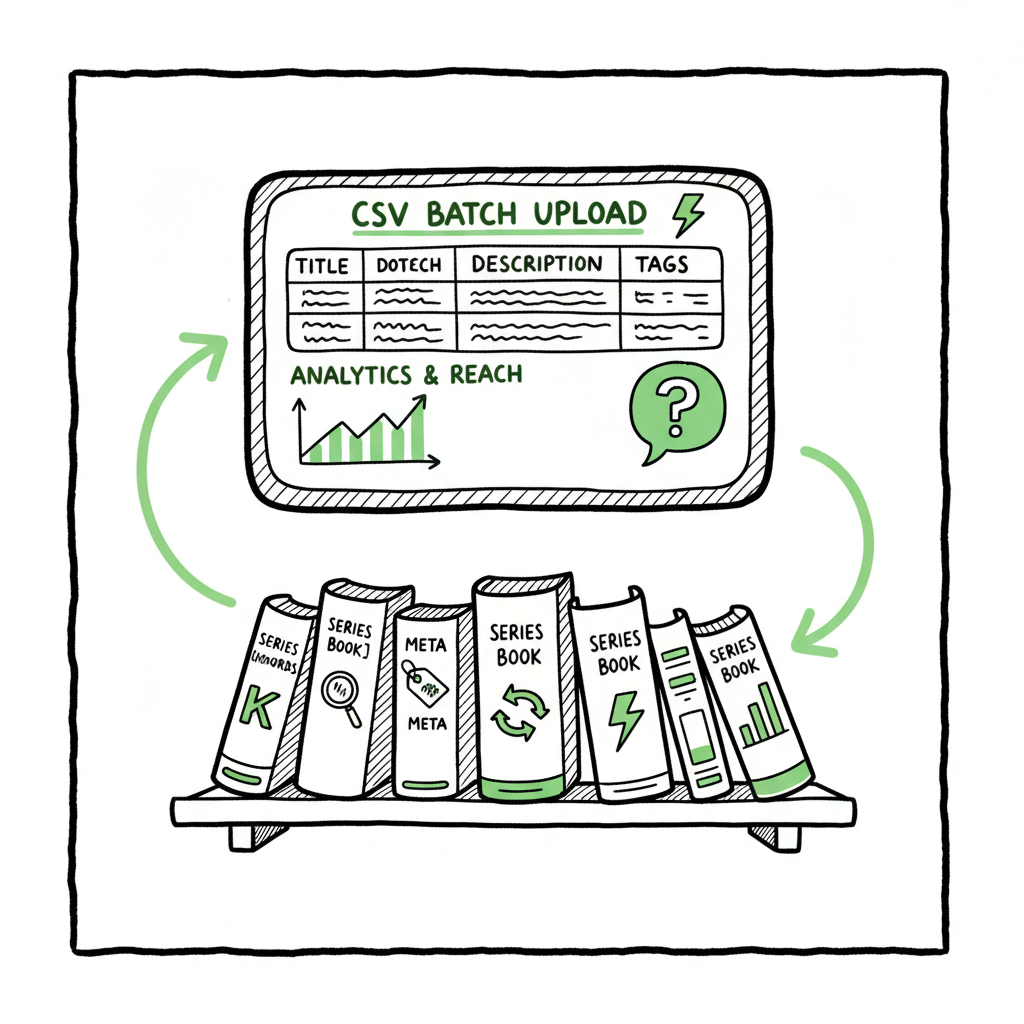
- Use CSV batch uploads to populate title, subtitle, series, volume number, and identifiers consistently across multiple SKUs.
- Ensure platform-specific rules are applied: some stores limit subtitle length, others treat series data differently. Your upload tool should apply conditional rules per store.
- When you produce ebooks and paperbacks, automate file conversion and package delivery so format differences don’t break metadata links. If you need a reliable EPUB workflow, consider a tool like an EPUB converter.
5) Cross-linking and discovery inside stores and off-platform
- Product-to-product links: where possible, link books inside the product description (e.g., “Also in this series: Book 2, Book 3”). Keep the language natural and avoid spammy lists.
- Author pages and storefronts: maintain an organized author page or storefront that groups series together. These pages help both internal store search and external search engines understand relationships.
- External signals: backlinks to your series landing page, interviews about the series, and consistent social links all feed discoverability.
- When you produce ebooks and paperbacks, consider a reliable book creation workflow to centralize output files and distribution.
6) Track the right signals
- Sales rank and category placement: these are noisy but informative. Watch how ranks move when you run promotions or add a pre-order.
- Search visibility: track how well the series title and volume terms rank on major store searches and on web search.
- Cross-sell lift: measure whether exposure to an earlier volume increases purchases of later ones.
How automation supports scale
Automation is the operational lever that lets you apply best practices uniformly. A good automation tool offers:
- Unified multi-platform publishing so you send one dataset to Amazon KDP, Kobo, Apple Books, Draft2Digital, and Ingram without rekeying.
- CSV batch uploads with platform-specific intelligence that enforces limits and maps fields correctly.
- Error reduction through validation rules and automated format checks.
- Time savings approaching ~90% for repetitive upload tasks, making wider distribution practical.
When you’re publishing at scale, an automated upload platform becomes an obvious upgrade. It frees you to focus on writing and series strategy rather than repetitive data entry. Automate the upload. Own the distribution.
Practical notes on file and asset handling
Ebook and paperback generation: treat ebook and paperback as separate SKUs with shared metadata. Automate the packaging and delivery so the same canonical metadata applies across formats. If you produce ebooks and paperbacks, consider a reliable book creation workflow to centralize output files and distribution.
EPUB conversion: use a tool that produces clean EPUBs that pass store validators; bad EPUBs can delay indexing or cause display issues. For a fast, reliable option, see the EPUB converter.
Covers: manage a single cover template for a series and output format-specific versions to maintain visual continuity; a cover generator can speed this step and keep brand elements consistent.
FAQ
Q: How soon should I create a series landing page?
A: As soon as you have more than one book. Even a simple page that lists titles and reading order helps the series rank and gives you a place to send external traffic.
Q: Should I include the series name in the book title?
A: Prefer using the series field first. If the store lacks a series slot, add a compact, consistent indication of the series in the subtitle rather than changing the main title.
Q: Do I need different keywords for each volume?
A: Keep core series keywords consistent, but tailor keywords to each volume’s unique premise or subtopic to capture range queries.
Q: Can automation handle store-specific quirks?
A: Yes—automation that understands platform rules (field limits, accepted characters, and field mappings) will adapt the same dataset into store-ready uploads and cut errors.
Q: What about covers and file formats?
A: Produce format-specific cover files and clean EPUBs early in the workflow. For quick, consistent covers, consider a cover generator. If you need reliable EPUB conversion, use a dedicated EPUB converter to avoid submission failures.
Final thoughts
Series SEO optimization is a mix of strategy and discipline. Pick a canonical identity for the series, make metadata decisions once, and apply them across every volume and store. When repetition grows, automate: CSV batch uploads, platform-aware rules, and validated output files remove human error and save huge amounts of time. At scale, automation is the practical choice.
Automate the upload. Own the distribution.
Sources
– https://blog.bookuploadpro.com/amazon-book-seo-for-authors
– https://www.bookautoai.com/book-cover-generator-processing
– https://www.bookautoai.com/epub-converter
– https://www.bookautoai.com
Sources
- https://blog.bookuploadpro.com/amazon-book-seo-for-authors
- https://www.bookautoai.com/book-cover-generator-processing
- https://www.bookautoai.com/epub-converter
- https://www.bookautoai.com
Series SEO Optimization: How to make a multi-book series findable and sell more Estimated reading time: 9 minutes Key takeaways Series SEO optimization treats a group of books as one discoverable asset: consistent metadata, cross-linking, and series-level pages matter. Optimize platform-specific fields, but automate repeats. CSV batch uploads and platform-aware rules save time and cut…