Scaling as a KDP Author for Predictable Launches and Growth
Scaling as a KDP author
Estimated reading time: 18 minutes
Key takeaways
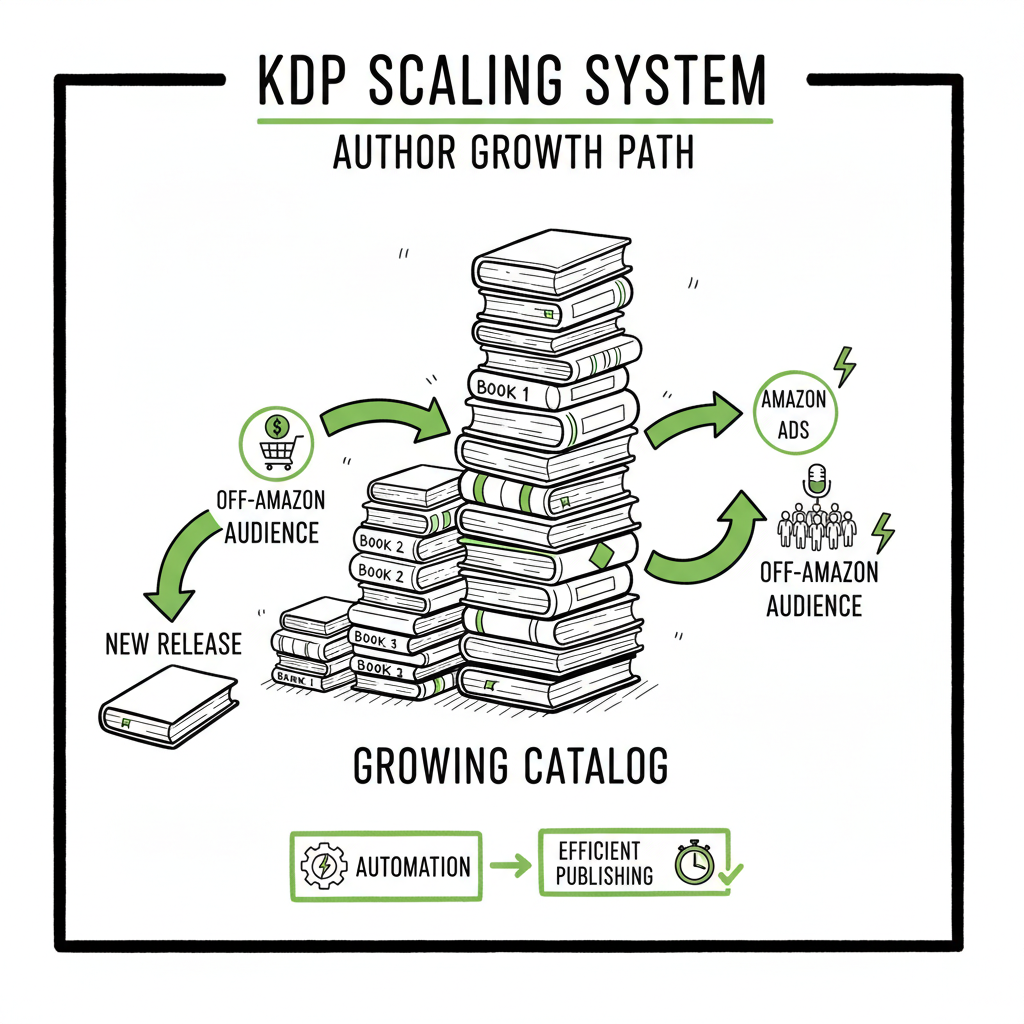
- Scaling as a KDP author means moving from one-off books to a repeatable, brand-focused system that lets each new title lift the whole catalog.
- Growth happens through catalog depth, disciplined Amazon Ads scaling, building an off-Amazon audience, and automating repetitive publishing tasks.
- Multi-platform distribution and batch workflows turn publishing from a trickle into a steady operation with predictable margins and far less busywork.
Table of Contents
- Why scaling matters and what it really looks like
- A practical blueprint for scaling your KDP publishing
- Operational levers: ads, catalog growth, audience, and margins
- Multi-platform distribution, formatting, and tooling to remove bottlenecks
- Final thoughts
- FAQ
- Sources
Why scaling matters and what it really looks like
If you’re an author who wants reliable income, scaling as a KDP author is about designing a system instead of hoping one book becomes a blockbuster. The first book validates a niche. The next books deepen it. Over time each title helps discover and convert readers for the rest of your backlist. That pattern — brand + catalog depth + repeatable launches — is how you go from occasional sales to a predictable publishing business.
Many authors think scaling is simply “publish more.” That’s part of it, but volume without coherence wastes time and money. Scaling requires discipline: choose a focused niche, make your titles consistent, and build simple processes for formatting, metadata, ad testing, and distribution. If you want a clear how-to focused on Amazon specifics, see Amazon KDP for Authors for background on the platform and its publishing process.
Scaling is not a single tactic. It’s a stack:
– Product: professional covers, clean interiors, formats (ebook/paperback/audio).
– Catalog: series, spin-offs, and related titles so readers can buy repeatedly.
– Marketing: repeatable ad campaigns, email funnels, and launch mechanics.
– Operations: templates, batch uploads, and tooling that remove manual steps.
Do this well and your revenue grows faster than your workload. Do it poorly and you’ll trade time for marginal gains. The rest of this article maps the practical path authors use to scale sustainably.
A practical blueprint for scaling your KDP publishing
Start with validation, then make every next move measurable.
-
Validate a niche with one book
Aim to prove demand. A clear niche and a single well-positioned title answer two questions: do readers want this, and will the book convert once they find it?
Validate with small, disciplined experiments: run ads at a controlled test budget, adjust cover and blurb, and watch conversion metrics. If ads convert and readers leave reviews, you have a foundation to build on.
-
Turn that validation into a brand and series
Don’t spray and pray across unrelated topics. Build a recognizable author brand or a series that signals to readers what to expect.
Series and themed backlists create compounding sales: if each book links to the others (front/back matter, boxed sets, recommended reading), a reader buys more than one title.
-
Standardize production and assets
Create templates for interiors, front matter, back matter, and metadata. Consistent formatting reduces errors and speed-ups the publishing cycle.
Professional covers are non-negotiable. If you invest in covers that read well at thumbnail size and match your niche, conversion improves across the catalog.
-
Make launches repeatable
A launch is a sequence: pre-launch traffic (email, low-cost ads), launch-day visibility, and post-launch follow-through. Build a checklist, but more importantly build the systems that let you run the checklist without re-inventing steps.
Use lead magnets inside books or on landing pages to build an email list that lifts future launches.
-
Measure everything and raise the right levers
Track ad ACOS, conversion rate, daily units sold, and the effect of price changes. Remove tactics that don’t scale and double down on those that do.
When one campaign proves profitable, increase budget incrementally and add campaign types (manual keywords, product targeting) rather than blasting budget across untested campaigns.
-
Protect margins as you scale
Volume collides with competition and price pressure. To maintain profits, reduce per-book costs through templates, batch tasks, and outsourcing, while improving conversion through better covers and copy.
This blueprint is deliberately simple. The difference between authors who stall and those who scale is operational discipline: turning decisions into repeatable processes.
Operational levers: ads, catalog growth, audience, and margins
This section walks through the levers you’ll use every month. Think of them as controls on a dashboard. When one lever performs, you shift budget or effort into it. When another underperforms, you reduce it.
Catalog strategy: depth beats breadth
Focused depth: publish several books that serve the same reader. A small cluster of related titles tends to outperform many unrelated one-offs because you can cross-promote and refine messaging.
Formats: offer ebook and paperback at minimum. Consider audio where the niche supports it. Different formats capture different reader habits and increase lifetime value.
Acquisition: paid ads and organic discovery
Treat Amazon Ads as a scaling lever: test at small budget, identify winning ASINs and keywords, then increase spend on proven campaigns. Avoid raising budgets on poor converters.
Expand marketplaces: once campaigns convert in one marketplace, move similar campaigns to additional Amazon marketplaces (UK, EU, Canada, etc.). Each market needs its own testing but proven creatives and copy translate faster than starting cold.
Audience building: email and off-Amazon traffic
An email list changes launch dynamics. Even a modest list provides reliable initial sales and helps get reviews for new titles.
Use lead magnets tied to your books. A short free guide or checklist that complements a paid book is a practical magnet that drives emails.
Production and repeatable publishing
Batch production: write, format, and schedule uploads in batches. Use templates for interior and back matter so each new title follows a fixed process.
Outsource low-skill or repeatable work: cover variants, metadata entry, and proofreading can be delegated once you have templates and clear instructions.
Margins and pricing
Test price sensitivity. Small price differences can change conversion and revenue across a catalog. Use temporary promotions and analyze long-term effects.
Maintain a feedback loop: watch how price, category, and ads interact. Scaling profitably is about maintaining unit economics as volume grows.
Risk management and compliance
Avoid tactics that risk policy issues: don’t reuse the same content across multiple uploads, and avoid manipulative metadata that could trigger delisting.
Keep a record of each upload, including screenshots and version notes, so you can troubleshoot if a title runs into problems.
If this sounds like a lot of moving parts, that’s because it is. The point of scaling is not to add more work forever; it’s to replace manual steps with systems and tooling that deliver predictable throughput.
Multi-platform distribution, formatting, and tooling to remove bottlenecks
Running an author business across formats and stores without tools is a grind. Multi-platform distribution widens reach, reduces dependency on one marketplace, and increases sales velocity from different reader pools.
Why distribute beyond Amazon
- Different platforms reach different audiences. Kobo and Apple Books have loyal readers outside Amazon’s ecosystem.
- Some formats and marketplaces have lower competition for certain niches. Spreading titles gives more touch points and stabilizes revenue.
Key platform considerations
- Metadata: each platform has its own metadata fields and rules. Map your metadata consistently so changes propagate cleanly.
- Timing: some stores take longer to approve books. Account for that in your launch schedule.
- Pricing and royalties: optimize price per platform to keep offers aligned and avoid arbitrage issues.
Batch uploads and CSV workflows
- When you scale, manual uploads are the bottleneck. Using CSV batch uploads lets you push dozens or hundreds of titles with the same, tested metadata structure.
- Advanced workflows include platform-specific intelligence: different cover sizes, file types, and distribution rights per marketplace.
Tooling and automation
- Tools that handle bulk formatting, cover processing, and EPUB conversion dramatically reduce errors and time. For example, a reliable book cover generator speeds the process of creating niche-matching thumbnails while keeping specs correct and consistent.
- Converting to platform-ready EPUB files is a recurring task. Use a dedicated EPUB converter that produces clean files ready for upload to stores that require EPUB.
- When you’re creating multiple ebooks and paperbacks, book creation tools that standardize page sizes and layouts make batch publishing practical.
Platform-specific intelligence and error reduction
- Automated checks catch missing fields, invalid fonts, or images that exceed limits. This reduces rejection rates and saves time.
- Systems that enforce rules across titles reduce accidental mistakes that cost time and sales.
Why this is an obvious upgrade once you publish seriously
– If you’re publishing more than a few books a year, the time saved by batch uploads and formatting tools quickly exceeds their cost.
– When your process moves from ad hoc to repeatable, you spend more time on high-value tasks: writing, marketing strategy, and creative testing.
Automate the upload. Own the distribution.
Final thoughts
Scaling as a KDP author is not a magic trick. It’s a series of choices: validate a niche, build a coherent catalog, run disciplined ad tests, grow an audience, and remove repetitive tasks with tooling. When those pieces work together you get predictable launches, lower per-title friction, and a publishing operation that produces reliable revenue without burning you out.
If you publish seriously and want to remove the bottleneck of repeated uploads, consider tools that focus on unified multi-platform publishing, CSV batch uploads, platform-specific intelligence, and error reduction. These systems make wide distribution practical and save authors meaningful time — often up to ~90% on repetitive tasks. For many authors, automating the upload is the obvious upgrade the moment they decide to scale.
Visit BookUploadPro.com to learn more and try the free trial.
FAQ
Q: How many books do I need to scale reliably?
A: There’s no fixed number. Most authors see compounding results after a small cluster — often 4–8 related titles — where cross-promotion and series mechanics begin to lift the whole backlist.
Q: Should I run Amazon Ads from day one?
A: Use ads to validate a book’s conversion and to drive targeted traffic for launches. Start small, measure conversion, and only scale budgets on campaigns that show repeatable returns.
Q: Can I scale with low-budget covers and templates?
A: Low-cost covers can work initially, but professional covers that read well at thumbnail size pay for themselves in higher conversion. Templates for interiors are essential; they reduce revisions and speed publishing.
Q: Is it risky to reuse content across platforms?
A: Reusing the same manuscript across platforms is normal. Avoid uploading duplicate content under different titles or minimal changes across multiple listings; that can trigger platform policy issues.
Q: Do I need a separate tool to manage batch uploads?
A: At scale, yes. Manual uploads create friction and errors. A CSV-driven batch workflow or a platform that supports multi-store batch publishing saves time and reduces mistakes.
Q: How do I protect margins as I scale?
A: Reduce per-title production costs with templates and outsourcing, optimize ads to profitable campaigns, and experiment with price points that preserve unit economics as volume grows.
Sources
- 3 Strategies for Scaling your KDP Book Business with Amazon Ads (YouTube)
- Scaling beyond $10K/MO on Amazon KDP: Proven Strategies | Part 1 (YouTube)
- Amazon’s New Kindle Feature Raises Author Concerns (SelfPub.substack.com)
- 5 Amazon KDP Strategies That ACTUALLY Works (YouTube)
- The Hidden Challenges of Self-Publishing on Amazon (Self-Publishing School)
- Biggest Challenges in Amazon KDP Publishing? (KDP Community)
Scaling as a KDP author Estimated reading time: 18 minutes Key takeaways Scaling as a KDP author means moving from one-off books to a repeatable, brand-focused system that lets each new title lift the whole catalog. Growth happens through catalog depth, disciplined Amazon Ads scaling, building an off-Amazon audience, and automating repetitive publishing tasks. Multi-platform…