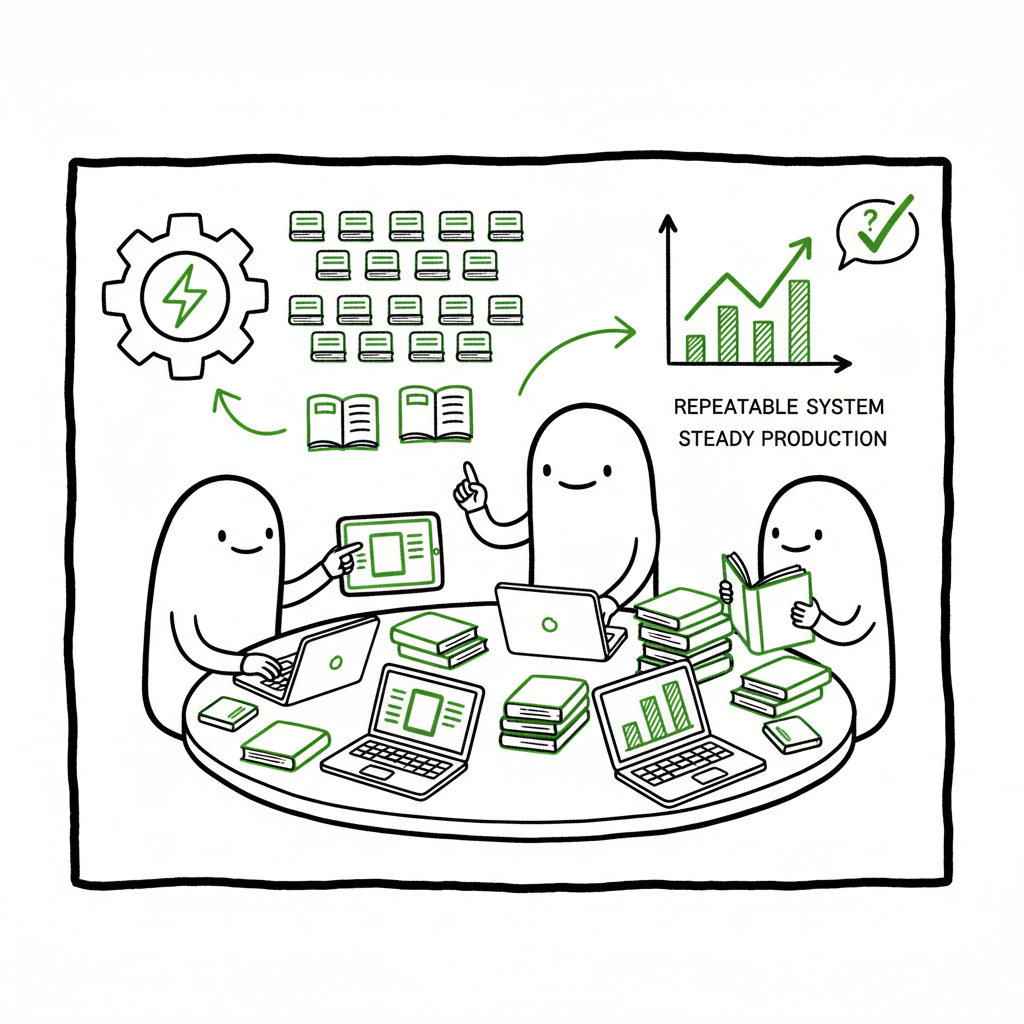
Scaling a Publishing Business with Repeatable Systems
Scaling a Publishing Business: How to Turn Books into a Repeatable Machine
Estimated reading time: 14 minutes
Key takeaways
- Scaling a publishing business means moving from one-off launches to repeatable systems: clear model, steady production, and predictable cash flow.
- Operational levers — formats, platforms, automation, and a small team — multiply output without multiplying headaches.
- Tools that automate uploads and standardize formatting make wide distribution practical; once you publish seriously, automated multi-platform publishing becomes an obvious upgrade.
Table of Contents
- Why scaling matters — what changes when you grow
- A practical scaling plan — steps you can run like a system
- Operational levers and tools — where the work actually scales
- FAQ — common questions answered
- Sources
Why scaling matters — what changes when you grow
Scaling a publishing business starts with a change in mindset. At the beginning, most authors focus on a single book, a single launch, or a single channel. That can work. But when you want reliable income, to expand publishing operations, or to grow a self publishing empire, you need to think like an operator: repeatable processes, predictable costs, and decisions guided by cash flow and throughput—not just inspiration.
When you plan to scale, three outcomes change immediately:
– Volume becomes possible. Once you stop treating each book as a brand-new marathon and instead build a production pipeline, you can publish more titles faster.
– Risk spreads. A single book’s sales curve can be volatile. A catalog smooths revenue: one slow month can be offset by other titles or formats.
– Leverage shifts. Systems, tools, and a small team let you multiply output without multiplying your hours.
Treating publishing as a business does not mean losing craft. It means arranging tasks so creative work is protected and repeatable work is automated or delegated. If you want a short primer on that shift, our longer guide on Self Publishing as a Business explains how to move from one-off launches to an operational publishing model.
Early signs you need to scale
- You regularly finish books but can’t get them to market quickly.
- Formatting, cover setup, and platform uploads take more time than writing.
- You want to publish in audio, paperback, and international stores but each extra format doubles your workload.
If these feel familiar, you’re at the threshold where systems make more sense than heroic effort.
What scaling is not
- It is not just publishing faster for the sake of output. Quantity without quality compounds problems.
- It is not a magic ad budget that sells any book. Marketing and audience work remain essential.
- It is not instant. Real scaling requires discipline in planning, testing, and accepting small, steady improvements.
Why multi-format and multi-platform matter
Diversifying where and how you sell is a structural move. An ebook-only strategy on a single retailer might be profitable today, but it ties revenue to one algorithm or policy. Expanding into print, audio, and additional retailers reduces that exposure. The cost of adding formats has fallen—especially if you standardize processes—so the return on bringing titles to more channels becomes attractive quickly.
Practical note: when you add formats, you create repeatable tasks. That’s good. Those tasks are exactly what automation and batch processes are built to handle.
A practical scaling plan — steps you can run like a system
Scaling doesn’t happen by accident. It follows a plan that aligns money, production, and audience-building. Below is a simple, practical plan you can run in quarters.
Quarter zero — where you start
- Audit your current catalog: sales, production time per title, review rates, and royalties by channel.
- Map costs: editing, covers, formatting, ads, and platform fees. Know your break-even for different price points.
- Decide a primary model: exclusive vs. wide, books-only vs. books-plus-services. Your choice affects marketing and platform work.
Quarter one — productize and schedule
- Create a production cadence. Decide how many titles you want to release in the next 12 months and break that into deliverables: draft, edit, cover, format, upload, and launch.
- Productize your non-writing work. Turn repeated tasks (formatting, metadata, cover generation) into checklists, templates, or jobs you can hand off.
- Price experiments. Test price points and bundling logically across new releases so you have data for reinvestment.
Quarter two — audience and offers
- Grow direct channels: email list and social properties. Prioritize email; it’s the most reliable revenue flywheel for launches and backlist sales.
- Test other revenue: subscriptions, serialized releases, or higher-ticket bundles. Aim to create at least one recurring or premium offer over 12 months.
- Use launch tests to learn: small ad spends, pre-order traction, or newsletter-only promotions give high-return data quickly.
Quarter three — expand formats and platforms
- Decide which formats to prioritize. Ebook and paperback are baseline; audio, enhanced ebooks, and translations add reach.
- Batch format production. Group tasks so you generate multiple formats in one run. This is where tools that convert manuscripts, make covers, and prepare print files save the most time.
- Start wide distribution. Add retailers and aggregators so you’re not dependent on a single channel.
Quarter four — systems and team
- Automate repetitive tasks and standardize metadata and assets.
- Hire or contract for specialized roles: a formatter, a cover designer, a paid-ads operator, or a virtual assistant for uploads.
- Measure key metrics monthly: titles in production, time per title, cost per title, revenue per title, and email growth.
Cash-flow thinking
Plan investments against expected returns. If you can save 90% of upload time using a tool or service, the money saved in hours is real working capital to fund editing and ads. Build break-even calculators for common investments: a formatter, audio production, or an automation tool.
A note on testing and failure
Scaling borrows the startup playbook: test small, measure, double-down on winners, kill losers. Keep experiments small so failure is cheap. One failed ad campaign is a data point; hundreds of failed, expensive experiments are not.
How to decide what to automate
- Automate repeatable, rule-based tasks (file formatting, metadata insertion, multi-platform uploads).
- Outsource creative exceptions (voice-sensitive editing, deep copyediting).
- Keep final quality control in-house: an automated pipeline should feed a quick human review before publish.
Operational levers and tools — where the work actually scales
When you move from plan to operations, four levers produce most of the results: formats, platforms, batching, and tooling. Use these systematically and you’ll increase output without multiplying errors.
-
1) Formats: more ways to sell
Expanding to paperback, audio, and foreign-language editions opens new income lines. Each format has a different cost structure and timeline. Paperback and ebook uploads can be automated; audio still requires production investment but often brings higher per-unit revenue.
If you create paperbacks and ebooks regularly, it’s helpful to use a processing tool that handles the repeated steps of layout and export. For straightforward paperback and ebook creation, a single production hub reduces the manual setup on each platform. Book creation workflow.
-
2) Platforms: spread your catalog
Amazon is usually the largest channel, but it’s not the only one. Kobo, Apple Books, Draft2Digital, and Ingram each reach different readers and geographies. Using an automated multi-platform approach reduces the overhead of separate uploads and lets you follow data to see which markets respond best. This is how you expand publishing operations without doubling your workload.
-
3) Batching: production in chunks
Batching is the simplest productivity multiplier. Instead of formatting one book at a time, format three. Instead of making a single cover, generate covers for a series at once. Batching reduces context switching and makes outsourcing cheaper because tasks become predictable.
Covers and interiors are prime targets for batching:
– Generate a set of cover directions and variations in one session.
– Convert multiple manuscripts to EPUB or print-ready PDFs together.
– Run all metadata through the same template and export as a CSV for bulk uploads.If you use an automated EPUB converter as part of your batch process, you save time and reduce the risk of per-platform errors. EPUB converter.
-
4) Tooling: where automation matters most
Standard tools that support scale do a few things well:
– Convert manuscripts to platform-ready files consistently.
– Apply templates and styles so interiors meet retailer specs.
– Produce multiple file types (EPUB, MOBI, print-ready PDF) from a single source.
– Generate and test metadata and keyword sets quickly.
– Export batch metadata as CSVs for bulk uploads.BookUploadPro sits in this layer as a production and upload engine. It automates repetitive uploads across Amazon KDP, Kobo, Apple Books, Draft2Digital, and Ingram. That unified multi-platform publishing reduces time spent on per-platform quirks and error checks. For authors or small teams scaling output, automated CSV batch uploads and platform-specific intelligence are the difference between ten titles and forty titles a year.
What BookUploadPro helps with in practice
– CSV batch uploads that let you queue dozens of titles and push them to multiple platforms with one workflow.
– Platform-specific checks that catch common errors before you hit “publish.”
– Standardized formatting so interiors and metadata are consistent across channels.
– Time savings at scale—authors commonly report ~90% time savings on upload and setup tasks.
Because these tasks are repetitive and precise, a tool that automates them is an obvious upgrade once authors start publishing seriously. Automate the upload. Own the distribution. -
5) Covers and assets
Cover creation scales differently than interior formatting. A one-off bespoke cover for a single title is fine. But when you publish multiple books, you need a process to produce covers that are consistent for series, genres, and marketing channels. If you spend time repeatedly resizing, exporting, and testing cover variants, you should centralize that work.
If you do in-house or automated cover generation, there are tools that process cover files and output final versions for each retailer. For authors who want to reduce repetitive cover work, a cover processing pipeline removes manual image steps and saves time. Book cover generator and processing.
-
6) Quality control: human oversight
Automation increases speed and reduces routine errors, but final human review is essential. Build a short QA checklist for each title:
– Correct ISBN and price settings
– Front matter and back matter presence and format
– Cover file resolution and color checks
– Delivery checks for EPUB and print PDF
– Metadata accuracy (title, series, author, description, categories)
Keep the QA checklist short—automation should handle the heavy lifting; humans should catch anything automation can miss.
Teams and roles
You don’t need a full staff to scale. A compact team covers most needs:
– Production lead: manages pipelines, templates, and batch uploads.
– Creative lead: copyediting and voice-sensitive edits.
– Designer: covers and brand assets.
– Marketing lead: email campaigns, ad strategy, and launches.
Often a mix of contractors and a small part-time employee works best. As revenue grows, bring a production lead or BookUploadPro in-house to keep the pipeline humming.
How to choose what to build vs. buy
- Buy a reliable tool if it saves time, reduces errors, and scales predictably.
- Build custom scripts or templates when your needs are very specific or when tools don’t support required formats.
For most indie publishers, the right balance is to use a production tool to standardize and speed uploads, then keep a lean set of human roles for review and creative work.
Wrap-up and next operational moves
Scaling becomes sustainable when you balance investment with predictable returns. Start by automating the parts of the process that repeat with little variation. Batch production, standardized covers, a reliable EPUB converter, and a multi-platform uploader move you from one-person hustle to a reliable publishing operation. When your pipeline is stable, you can invest in audience building and higher-value offers.
- Document the production pipeline and QA steps.
- Batch at least three tasks together (covers, formats, uploads).
- Use a tool to export metadata as CSV and push to multiple platforms.
- Keep a simple monthly dashboard for output and costs.
Visit BookUploadPro to explore multi-platform publishing automation and try the free trial.
FAQ
Q: How soon can I expect results after I start scaling my publishing business?
A: Scaling is a medium-term project. You can see immediate time savings from automating uploads and batch formatting, but revenue benefits usually take several months as new titles and formats start selling and your audience grows.
Q: Do I need to stop doing creative work if I scale?
A: No. The goal of scaling is to protect and prioritize creative time. Automate repetitive work so you can focus on writing, strategy, and building audience assets.
Q: Can I scale without spending on ads?
A: You can scale output without ads, but growing an audience and getting steady sales is faster with some promotion. Many authors combine organic list-building with small ad tests and reinvest profits into production.
Q: Is it safe to use automated tools for formatting and uploads?
A: Yes, when you pair them with quality templates and a short human QA pass. Automation reduces human error on repetitive tasks but should not replace final checks.
Q: Will automation change the voice or quality of my writing?
A: Automation typically applies to production tasks, not creative voice. If you use AI for drafting, you still need human editing to preserve voice and accuracy.
Q: How do I decide which platforms to prioritize?
A: Start with your current revenue channels and test additional platforms in small batches. Prioritize platforms that reach different markets or offer better royalty structures for your books.
Sources
- https://www.kobo.com/kobo-writing-life/blog/how-to-start-your-writing-business-scaling-your-self-publishing-business
- https://www.theauthorstack.com/p/scale-your-author-business-like-a
- https://selfpublishingadvice.org/business-models-for-authors/
- https://www.thecreativepenn.com/2018/11/19/how-to-scale-your-author-business-with-joseph-alexander/
- https://www.writtenwordmedia.com/5-marketing-strategies-to-become-a-six-figure-author/
Scaling a Publishing Business: How to Turn Books into a Repeatable Machine Estimated reading time: 14 minutes Key takeaways Scaling a publishing business means moving from one-off launches to repeatable systems: clear model, steady production, and predictable cash flow. Operational levers — formats, platforms, automation, and a small team — multiply output without multiplying headaches.…