How to Rank Books on Amazon for Better Discoverability
How to Rank Books on Amazon
Estimated reading time: 7 minutes
Key takeaways
- Amazon ranking is driven by relevance and recent performance: metadata plus sales and conversion matter most.
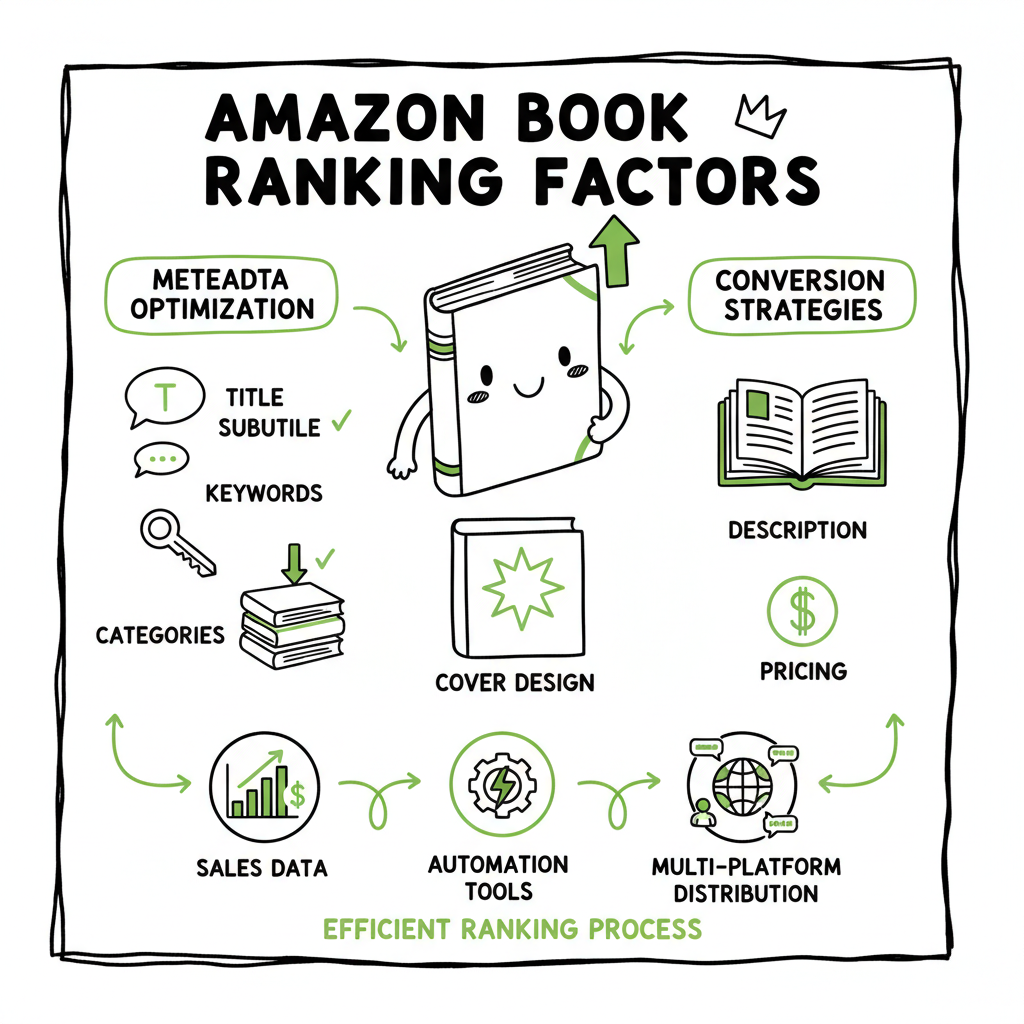
- Optimize title, subtitle, keywords, and categories for discoverability while improving conversion with your cover, description, and price.
- Scale distribution and reduce manual work with multi-platform automation; once you publish seriously, automation is the obvious upgrade.
Table of Contents
- What moves Amazon’s algorithm?
- Metadata, discoverability, and conversion
- Pricing, promotions, and traffic strategies
- Scale publishing without breaking routines
- FAQ
- Sources
What moves Amazon’s algorithm?
When authors ask how to rank books on amazon they usually mean: “How do I get my book to appear on page one and stay visible?” Amazon Book SEO for Authors uses an A9-style system that mixes relevance signals (how well your metadata matches a search) with performance signals (recent sales, conversion rate, and engagement). In plain terms, two things matter: 1) can people find your book, and 2) do they buy it when they see it?
Relevance comes from title, subtitle, description, backend keyword fields, and categories. Performance comes from how often browsers buy your book after clicking, plus recent sales momentum. Reviews help, but they are supporting evidence — they improve conversion rather than directly “unlock” a rank. For tactical, hands-on guidance on optimizing your metadata and keywords, consult the guide. This covers the phrases and placement that make your book match reader searches.
Track performance daily for the first weeks after launch. Amazon weights recent activity heavily. A steady trickle of sales is better than a single spike that fades. Ads and promotions can kickstart the momentum, but they must also lead to purchases at a good conversion rate to continue helping rank.
Metadata, discoverability, and conversion
Metadata is your visibility engine. Treat the title and subtitle as keyword real estate and the description as your sales page. Use clear, reader-focused language. Avoid keyword stuffing — choose a few strong phrases a reader would actually type.
Categories and keywords: Pick two precise BISAC categories that fit but aren’t overcrowded. Use the keyword fields to include alternate phrasings and long-tail terms. Monitor where similar books rank and learn from their metadata.
Cover and description: A professional cover raises conversion immediately. If you’re still testing a few design ideas, use realistic mockups and A/B test on ads or social posts before you commit. If you need tools for cover production, you can use a book cover generator to get consistent, print-ready designs quickly. Your description should lead with reader benefit, show a short hook, and include a short-author bio. Bullet features work well on Amazon because they scan easily.
Formatting and files: Amazon prefers clean, well-formatted files. Converting a manuscript to EPUB is a common step for ebook distribution; a smooth conversion reduces formatting errors that harm reviews and returns. If you’re producing both ebook and paperback, plan for interior templates and ISBN handling early.
Conversion rate is king. Everything you change — price, cover, first-page formatting — should aim to improve the percent of browsers who click Buy. Lower price can increase conversion but may hurt long-term revenue; experiment with short promotions and measure net effect over 30 days.
Pricing, promotions, and traffic strategies
A practical launch plan balances organic discovery with paid boosts and external traffic. Organic includes metadata, categories, and reviews. Paid includes Amazon Ads (AMS) and book promotion services. External traffic includes newsletter swaps, social audiences, and podcast interviews.
Pre-launch and launch windows: Pre-orders help centralize sales momentum into the release date. If you have a small audience, consider a soft launch with friends and readers to generate early reviews and conversion signals. Then use targeted ad campaigns to expand reach. Track ACOS and conversion — an ad only helps rank if it leads to a sale at a reasonable cost.
Reviews and quality signals: Encourage honest reviews via reader outreach but avoid any policy violations. Reviews increase social proof and improve conversion long-term. Address early formatting or content issues quickly; a spike in returns or negative reviews can push rank downward.
- Track daily sales and conversion for the first 30 days.
- Run small keyword-targeted ads to validate metadata choices.
- Use temporary price drops to widen the funnel and gather data.
- Focus on one strong book page element at a time (cover, blurb, or price) to isolate effects.
Scale publishing without breaking routines
If you publish more than a few titles, manual uploads and platform quirks cost time and introduce errors. That’s where automation becomes practical. Unified multi-platform publishing reduces repetitive tasks and keeps distribution consistent across Amazon KDP, Kobo, Apple Books, Draft2Digital, and Ingram. A good automation tool will let you upload with CSV batch uploads, apply platform-specific intelligence to metadata and categories, and cut error rates. At scale, this can approach ~90% time savings and make wide distribution practical.
Operational tips for scale:
- Standardize metadata templates for series, author name variants, and BISAC categories.
- Use CSV batch uploads for simultaneous listings across stores.
- Keep a single source of truth for manuscript files and cover assets.
If you need batch-ready EPUBs or quick conversions, an epub converter streamlines producing clean ebook files for multiple stores. For the whole creation pipeline — from generating the interior to publishing tools that handle both the file generation and the upload steps saves hours per title. And if you’re producing covers in volume, a cover generator lets you keep branding consistent across formats and sizes.
FAQ
Q: How long until a change in metadata affects rank?
A: Changes usually show in search within 24–72 hours, but sustained rank shifts need consistent sales and conversion over several days to weeks.
Q: Do reviews directly affect Amazon rank?
A: Reviews mainly influence conversion. More positive reviews mean higher conversion, which in turn supports rank. Reviews are important but not the sole driver.
Q: Should I enroll in KDP Select?
A: KDP Select can help if you want Kindle-focused promotions and Kindle Unlimited reads. It limits wide distribution for the enrolled titles, so weigh the benefits against reaching other stores.
Q: How many keywords should I use?
A: Use the full space Amazon provides. Focus on relevant long-tail phrases and reader language. Avoid repeating the same words across all keyword fields.
Q: Can pre-orders help momentum?
A: Pre-orders can help momentum; plan them around your release and convert anticipation into initial sales and reviews.
Final thoughts
Ranking books on Amazon is an operational problem as much as a marketing one. Build reliable metadata, improve conversion on the book page, and drive steady sales. When you publish multiple titles, invest in tools that automate uploads, format files cleanly, and apply platform-specific rules. That reduces errors, saves time, and makes wide distribution repeatable. If you want practical help applying these ideas, try BookUploadPro to publish across platforms and batch CSV uploads.
Sources
- https://kdp.amazon.com
- https://blog.bookuploadpro.com/amazon-book-seo-for-authors
- https://www.bookautoai.com/epub-converter
- https://www.bookautoai.com/book-cover-generator-processing
- https://www.bookautoai.com
How to Rank Books on Amazon Estimated reading time: 7 minutes Key takeaways Amazon ranking is driven by relevance and recent performance: metadata plus sales and conversion matter most. Optimize title, subtitle, keywords, and categories for discoverability while improving conversion with your cover, description, and price. Scale distribution and reduce manual work with multi-platform automation;…