Publish Wide vs Exclusive KDP Practical Guide for Authors
Publish Wide vs Exclusive KDP: A Practical Guide for Authors
Estimated reading time: 9 minutes
Key takeaways
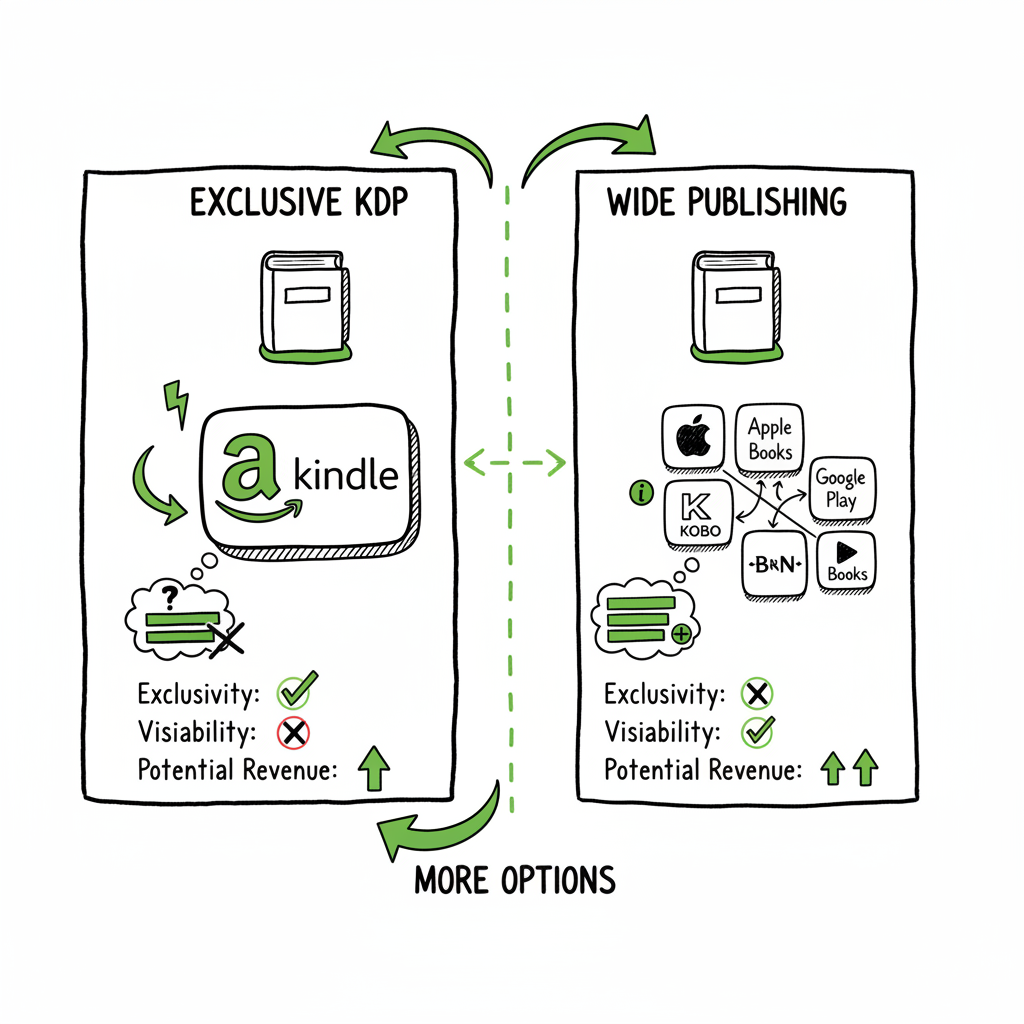
- KDP Select (exclusive KDP) trades broad reach for Amazon/KU advantages: faster visibility, page‑read royalties, and promo tools but requires 90‑day ebook exclusivity.
- Going wide spreads risk and revenue across Apple, Kobo, Barnes & Noble, Google Play, libraries, and international markets—but it needs more marketing systems and operational work.
- Many authors use hybrid strategies: launch or test in KDP Select, then move titles wide, or split series between exclusive and wide to balance short‑term traction and long‑term resilience.
- Operational friction is the real barrier to going wide at scale. Tools that handle formatting, uploads, and metadata make wide distribution practical and save hundreds of hours.
- If you want an operational workflow for broad distribution, see Publish Wide Self Publishing Workflow to understand the steps and scale considerations.
Table of Contents
- How the trade-offs work
- When KDP Select makes sense
- When going wide makes sense
- Putting strategy into practice: workflows and tools
- FAQ
- Final thoughts
- Sources
How the trade-offs work
Authors face a simple business choice: accept Amazon’s ebook exclusivity rules in exchange for Kindle Unlimited benefits, or list everywhere and accept more complexity for more control. The decision—publish wide vs exclusive KDP—looks binary on a checklist but in practice has layers that matter to your genre, catalog, and systems.
At the center are three variables: visibility, revenue source, and operational cost. KDP Select boosts visibility within Amazon. If readers rent your book in Kindle Unlimited, you earn page‑read royalties from a shared KU fund. Amazon’s promo tools—Countdown Deals, Free Days—are only for exclusives and can push rank quickly. That often translates into faster initial sales or reads.
Going wide shifts the balance. You give up KU access and the Amazon‑only promos, but you open Apple Books, Kobo, B&N, Google Play, and library channels. Those outlets may not reward page reads, but they offer direct sales, international markets, and library income. Over time, wide distribution reduces dependence on a single platform’s changing policies.
Genre and catalog size change the math. Page‑intensive binge genres—romance, serial thriller, some fantasy—can earn strongly in KU. Nonfiction, niche literary fiction, and many children’s books often sell better outright and benefit from libraries and international channels. If you’re unsure where your readers live, a short exclusive test in KDP Select can give immediate data; a later wide rollout will require updating files and metadata thoughtfully.
Operationally, going wide is the heavier lift. Each retailer has different file formatting quirks, cover image requirements, pricing fields, and metadata fields. If you plan to scale—multiple books per year or a large backlist—manual uploads become a recurring time sink. That’s where tools matter. A reliable multi‑platform uploader reduces formatting errors, supports CSV batch uploads, and removes the repetitive parts of the job so you can focus on marketing and writing.
When KDP Select makes sense
KDP Select is designed to reward authors who anchor their ebook on Amazon for at least 90‑day enrollment periods. The program’s advantages are straightforward and predictable, which makes it attractive for certain business models.
Fast traction and algorithmic lift
If you need quick visibility and you expect most buyers to be on Amazon, KDP Select gives you promo levers that can accelerate rank. Free Days and Countdown Deals, when used with reader lists and AMS or BookBub traffic, can tilt Amazon’s algorithm and reach new readers faster than organic wide launches.
Page‑read revenue
KU payments are per page read. If your books are long, and readers binge across multiple titles in a series, KU can produce reliable monthly income that scales with catalog size. Authors who write serial fiction frequently find KU particularly lucrative.
Simplicity at launch
For a single author with limited time, exclusive KDP is operationally simpler. You prepare one ebook file, upload to KDP, and use Amazon’s tooling. That simplicity lowers the chance of accidental policy missteps and keeps you focused on launch mechanics.
Controlled experiments
KDP Select is a useful testing ground. Many authors launch the first book in a new series exclusively to build a reader base quickly, then use that base to drive wider series sales later. The program’s 90‑day cycles let you iterate without committing forever.
When it’s less appropriate
KDP Select isn’t a universal win. If your audience is global and you expect decent sales outside Amazon, exclusivity limits reach. If you sell significantly on Apple Books, Kobo, or rely on library circulation, the long‑term income picture often favors wide. Also, KU payouts are variable and influenced by a shared fund and algorithm changes; that volatility sits behind the program’s upside.
When going wide makes sense
Going wide is not an artistic choice so much as a business decision about diversification and control. Wide distribution suits authors who think in catalogs and channels rather than single‑book launches.
Income diversification and international reach
Wide puts your book where readers already live: Apple Books is strong on iOS, Kobo has international strength (Canada, parts of Europe), Barnes & Noble reaches US shoppers who prefer Nook, and Google Play surfaces books to Android users in multiple markets. Libraries—via Ingram or aggregators—add another predictable revenue stream. These outlets reduce dependence on Amazon’s KU fund and policies.
Control over pricing and promos
Wide authors can run retailer‑specific promotions, negotiate price changes in markets, and use platform promotions that fit their long‑term strategy. Pricing control across territories matters for series pricing and bundles.
Long‑tail discoverability
Many authors find that wide distribution supports a steadier long tail of sales. A title that places in multiple catalogues has more chances to be discovered through different algorithms, reader discovery features, and paid promotional opportunities (e.g., BookBub, retailer‑specific promos). Over years, the accumulated sales from multiple retailers often outpace a single-channel strategy for the right kinds of books.
When it’s operationally heavier
Going wide requires handling files, ISBNs, metadata formats, and occasionally different interior layouts (fixed layout vs reflowable for certain formats). You must coordinate releases across platforms, manage pricing parity where appropriate, and monitor each retailer’s reporting. That operational cost is what keeps many single‑title authors on Amazon‑only paths.
Putting strategy into practice: workflows and tools
Strategy without a repeatable workflow is noisy and exhausting. If you plan to publish more than a handful of books, focus on systems: file templates, metadata standards, and a chain of actions that you can run from a CSV or dashboard.
Start with a decision tree
- Launch goal: immediate Amazon traction vs multi‑market reach.
- Genre fit: KU-friendly? Series-heavy?
- Catalog plan: single title, multiple titles per year, or large backlist?
- Marketing capacity: can you run BookBub/ads for multiple retailers?
These answers determine whether you choose exclusive KDP, go wide immediately, or adopt a hybrid plan.
Hybrid and phased strategies
A common operational pattern: enroll new titles in KDP Select for one or two 90‑day periods to harvest early KU visibility, then move them wide once initial momentum slows. Another approach keeps frontlist titles in KDP Select while backlist items remain wide. Both methods require disciplined file management and careful timing around KDP’s re‑enrollment and delisting processes.
Scale requires automation and standardization
If you want to publish a series a year or maintain a backlist across multiple stores, you’ll feel the operational burden. That’s where a service that handles unified multi‑platform publishing becomes an obvious upgrade. At scale, the value isn’t just saving time; it’s reducing errors (wrong metadata, bad covers, incorrect file types), preventing accidental exclusivity breaches, and enabling CSV batch uploads for dozens of titles.
Practical tool checklist
– Single source of truth: keep one metadata CSV for title, series, description, keywords, price, territories, and rights. That file should drive uploads.
– Validated files: use an EPUB validator or a converter that ensures files meet Apple, Kobo, and Google Play expectations. If you need a quick conversion path, an EPUB converter can save hours of debugging.
– Cover and interior assets: generate retailer‑ready covers and interior files in standard sizes; a reliable Book cover generator helps maintain consistent branding at scale.
– Batch uploads and platform intelligence: a system that maps your CSV to each retailer’s API, applies platform‑specific intelligence (image size, metadata field mapping), and performs uploads reduces manual clicks and errors.
– Reporting and reconciliation: centralize royalty and sales reporting so you can compare performance across platforms without logging into five different dashboards.
Operational examples
– A romance author launches Book 1 exclusive to build a KU reader base. After two enrollments, they move Book 1 and Book 2 wide together, updating metadata and submitting to Apple Books, Kobo, and library channels via an aggregator. The transition is handled by a tool that regenerates EPUBs and pushes files to each store.
– A nonfiction author decides to go wide from day one to reach academic libraries and Apple Books readers. They use a template for interior and EPUB conversion, create a separate paperback file for Ingram distribution, and schedule promotions around retailer features.
FAQ
FAQ
Q: Do I lose my ISBN if I enroll in KDP Select?
A: KDP Select covers ebook exclusivity only. It doesn’t change your ISBN for print books, but if you use Amazon’s free ISBN for paperbacks, that’s separate from your ebook’s enrollment. Always track which publisher name and ISBN you used for each channel.
Q: Can I move a book out of KDP Select before 90 days?
A: No. KDP Select requires a 90‑day commitment per enrollment. Plan your enrollment windows around launch promotions and any intended wide rollouts.
Q: What genres benefit most from KU?
A: KU performs best for binge‑friendly, page‑heavy genres—romance, serial thrillers, certain urban fantasy and LitRPG titles—because payments are tied to pages read. Nonfiction and kidlit typically perform better on sales channels outside KU.
Q: How do I avoid accidental exclusivity breaches when going wide?
A: Use a controlled workflow: track enrollment dates, keep a single metadata master file, and use a tool that prevents accidental uploads to non‑Amazon stores while enrollment is active. Also validate your files and metadata before each upload.
Q: Do I need separate covers for KDP and wide?
A: Not always, but retailers have different image size and spine requirements. A single design can work across stores if exported correctly; using a cover generator that produces retailer‑ready assets cuts the chance of errors.
Q: How do libraries fit into wide distribution?
A: Libraries often access books through aggregators or Ingram. Going wide and making sure your book is available for library distribution opens another revenue channel that KDP Select does not cover.
Final thoughts
The publish wide vs exclusive KDP choice is both strategic and operational. Strategy tells you where the readers are and what revenue streams to prioritize. Operations determine whether you can execute that strategy reliably and at scale. For single titles or authors focused on quick, Amazon‑first growth, KDP Select is a sensible path. For authors building catalogs, seeking international reach, or reducing platform risk, wide distribution pays off—if you can handle the files, metadata, and uploads.
If operational friction is the reason you hesitate to go wide, remove the friction. Use validated file workflows, a single metadata source of truth, and a multi‑platform publisher tool to handle the repetitive parts. Integrate cover generation and EPUB conversion where possible so launches are cleaner and less error‑prone.
Final step: If you want to test a workflow for scaling distribution—whether you plan to stay exclusive for launch or move wide after enrollment—use the right toolset and standard templates. That lets you run experiments without burning time on manual uploads and fixes.
Visit BookUploadPro.com to try the free trial.
Sources
- Wide vs Kindle Unlimited: Pros, Cons, Strategy
- Wide Versus Exclusive: What Does It Mean?
- Should You Publish Your Book Wide or Go Exclusive with Amazon?
- KDP vs Wide Publishing 2025: Pros and Cons
- Wide vs. Exclusive: A Tale of Two Marketing Systems
Publish Wide vs Exclusive KDP: A Practical Guide for Authors Estimated reading time: 9 minutes Key takeaways KDP Select (exclusive KDP) trades broad reach for Amazon/KU advantages: faster visibility, page‑read royalties, and promo tools but requires 90‑day ebook exclusivity. Going wide spreads risk and revenue across Apple, Kobo, Barnes & Noble, Google Play, libraries, and…