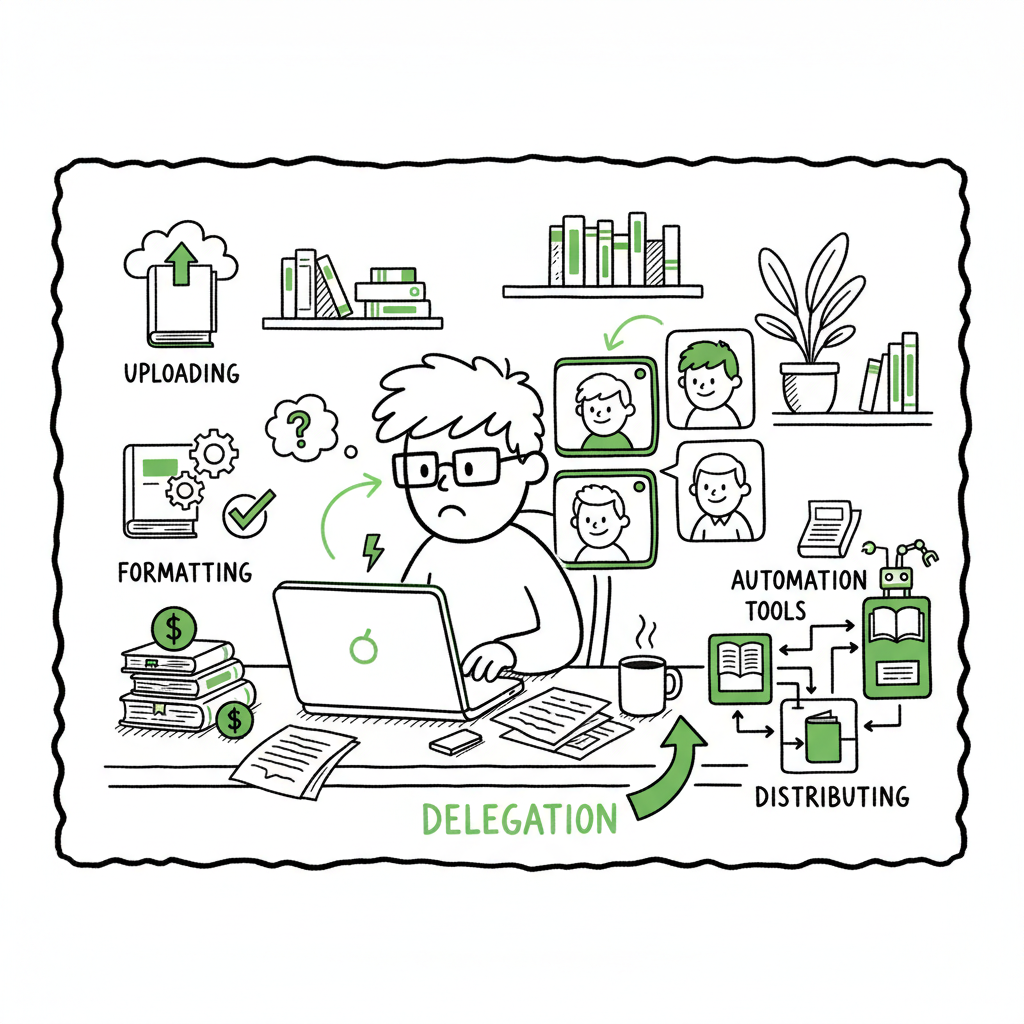
Outsourcing Self Publishing Without Losing Control
Outsourcing Self Publishing: How to Delegate Without Losing Control
Estimated reading time: 9 minutes
Key takeaways
- Outsourcing self publishing can save time and reduce errors when you pick the right tasks and vetted providers.
- Focus outsourcing on technical, repeatable work: formatting, uploads, distribution, proofing, and metadata.
- Use automation tools for multi‑platform publishing to scale safely—BookUploadPro automates batch uploads, reduces errors, and saves time.
Table of Contents
- Overview: Outsourcing Self Publishing
- When to outsource
- What to outsource and how to vet providers
- Frequently asked questions
Overview: Outsourcing Self Publishing
Outsourcing self publishing means hiring people or services to handle parts of the publishing workflow you don’t want to do yourself. Authors outsource to buy time, avoid repetitive tasks, or fill skills gaps like ebook formatting or retail uploads. Done right, outsourcing lets you focus on writing and marketing. Done wrong, it wastes money and creates headaches.
Most DIY platforms — Amazon KDP, Ingram, Draft2Digital, Kobo, and Apple Books — let you upload for free. The tricky part is scaling: multiple retail platforms, different file requirements, and repeated metadata entry. That’s where automation and batch tools help. BookUploadPro, for example, centralizes uploads across platforms, offers CSV batch uploads, and applies platform-specific intelligence. It’s built for authors publishing at scale, cutting repetitive work by roughly 90% while lowering upload errors. Automate the upload. Own the distribution.
This guide explains when outsourcing makes sense, which tasks to outsource, how to vet providers, and how to combine human services with automation so you stay in control.
When to outsource
Outsourcing is worth it when the time or cost to do work yourself is higher than paying someone else — or when the task requires skills you don’t have. Common signals that it’s time:
- You’re publishing several titles a year. Repeating the same upload steps across platforms becomes a time sink.
- Technical tasks slow you down. If formatting, cover prep, or cataloging takes you more time than writing, outsource those tasks.
- You need consistent, error-free distribution. Retailers reject incorrect files and metadata; vendors with platform experience reduce rejections.
- You want to expand formats quickly. Moving from ebook to paperback or audiobook adds new technical steps and quality checks.
Avoid outsourcing when the task affects your brand voice or royalties without clear oversight—ghostwriting, nontransparent contracts, or services that require revenue shares without reporting are red flags.
What to outsource and how to vet providers
Which tasks scale well and which don’t? Here are practical choices and vetting tips.
Tasks that scale well
- File preparation and formatting: Converting a manuscript to clean EPUB and print-ready PDF is mechanical but detailed. If you don’t want to learn the quirks of EPUB and KDP print templates, pay a formatter. If you need an automated conversion workflow, consider tools that convert to EPUB reliably and at scale.
- Retail uploads and distribution: Uploading to KDP, Apple Books, Kobo, Draft2Digital, and Ingram requires different metadata and file rules. Outsourcing uploads or using a multi-platform publisher reduces repeated manual entries.
- Proofreading and quality checks: A human read-through for formatting glitches, broken links, or page-number issues is valuable before wide distribution.
- Cover production and technical processing: Creating a print-ready cover with spine and back matter is precise work. A specialist or a generator that outputs production-ready files saves time.
- Metadata and categorization: Picking categories, keywords, and BISAC codes is researchable and repeatable—good for an assistant or specialist.
- Batch operations: CSV-based updates, batch price changes, or bulk territory settings are repetitive and suited to automation or a dedicated operator.
Tasks to keep close
- Creative control: Manuscript edits that affect voice, book description copy, and rights decisions should remain with you.
- Royalties and contracts: Never sign away rights or accept opaque accounting. Keep records and insist on clear reporting.
Vetting providers (practical checks)
- Ask for platform experience and references. Look for recent experience with the exact platforms you use.
- Review file samples. A reputable formatter or cover designer will show print-ready PDFs and EPUB test results.
- Check refund and revision policies. Good vendors offer a clear revision window and a fix policy for work that fails retailer checks.
- Avoid vanity publishers that charge large upfront fees and promise distribution without proof. Public forums contain complaints; research before you pay.
- Use small trial jobs. Start with a single formatting job or a single upload to see if they match specs and deadlines.
- Require reporting. You should get receipts, retailer confirmation screenshots, and final file copies.
Practical workflow combining human help and automation
- Use a formatting specialist or conversion tool to create master files: EPUB for ebook, PDF for print.
- Send master files to an uploader or use a multi-platform tool to push to retailers. Automation reduces manual re-entry and mistakes.
- Keep a CSV inventory of titles, metadata, and assets. This file becomes your single source of truth for batch updates.
- Build quality gates: one proofreading pass, one platform validation pass, then push to stores.
Operational pitfalls and how to avoid them
- Hidden fees: Clarify fees upfront. Platforms like IngramSpark charge for uploads and revisions; factor that into costs.
- Exclusivity traps: Some services ask for exclusivity for higher royalties. Know the terms and duration before agreeing.
- Poor reporting: If you can’t reconcile distribution or royalties, stop using the provider until reports improve.
Automation benefits for multi-platform publishing
- Manual uploads to multiple retailers multiply both errors and time. Automation tools designed for multi-platform publishing handle different file requirements, map metadata fields correctly, and allow CSV batch uploads for hundreds of titles.
- Time savings: Batch uploads and templated metadata cut repetitive work by an order of magnitude.
- Fewer errors: Platform-specific intelligence reduces rejections and wasted proof copies.
- Scalability: You can publish series faster and add formats without duplicated effort.
- Cost control: Automation keeps staff costs predictable and reduces dependency on expensive full-service vendors.
When you combine automation with vetted human services — for example, a formatter plus an automated uploader — you get the best of both worlds: human judgment where it matters and machine speed where it doesn’t.
Practical note on covers, paperbacks, and formats
- For cover work, use a processor that outputs production-ready files and handles spine calculations for different page counts.
- If you need an automated cover workflow, consider a cover generator that can produce print and ebook versions ready for retailer specs.
- Paperback creation requires correct trim size, bleed, and cover wrap. Use templates and proof copies.
- If you plan large runs of ebooks, ensure your conversion pipeline produces validated EPUBs and checks for accessibility and image optimization.
Final thoughts
Outsourcing self publishing is not an all-or-nothing choice. Treat it like a production line: keep creative decisions in-house, outsource repeatable technical work, and use automation to stitch everything together. A disciplined mix of vetted service providers and automation tools makes multi-platform distribution practical, reduces risk, and keeps your publishing calendar predictable.
Frequently asked questions
Q: Will outsourcing cost more than doing it myself?
Not necessarily. Outsourcing removes time cost and learning curves. If your time is better spent writing, outsourcing can increase your effective output without raising overall costs.
Q: How do I protect royalties and rights when outsourcing?
Use written agreements that specify deliverables, revisions, and reporting. Never sign exclusivity without understanding duration and revenue impact.
Q: Can automation replace human formatters?
Automation handles many repeatable tasks, but human oversight is still important for quality checks and complex layouts.
Q: What tasks should I outsource first?
Start with file preparation/formatting, then batch uploads, followed by metadata work and quality checks as you scale.
Q: How do I vet providers?
Check platform experience, request samples, review revision policies, run small trial jobs, and ensure clear reporting.
Q: How can I ensure consistency across retailers?
Use a multi-platform solution that maps metadata to retailer specs and maintain a master CSV for updates.
Sources
- The Most Popular Self-Publishing Platforms: Pros & Cons
- SELF-PUBLISHING COMPANIES TO AVOID
- Self-Publishing Services Reviews and Ratings
- Amazon Publishing Pros – KDP Community
Outsourcing Self Publishing: How to Delegate Without Losing Control Estimated reading time: 9 minutes Key takeaways Outsourcing self publishing can save time and reduce errors when you pick the right tasks and vetted providers. Focus outsourcing on technical, repeatable work: formatting, uploads, distribution, proofing, and metadata. Use automation tools for multi‑platform publishing to scale safely—BookUploadPro…