Niche Stacking for Books Practical Guide for Self-Publishers
Niche Stacking for Books: A Practical Guide for Self-Publishers
Estimated reading time: 8 minutes
Key takeaways
- Niche stacking for books means combining specific audience angles so each title reaches several small but engaged groups.
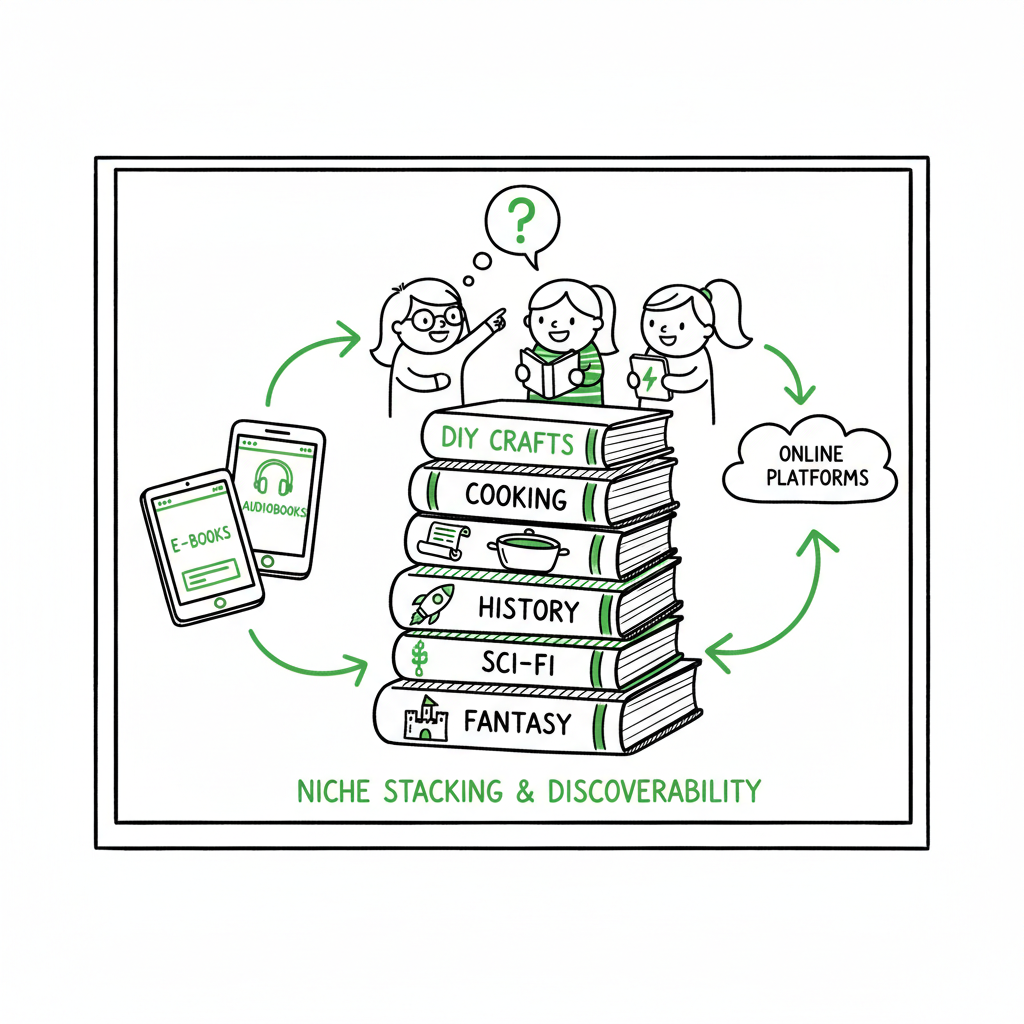
- Apply niche stacking across formats and platforms to multiply discoverability while keeping production efficient.
- Automation and batch workflows let you scale niche-stacked publishing without multiplying errors or upload time.
Table of Contents
- What is niche stacking for books?
- Why niche stacking helps self-publishers
- How to implement niche stacking across formats and platforms
- Common mistakes and quick checklist
- FAQ
- Final thoughts
- Next steps
- Sources
What is niche stacking for books?
Niche stacking for books is a publishing approach: instead of aiming one book at one broad market, you deliberately layer two or three narrow audience angles so the same title fits multiple small searches and reader habits. Think of a cookbook that’s not just “plant-based” but “plant-based for busy teachers.” Each extra angle is a niche layer that increases the ways readers can find and buy the book.
This idea is practical, not theoretical. If you’re still exploring which topics perform best, start with Book Niches That Sell to validate demand and find complementary angles. Niche stacking is not about watering down focus; it’s about targeting intersecting interests where competition is lower and reader intent is clearer.
Why niche stacking helps self-publishers
Readers search in very specific ways. A reader may look for “journals for anxious teens,” “journaling prompts for homeschooling moms,” or “gratitude journal for nurses.” When you stack niches, one book can be described and marketed so it appears in all three search paths.
- Better discoverability: Multiple small audiences add up to meaningful sales without needing a bestseller.
- Lower competition per search: Niche phrases often have fewer competing titles than broad categories.
- Efficient marketing: A single title can support multiple targeted ads or newsletter segments.
- Evergreen positioning: Books that solve specific, recurring problems keep selling over time.
Niche stacking also changes how you plan product families. When you see one niche working, you can create follow-ups that shift one layer (same audience + new use case) and get compounding returns.
How to implement niche stacking across formats and platforms
Start with the reader, not the platform. Ask: who is this book for, exactly? What words do they use? Then work through these practical steps.
-
1. Research and pick two to three complementary niches
- Combine role, problem, and format. Example: “busy nurses” (role) + “meal planning” (problem) + “cheat-sheet” (format).
- Use keyword tools and category browsing to confirm each niche has searchers and a manageable number of competing books.
-
2. Optimize metadata for multiple angles
- Title and subtitle: keep the main title simple; use the subtitle to layer in niches. Example: “Simple Weeknight Meals — Meal Plans for Busy Nurses and Shift Workers.”
- Description and backend keywords: write descriptions that naturally contain each niche phrase and use backend keyword fields per platform.
-
3. Design covers and interiors with adaptive cues
- Keep a core cover that reads well at thumbnail size and add small visual or text cues to hint at stacked niches (e.g., a small badge: “For Shift Workers”).
- If you create multiple editions (e.g., planner + paperback + ebook), keep brand consistency so readers recognize the family.
- If you need a fast way to make covers, use an automated cover generator designed for batch work — a reliable tool speeds iterations and keeps visual identity consistent across variants.
-
4. Format and distribute for every reader preference
- Publish both ebook and paperback; consider audio when the niche supports it.
- Convert the manuscript to EPUB for Apple, Kobo, and other retailers. A robust EPUB converter helps avoid formatting problems that block distribution.
-
5. Scale uploads without scaling headaches
- When you publish niche-stacked titles at scale, the manual work multiplies. This is where batch tools matter:
- CSV batch uploads let you prepare dozens of titles with consistent metadata.
- Platform-specific intelligence fills category choices and royalty settings correctly.
- Automated uploads reduce human errors that cause delisted titles or missed releases.
- BookUploadPro automates repetitive uploads across Amazon KDP, Kobo, Apple Books, Draft2Digital, and Ingram. For active self-publishers, automation delivers roughly 90% time savings on uploads, reduces errors, and makes wide distribution practical. Automate the upload. Own the distribution.
How to test and iterate
– Start with one niche stack and run small paid tests or targeted newsletter campaigns.
– Track which angle drives the most traffic and lean into it for new variants.
– Repurpose backlist titles by updating subtitles, descriptions, and categories to target new niche layers.
Common mistakes and quick checklist
Mistakes to avoid:
- Overstacking: more than three niches makes messaging fuzzy.
- Ignoring format preference: the same niche may prefer print or ebook—don’t publish only one format.
- Manual-only scaling: spreadsheets and copy-paste invite errors as you grow.
Quick checklist before publish
- Title/subtitle tested for clarity across niches
- Description includes each niche naturally
- Thumbnail tested at small size
- Interior files formatted for paperback and ebook; convert to EPUB for retailer compatibility
- Cover optimized and exported for each store
- Metadata prepared in a CSV for batch upload to save time
If you create paperbacks or ebooks frequently, look for tools that speed book creation and file preparation so you can keep focus on niche strategy rather than file wrangling.
FAQ
Q: Is niche stacking useful for fiction?
A: Yes. Fiction stacks work by combining subgenre + trope + setting (e.g., “cozy mystery + librarian sleuth + small coastal town”). Readers search for combinations; clear stacking helps match expectations.
Q: How many niches should I stack per book?
A: Two to three is practical. One is fine if it’s very focused; more than three often dilutes the pitch.
Q: Do I need separate covers for each niche angle?
A: Not usually. Use a consistent core cover and tweak badges or edition text when you create a clear variant (like a workbook vs. a handbook).
Q: Will changing metadata frequently hurt ranking?
A: Frequent, random changes can confuse readers and algorithms. Test changes methodically and track results before rolling out updates widely.
Q: What role does wide distribution play in niche stacking?
A: Wide distribution matters because different platforms have different readers. Some niche searches happen on Kobo or Apple Books rather than Amazon. Distributing broadly increases the chance each niche layer finds its audience.
Final thoughts
Niche stacking for books is a deliberate, operational strategy: pick complementary audience angles, optimize metadata and assets for each layer, and use tools that let you scale without multiplying manual work. For authors publishing seriously, the next obvious step is automating uploads and distribution so you spend more time writing and marketing and less time repeating the same tasks.
Next steps
Visit BookUploadPro.com and try the free trial to see how CSV batch uploads, platform-specific intelligence, and cross-store automation make niche stacking practical at scale.
Sources
- http://worldsinink.blogspot.com/2011/10/vertical-versus-horizontal-stacking.html
- https://www.incompassinged.com/post/fostering-life-long-reading-habits-the-power-of-a-reading-stack
- https://www.hunker.com/1673330/design-home-library-how-display-books/
- https://en.wikipedia.org/wiki/Library_stack
- https://www.entrepreneur.com/growing-a-business/5-tips-for-helping-your-book-stand-out-in-an-overcrowded/464949
Niche Stacking for Books: A Practical Guide for Self-Publishers Estimated reading time: 8 minutes Key takeaways Niche stacking for books means combining specific audience angles so each title reaches several small but engaged groups. Apply niche stacking across formats and platforms to multiply discoverability while keeping production efficient. Automation and batch workflows let you scale…