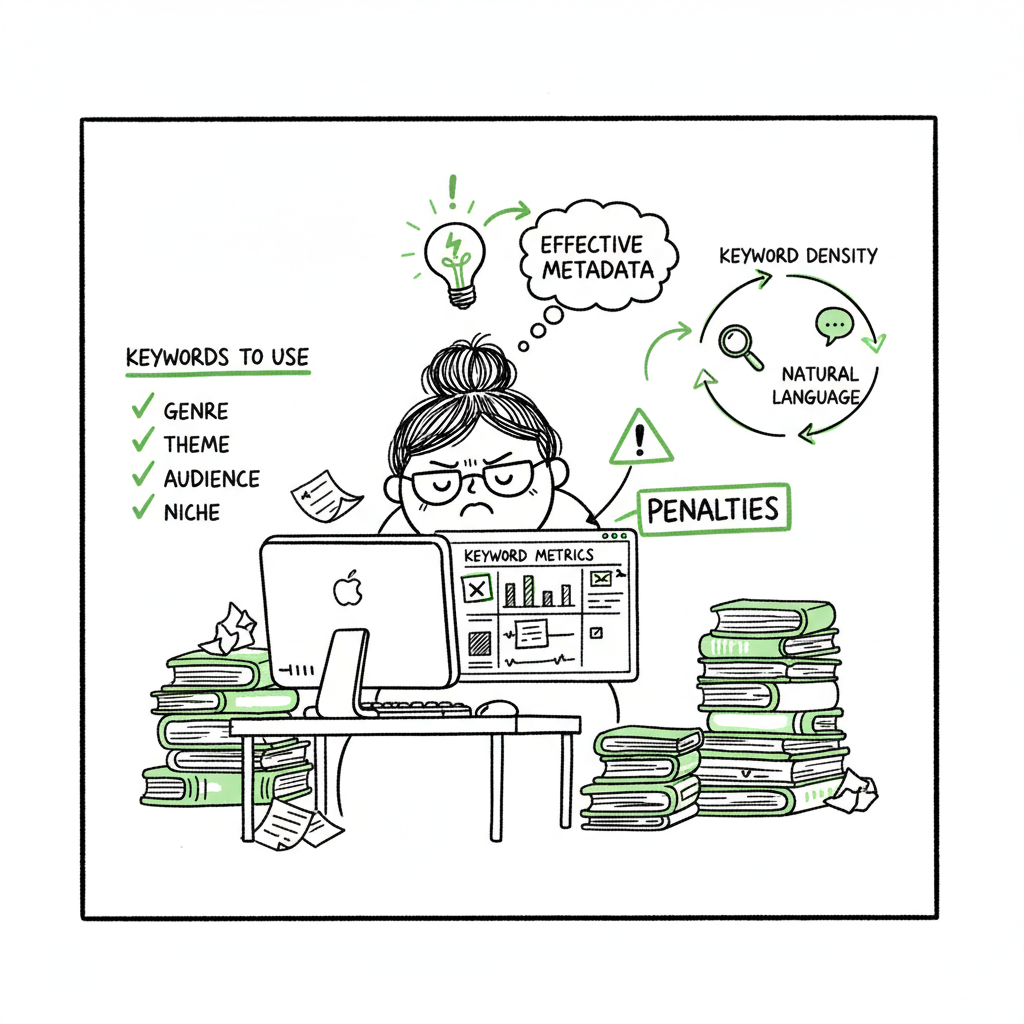
Keyword Stuffing Penalties for Self-Publishing Authors
Keyword Stuffing Penalties: What Self-Publishing Authors Need to Know
Estimated reading time: 8 minutes
Key takeaways
- Keyword stuffing penalties reduce visibility and can remove listings; avoid repetitive, irrelevant keywords.
- Focus on useful metadata and natural language in titles, descriptions, and backend fields.
- Use automation to keep metadata consistent across platforms and prevent accidental stuffing when scaling.
- Preparing clean EPUBs, covers, and book files reduces manual errors that trigger flags.
- Treat platform rules as part of quality control, not just SEO tactics.
Table of Contents
- What are keyword stuffing penalties?
- How search engines and marketplaces detect stuffing
- Avoiding penalties while keeping discoverability
- Practical checklist for scaled publishing processes
- Final thoughts
- FAQ
- Sources
What are keyword stuffing penalties?
Search engines and marketplaces penalize pages and listings that repeat keywords unnaturally. For authors, “keyword stuffing penalties” usually shows up as lower ranking in search results, suppressed listings on stores, or manual takedowns for repeated or irrelevant keyword use. On Amazon and other retailer sites, penalties are triggered when metadata—titles, subtitles, descriptions, or backend keyword fields—looks like it’s trying to game relevancy rather than helping a reader.
If you publish multiple formats or editions, the risk grows. Adding long lists of synonyms, genres, or repeated brand names across formats can look like manipulation. Early checks and sensible metadata practices protect both visibility and sales.
For deeper guidance on best practices, see Amazon Book SEO for Authors.
How search engines and marketplaces detect stuffing
Platforms use a mix of automated signals and human review. The automated side looks for patterns that suggest manipulation:
- Repeated exact phrases in title, subtitle, and metadata
- Lists of keywords in description or backend fields instead of natural sentences
- Excessive use of categories, tags, or author name repetition
- Mismatched content and metadata (description promises content not delivered)
Marketplaces also compare your listing to others. If your metadata is an outlier—very long titled filled with repeated phrases—algorithms flag it. Human reviewers then follow platform policy and may impose keyword stuffing penalties.
Practical implications for authors:
- Amazon evaluates both on-page text and backend keyword fields.
- Storefronts use signals from file metadata, so poorly formatted EPUBs or uploads can carry problem fields across platforms.
If you want platform-specific guidance on structure and allowed fields, our Amazon Book SEO for Authors guide covers practical examples and safe patterns for titles, descriptions, and backend keywords.
Avoiding penalties while keeping discoverability
The goal is to be discoverable without triggering penalties. That requires thinking like a reader and applying checks that scale.
Do these instead of stuffing:
- Use one clear, reader-focused title and one subtitle that adds value.
- Write a description that reads naturally and includes target phrases once or twice in context.
- Use backend keyword fields for related variants—don’t paste long keyword lists.
- Keep category and BISAC choices accurate rather than generous.
- Avoid repeating your author name, series name, or publisher across every metadata slot.
Cross-platform considerations
When you publish to multiple stores or create both ebook and paperback editions, reuse of metadata can create accidental duplication. Prepare platform-specific metadata templates and let automation handle field mapping. That reduces human error and keeps listings compliant across Amazon KDP, Kobo, Apple Books, Draft2Digital, and Ingram.
If you’re converting manuscripts to store-ready files, consider using a reliable EPUB converter to ensure metadata lives in the correct fields and doesn’t duplicate into descriptions or backend tags. A clean conversion process prevents hidden metadata from carrying unwanted keywords into uploads. EPUB converter.
For cover work and image processing, a reliable cover generator can automate sizing and metadata embedding while preventing accidental keyword fields in image files. If you’re producing ebooks and paperbacks, a solid book creation workflow will save time and reduce errors during bulk uploads.
Practical checklist for scaled publishing processes
When you publish at scale, process beats ad hoc fixes. Build a simple workflow and checkpoints that prevent keyword stuffing penalties before you upload.
- Metadata template per platform
- One source of truth for title, subtitle, description, keywords, categories.
- Map fields to each platform with rules (max length, banned phrases, allowed characters).
- Natural descriptions
- Keep descriptions in readable paragraphs.
- Include primary search terms organically—once in the opening and once more if needed.
- Backend keyword discipline
- Use all available keyword slots, but list only distinct phrases.
- Avoid punctuation-separated word lists or using commas to jam many terms into one slot.
- File preparation and validation
- Convert manuscripts with a tested EPUB converter to ensure metadata and structure are clean.
- Generate separate files for ebook and print; don’t reuse one file without checking embedded metadata.
- Produce covers that match store specs; avoid stuffing titles or keywords into image alt text or embedded metadata.
- Automate uploads and checks
- Use CSV batch uploads and platform-specific intelligence to detect anomalies before submission.
- Automation captures common errors: titles too long, keyword duplication, or mismatched categories.
- Automation also saves time—about 90% on repetitive upload tasks—and reduces the manual mistakes that trigger penalties.
- Monitor and iterate
- Track impressions and conversion. If visibility drops after metadata changes, audit the title and backend fields first.
- Keep records of previous successful metadata so you can restore workable configurations quickly.
Final thoughts
Keyword stuffing penalties are avoidable with clear, reader-focused metadata and reliable processes. Think less about cramming as many phrases as possible and more about accurate, helpful listings that searchers and store algorithms can trust. Use automation to keep metadata consistent across formats and stores, validate files before upload, and reduce time spent on routine tasks.
FAQ
Q: Can a long title trigger keyword stuffing penalties?
A: Yes. Long titles that cram keywords or repeat phrases can be flagged. Use concise, meaningful titles and reserve extra detail for the subtitle or description where allowed.
Q: What happens if my book is penalized?
A: Penalties vary: reduced visibility, suppressed listings, or requests to change metadata. Fix the offending fields, resubmit where allowed, and monitor the listing for recovery.
Q: Should I change metadata to match trending searches?
A: Use trends to inform natural wording, not to force repeated keywords. If you update metadata, keep changes reader-focused and within platform guidelines.
Q: How often should I review metadata across platforms?
A: Review whenever you publish a new edition, launch a new format, or make a marketing push. Regular audits when scaling are best to prevent accidental stacking of keywords.
Q: Is there a risk in reusing metadata across formats?
A: Reusing metadata can be efficient, but ensure each format provides unique value and aligns with platform guidelines to minimize penalties.
Sources
- https://developers.google.com/search/docs/essentials/spam-policies#keyword-stuffing
- https://support.google.com/webmasters/answer/66351?hl=en
Keyword Stuffing Penalties: What Self-Publishing Authors Need to Know Estimated reading time: 8 minutes Key takeaways Keyword stuffing penalties reduce visibility and can remove listings; avoid repetitive, irrelevant keywords. Focus on useful metadata and natural language in titles, descriptions, and backend fields. Use automation to keep metadata consistent across platforms and prevent accidental stuffing when…