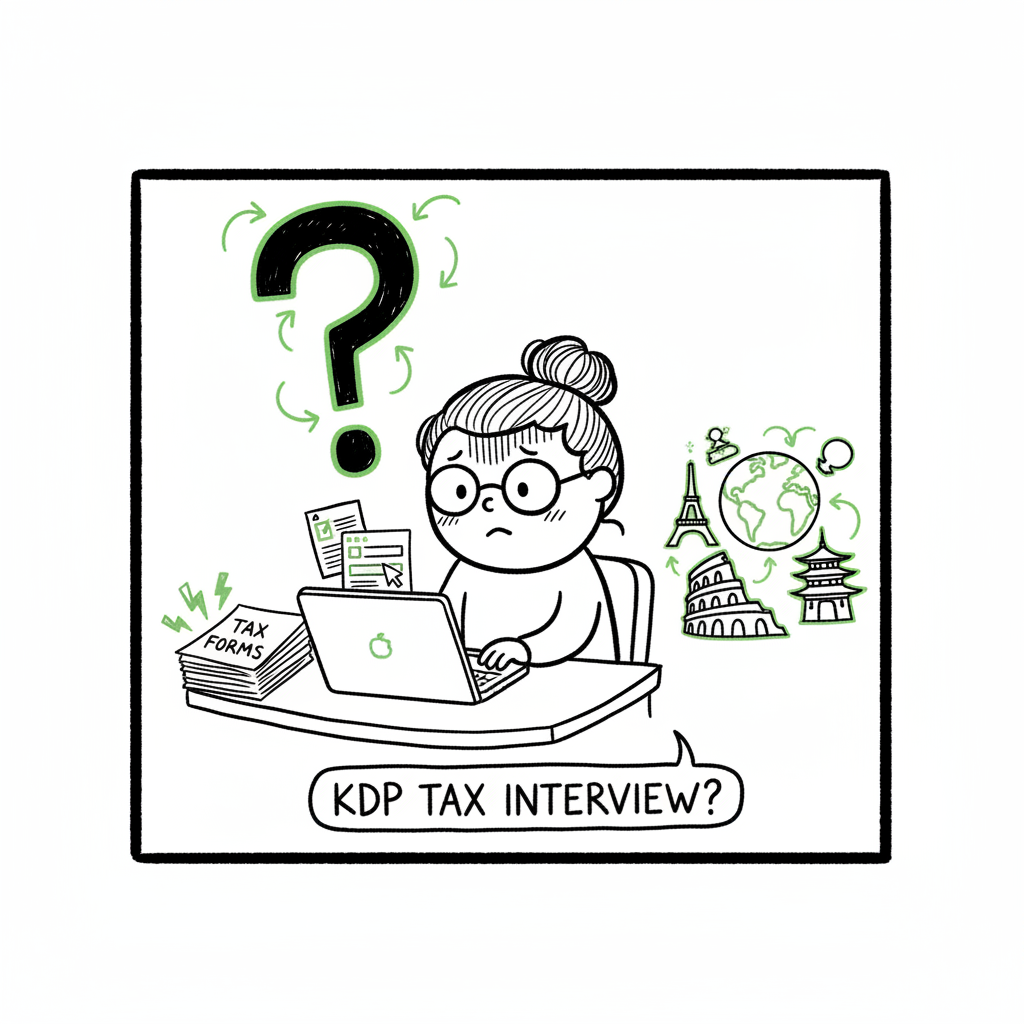
KDP tax interview confusion explained for indie authors
kdp tax interview confusion: a practical guide for self-publishing authors
Estimated reading time: 14 minutes
Key takeaways
- kdp tax interview confusion is common, especially for non-U.S. authors; understanding required fields and TIN rules prevents unexpected 30% withholding.
- Walk through the interview step by step, check common form errors, and update records if your situation changes.
- When you publish multiple books, automation tools that handle platform nuances and CSV batch uploads make tax setup and distribution manageable.
Table of Contents
- What the KDP tax interview asks — and why it matters
- kdp tax interview confusion: common errors and practical fixes
- Step-by-step guide to complete the KDP tax interview
- Reduce repeated tax setup when you publish at scale
- FAQ
- Sources
What the KDP tax interview asks — and why it matters
Amazon requires every KDP account to complete a tax interview before royalties are paid. That requirement is the root of much kdp tax interview confusion: authors see questions tied to U.S. tax rules and don’t always know which ID to enter, how withholding works, or whether a treaty applies.
The tax interview collects basic classification data: are you a U.S. person or not; are you publishing as an individual or a business; what country you live in; and what tax ID you can provide. For U.S. citizens or residents the form will generally generate a W-9 and feed Amazon’s 1099 reporting. For non-U.S. persons the system uses W-8 forms and can trigger 1042-S reporting. If you skip the interview or enter incomplete data, Amazon may apply a default 30% withholding on U.S.-sourced royalty payments until the record is corrected.
If you plan to scale beyond a single book, the tax interview is one of several administrative steps you’ll repeat across platforms. For a straightforward walkthrough of publishing on Amazon at scale, see Self Publish Book Amazon KDP — it explains the publishing flow and where tax setup fits into a larger distribution plan.
kdp tax interview confusion: common errors and practical fixes
Most of the confusion includes predictable mistakes. Knowing them reduces surprises.
Missing or incorrect TIN
– Issue: Non-U.S. authors see questions about a U.S. TIN and assume they must have an ITIN immediately. They worry about applying for W-7 and wait.
– Reality: You can complete the KDP interview without a U.S. TIN in many cases. Use your national taxpayer ID when the interview asks for a foreign TIN. If you later obtain an ITIN, update the tax interview. Until validated, Amazon may apply backup withholding depending on your selections.
– Fix: Enter the national ID in the foreign TIN field, select the correct treaty status if applicable, and plan ITIN applications if you need one for other U.S. tax reasons.
Choosing between individual and business
– Issue: Authors aren’t sure whether to classify as an individual, sole proprietor, or company.
– Reality: For many indie authors, “individual” is correct. If you have a registered company and you receive royalties in that business’s name, choose “business.” The classification affects what name appears on forms and which TIN you provide.
– Fix: Match what’s on your bank and tax registration documents. If payouts go to a business bank account tied to an EIN, register the account as a business in KDP.
Misunderstanding treaty benefits
– Issue: Authors from treaty countries assume zero withholding always applies or that it’s automatic.
– Reality: Treaty benefits need correct treaty claim entries and, in some cases, proof tied to country-specific rules. Amazon’s interview asks if you’re claiming treaty benefits; you must select the correct country and provide a foreign TIN in most cases.
– Fix: Read the treaty line items relevant to royalties for your country (or get a quick tax advisor check) and enter your national ID accurately. If Amazon validates the claim, withholding is reduced or eliminated according to the treaty terms.
Address vs. residency mismatches
– Issue: Authors enter a U.S. address, travel frequently, or use mail forwarding and then receive U.S. taxes incorrectly applied.
– Reality: The interview asks about tax residency, not postal addresses. Residency determines tax treatment, so using a mail forwarding address can confuse the system.
– Fix: Use your legal tax residence. If you live abroad but maintain a U.S. mailing address, keep the residency field set to the country where you are tax-resident.
Document download and review
– Tip: After finishing the interview, download the confirmation PDF and keep it with your records. That PDF often shows exactly which form (W-9 or W-8BEN) Amazon has generated and which fields were captured.
Step-by-step guide to complete the KDP tax interview
This section gives a practical, low-friction approach. Move through it slowly; the interview saves as you go.
1) Gather documents first
– Have your passport or national ID, tax identification number (national TIN, EIN, or SSN/ITIN), and bank details ready. If you represent a business, have business registration and EIN information.
2) Start the interview with the right mindset
– Open the KDP tax interview with the intention to confirm tax residency and classification. Don’t try to “trick” the system for better withholding rates; correct data avoids later payment blocks.
3) Answer the residency question accurately
– If you live and pay tax in Country A, select Country A. This determines treaty status options and what counts as a foreign TIN.
4) Provide the correct tax ID
– If you are a U.S. person, provide your SSN/ITIN or EIN (for businesses).
– If you’re a non-U.S. person and your country has a treaty, provide your national TIN in the foreign TIN field. If you don’t have a foreign TIN, leave the field blank only if that’s allowed, but expect possible withholding until you provide proof.
5) Claim treaty benefits only when eligible
– If the withholding rate under your country’s treaty is lower than 30%, select the treaty option and supply the required country and TIN. Amazon will validate the claim during processing.
6) Confirm the payee name matches tax documents
– The legal name entered must match your tax ID records. If you publish under a pen name, use your legal name in the tax interview; pen names belong on the book metadata.
7) Review and download the generated form
– After completion you’ll see which form Amazon will use. Download the PDF, store it with your records, and check that names, TINs, and residency look right.
8) Update promptly if things change
– If you later receive an ITIN, register it on Amazon. If your residency changes, complete the interview again. Changes are not retroactive for past payments, but they avoid future withholding.
Common troubleshooting steps (fast)
– If Amazon shows 30% withholding after you complete the interview: confirm whether you left foreign TIN blank or mistakenly declared U.S. residency. Update the interview with accurate IDs.
– If a treaty claim is rejected: verify that you entered your national TIN exactly as shown on your tax documents and check whether your country’s treaty applies specifically to royalties.
– If you need to apply for an ITIN: start the W-7 process early; it can take weeks. In the meantime, use national TIN fields to prevent withholding if possible.
Practical examples
– A U.K. author entering their National Insurance number into the foreign TIN field may be mistakenly rejected if formatting varies. Enter digits only, without spaces or punctuation, to match government records.
– A sole proprietor in Canada who used their business name instead of legal given name saw reporting mismatches. Always use the legal individual or business name that matches the tax ID.
Reduce repeated tax setup when you publish at scale
Once you cross from occasional publishing to consistent output, repeating the same steps for each new title becomes wasted time. That’s where multi-platform automation matters.
Why scale amplifies tax friction
– Publishing one title means you can afford manual fixes. Publishing dozens of titles across Amazon, Apple, Kobo, Draft2Digital, and Ingram multiplies administrative steps: metadata, pricing, formats, and the occasional tax interview re-check. Small mistakes scale into larger payment delays and reporting headaches.
How automation helps
– A unified multi-platform publishing approach keeps tax and payout details tied to the account, not individual titles. BookUploadPro automates repetitive uploads across Amazon KDP, Kobo, Apple Books, Draft2Digital, and Ingram, using CSV batch uploads and platform-specific intelligence to cut manual work by about 90%. That reduces human error in metadata and ensures consistent payee information across platforms — making wide distribution practical and less error-prone. Automate the upload. Own the distribution.
Practical automation benefits that matter for tax setup
– Central tax profile control: If you update residency or TIN in one place, the system pushes consistent metadata to each platform where possible, reducing the chance of mismatched payee names.
– Error reduction: Platform-specific rules (like field character limits and expected TIN formats) are applied automatically, catching issues before upload.
– CSV batch uploads: Instead of repeating the same tax selections per title, batch files attach consistent payee details to groups of books.
– Time savings: When you start publishing seriously, the hours saved are obvious — uploading, fixing, or updating dozens of records manually is slow and error-prone.
Related production tasks to keep tidy
– Formatting and file prep: When you convert manuscripts to EPUB or prepare print-ready files, consistent file naming and metadata help avoid confusion later. If you need a fast, reliable way to convert manuscripts, consider using an EPUB converter early in the workflow to produce clean files for Apple Books and Kobo.
Tools that fit into a scaled workflow
– EPUB conversion tool: A dedicated EPUB converter removes manual reflow issues and gives consistent results across ebook stores. EPUB converter.
– Book cover generator: A cover tool that outputs the correct spine width and bleed for paperback saves rework at proof stage. book cover generator.
– Multi-platform publisher: A publisher that handles KDP, Kobo, Apple, Draft2Digital, and Ingram with CSV batch uploads and platform-specific templates lets you publish many books without repeating tax and metadata entry each time. book creation workflow.
If you need a dependable EPUB conversion step in your pipeline, a good EPUB converter helps keep files consistent when distributing broadly. For cover creation, a book cover generator will produce correctly dimensioned covers for ebook and paperback uploads. And when you’re ready to assemble everything, using a unified book creation workflow lets you push one clean package to multiple stores with fewer mistakes.
Final thoughts
kdp tax interview confusion is normal. The interview mixes U.S.-centric tax logic with an international author base, and small mistakes — the wrong TIN format, a mismatched name, or an incorrect residency — trigger withholding or reporting that’s hard to untangle later. The practical approach is simple: gather documents, answer residency and payee questions accurately, claim treaty benefits only when eligible, and download your confirmation.
When publishing at scale, use automation and consistent workflows. A multi-platform publisher that supports CSV batch uploads, platform-specific intelligence, and centralized payee data dramatically reduces repetitive work and prevents avoidable tax and payout errors. For authors who plan to publish multiple titles, embracing automation is an obvious upgrade.
If you want to streamline file prep, convert manuscripts reliably, or create production-ready covers, there are focused tools that fit into a predictable pipeline: an EPUB converter for clean ebook output, a book cover generator for consistent covers, and a central book creation workflow that reduces manual steps. Using these tools together with a multi-platform publishing automation service makes wide distribution practical and affordable.
FAQ
Q: Is the KDP tax interview mandatory?
A: Yes. Amazon requires a completed tax interview before royalty payments are processed. Failure to complete it can lead to default withholding.
Q: I don’t have a U.S. TIN. Can I still publish?
A: Yes. Many non-U.S. authors publish without a U.S. TIN by providing a national taxpayer ID. If your country has a treaty, you may reduce withholding by claiming treaty benefits and supplying your foreign TIN. If you need a U.S. ITIN, apply using the W-7 process and update Amazon when you receive it.
Q: What causes the 30% withholding?
A: 30% withholding is the default for non-U.S. payees who haven’t provided sufficient tax documentation or haven’t claimed treaty benefits. Enter correct residency and TIN information to avoid default withholding.
Q: How often must I update the interview?
A: Update whenever your tax residency, payee name, or TIN changes. Amazon may also prompt revalidation periodically. Keep records of downloads and confirmations for tax reporting.
Q: Can automation fix tax interview errors?
A: Automation reduces data entry errors by centralizing payee information and applying platform-specific formats. It doesn’t replace correct legal documentation, but it prevents common mismatches that lead to withholding or delayed payments.
Sources
- Kindle Direct Publishing’s new tax interview – be prepared!
- The Amazon KDP tax interview | A simple 4 Step tutorial for authors
- How to File Your KDP Taxes as a Self-Published Author – Keeper Tax
- Help with required tax interview – KDP Community
Visit BookUploadPro.com and try the free trial to see how consistent, automated uploads can remove repetitive tax and metadata work from your publishing flow..
kdp tax interview confusion: a practical guide for self-publishing authors Estimated reading time: 14 minutes Key takeaways kdp tax interview confusion is common, especially for non-U.S. authors; understanding required fields and TIN rules prevents unexpected 30% withholding. Walk through the interview step by step, check common form errors, and update records if your situation changes.…