KDP Author Workflow Guide for Self-Publishing and Automation
KDP Author Workflow: Step-by-Step
Estimated reading time: 18 minutes
Key takeaways
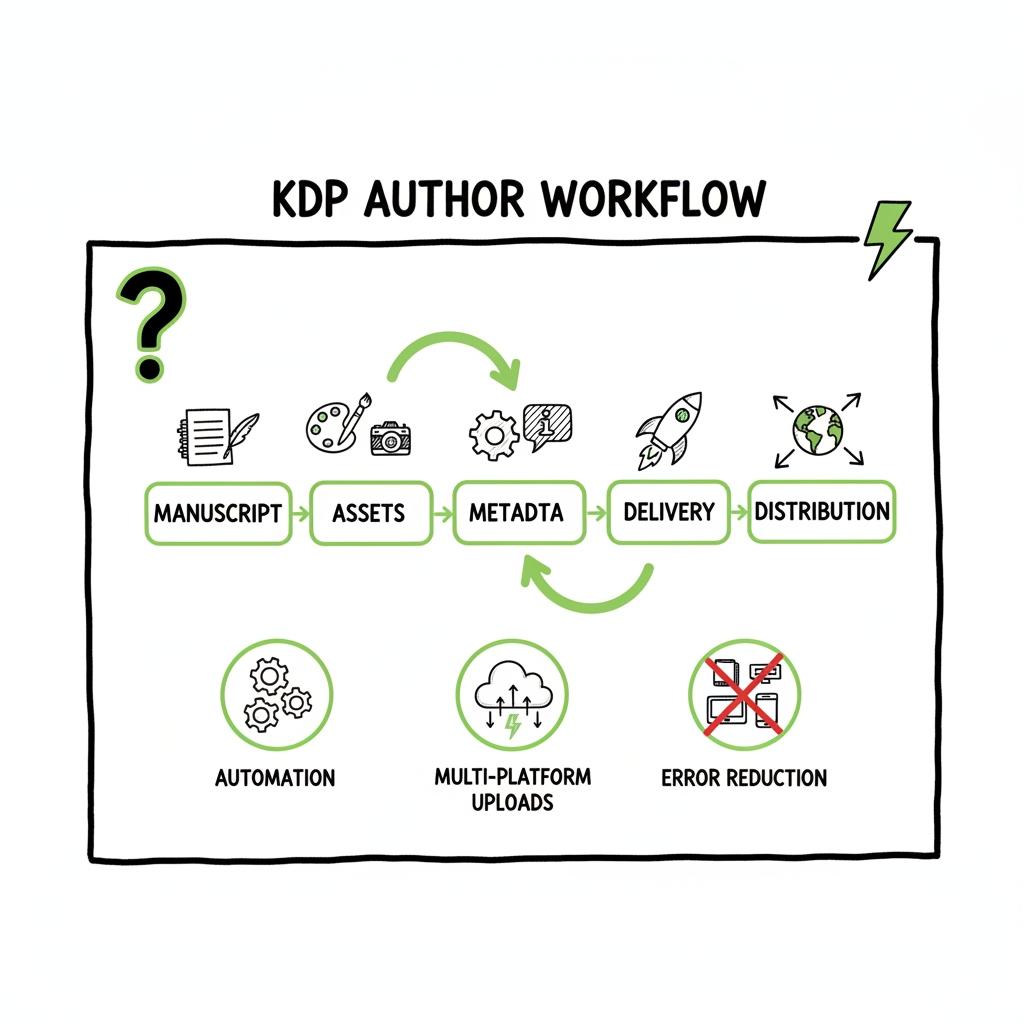
- A reliable kdp author workflow breaks publishing into repeatable, testable stages: manuscript, assets, metadata, delivery, and distribution.
- Automation and multi-platform uploads cut repetitive work—CSV batch uploads and platform-specific intelligence remove the friction of scale.
- BookUploadPro pairs platform-aware uploads with error reduction, making wide distribution practical and saving roughly 90% of manual time.
Table of Contents
- Overview
- KDP Author Workflow: Step-by-Step
- Scaling and Automation for Multi-Platform Publishing
- FAQ
- Sources
Overview
A practical kdp author workflow is the difference between publishing one book and running a reliable publishing program. For a single release you can muddle through forms, file conversions, and cover tweaks. When you publish multiple titles, or use series and variations, manual uploads become costly in time and mistakes. This article shows how to design a durable workflow that keeps quality high while speeding the routine steps: formatting, cover production, metadata, publishing choices, and distribution. If you want a focused guide that applies specifically to Amazon, see Amazon KDP for Authors for a concise tour of KDP’s interface and policies.
Good workflows do two things: reduce variation and reduce repetition. They separate authoring from delivery and make the handoffs predictable. Below you’ll find a practical step-by-step kdp author workflow that works for single titles and scales into batches, plus the automation and distribution options that remove the repetitive work.
BookUploadPro automates repetitive book uploads across platforms, reducing manual effort. It connects a single metadata CSV and production files to platform-specific delivery engines. The value is practical: CSV batch uploads, platform-specific intelligence, and automated error checks reduce manual time by roughly 90% and dramatically lower failure rates.
Note: A ready-to-use automation-friendly setup can be tailored to your publishing goals, helping you reach readers across stores with consistent formatting and metadata.
KDP Author Workflow: Step-by-Step
This section describes the core workflow you’ll use every time you publish. It’s written for authors who want an operational process they can follow for a single book and repeat at scale. Secondary keywords like streamline kdp author process, efficient kdp publishing steps, and kdp task automation are addressed across the steps.
-
1) Start with a clean manuscript
- Finish your draft and run a pass for structure: chapter breaks, front/back matter, and consistent styling.
- Export a working master file (DOCX or manuscript editor format). Keep a single source of truth so last-minute edits don’t fragment versions.
-
2) Prepare ebook and paperback files
- Format for reflowable reading (EPUB or high-quality DOCX exported to EPUB). EPUB is the accepted file type for most stores and reduces formatting surprises on KDP.
- For print, use a fixed-layout PDF sized to your trim (e.g., 6” x 9”), with embedded fonts and correct margins.
-
3) Create production-ready covers
- Design covers with final trim size and industry standards in mind. For print, include back cover and spine text baked into the file.
- Test thumbnails: most sales happen with a tiny image, so evaluate legibility at small sizes.
-
4) Gather and standardize metadata
- Title, subtitle, series name and number, author/publisher names, contributor roles, language, and ISBNs for print.
- Categories and keywords: pick two BISAC categories for most titles and use focused keyword phrases that match reader intent.
- Pricing and royalty choices: decide upfront whether you’ll enroll in KDP Select, set list price ranges, and prepare multiple regional prices.
-
5) Validate and preflight
- Open the EPUB in multiple readers and validate with an EPUB checker. For print, examine the print-ready PDF with a soft-proof and check bleed and pages.
- Spell-check metadata and run a sample upload to KDP’s previewer. Catching simple mismatches here saves author time and buyer confusion later.
-
6) Upload and publish
- For a single title, follow the KDP steps: book details, content upload (manuscript and cover), paperback setup, rights & pricing, and publish.
- For multi-title publishing, use batch uploads or a platform that supports CSV bulk delivery. Bulk CSV uploads remove the per-title form entry and reduce copy/paste error.
-
7) Post-publish checks and distribution
- After the title goes live, verify that metadata, table of contents, and sample all appear correctly on storefronts.
- Set up tracking: sales dashboards, reporting schedules, and any listener or reader feedback systems.
A good workflow includes a short QA checklist you run after each title is live. That checklist should be short and automatable: confirm ASIN/ISBN assigned, sample download works, and storefront metadata shows correctly.
Process notes on efficiency
- Keep two versions: working draft and production-ready files. Never edit the production files directly; update the working draft and re-export.
- Standardize filenames and folders. Use consistent naming like TITLE_TYPE_DATE (e.g., QuietRoom_EPUB_2026-01-01).
- Use CSV metadata for all platforms. The same fields can map to KDP, Kobo, Apple Books, and Ingram with minimal adjustment.
Scaling and Automation for Multi-Platform Publishing
Once you have a stable kdp author workflow, the next step is scale. Authors who plan to release multiple titles or multiple formats quickly run into the same production bottlenecks: repetitive uploads, differing platform requirements, and human errors in form fields. The goal of automation is not to replace careful work; it’s to remove repeatable manual tasks so you can focus on content and strategy.
Where automation helps most
- Batch metadata delivery: CSV templates upload dozens of titles in one operation rather than filling forms repeatedly.
- File format intelligence: automated checks that route EPUBs to ebook deliveries and PDFs to print, plus automatic spine calculation and trim matching.
- Asset reuse: one cover source that outputs both thumbnail images and print-ready PDFs without manual reconstruction.
Platform-specific intelligence matters. A system that knows KDP expects EPUB or KPF, while Ingram may require PDF for print, avoids the back-and-forth that eats days when you publish at scale. That’s why unified multi-platform publishing is useful: it maps your single source files to store-specific requirements and handles the conversions.
How BookUploadPro changes publishing at scale
BookUploadPro automates repetitive book uploads across Amazon KDP, Kobo, Apple Books, Draft2Digital, and Ingram. It connects a single metadata CSV and a library of production files to platform-specific delivery engines. The value is practical: CSV batch uploads, platform-specific intelligence, and automated error checks reduce manual time by roughly 90% and dramatically lower failure rates.
Operational results you can expect
- Faster per-title throughput: what used to take an hour per platform now often completes in minutes when batched.
- Fewer errors: automated validation finds missing trim sizes, bad EPUB markup, and inconsistent metadata before it reaches stores.
- Wider distribution without the headache: distributing broadly becomes practical rather than an admin burden.
Automating common tasks
- Format conversion: automated EPUB creation, but retain manual review for complex interiors. If you use an EPUB converter as part of your process, conversions are consistent and faster.
- Cover generation: automated cover export pipelines produce consistent thumbnails and print-ready layouts from the same design source.
- Pricing matrix: set regional price rules once and apply automatically across platforms.
Create predictable workflows
Treat automation like a factory line: each step accepts a clean input and emits a validated output. Inputs are the master manuscript, final cover assets, and a single CSV of metadata. Outputs are store-ready EPUBs, print PDFs, and normalized metadata packages. This design minimizes ad-hoc fixes and supports batch publishing.
A short example sequence for 10 titles
- Finalize manuscripts in the authoring folder.
- Run batch EPUB converts and run an EPUB validator across all files.
- Generate covers in the necessary sizes and export print-ready PDFs.
- Prepare a single CSV with metadata for all 10 titles.
- Use an automated uploader to deliver to KDP, Kobo, Apple Books, and Ingram simultaneously.
- Run an automated QA report to confirm ASIN/ISBN creation and live status.
Tools to support automation
- Batch upload platforms that accept CSVs and map fields to store APIs.
- Conversion utilities for EPUB and print PDF generation.
- Cover processing services that output multiple file types from a single design source.
Automate the upload. Own the distribution.
Once you publish seriously—multiple titles, special editions, or translations—automation becomes an obvious upgrade. Systems that combine CSV batch uploads, platform-aware checks, and error reduction let authors focus on writing and marketing instead of form-filling.
Production edge cases and how automation helps
- Series management: automatically link series fields across listings so readers see correct ordering and metadata without manual edits.
- Multiple editions: reuse the same metadata but route different files (e.g., illustrated vs text-only) to the correct product page.
- International pricing: apply region-specific price rules in bulk so local storefronts display consistent pricing.
Integrations and companion tools
- If you use a separate cover creation tool, ensure the output matches your uploader’s expected formats. A cover generator that exports both thumbnail and print-ready files short-circuits a common bottleneck.
- If you rely on third-party converters, keep a tested toolchain and an EPUB validator step to avoid rejections on stores.
Practical adoption tips
- Start automating a small set of titles first. Use two or three books to test conversions, metadata mappings, and delivery behavior.
- Keep the manual QA pass in your workflow. Automation reduces work but doesn’t replace a final human check.
- Maintain good records. Log deliveries, store IDs, and any API responses so when you need to troubleshoot, you have a clear history.
BookAutoAI companion services (if you use them)
- If your process includes creating covers at scale, a cover generator can standardize series art and export the required sizes for both ebook and print.
- For file conversions, an EPUB converter that integrates with your pipeline removes a manual conversion step.
- If you generate paperback or ebook files programmatically, centralized book creation tools help keep naming, metadata, and layout consistent.
Operational example: how a release week looks with automation
- Monday: finalize manuscripts and run batch conversions.
- Tuesday: generate covers and upload all assets with a CSV.
- Wednesday: check automated validation logs, correct any flagged issues.
- Thursday: schedule marketing and confirm live pages.
- Friday: run sales tracking and export publishing reports.
This rhythm turns a chaotic release week into a repeatable schedule.
FAQ
What is the simplest kdp author workflow for a first-time author?
Start with a single-source manuscript and a checklist: format to EPUB, create a basic cover, fill metadata, upload to KDP, and run the KDP previewer. Keep the process minimal: one master file, one cover file, and one metadata sheet.
How do I streamline kdp author process when I have many titles?
Move from manual form entry to CSV metadata and batch uploads. Standardize filenames, use validated EPUBs and print-ready PDFs, and adopt a platform that offers CSV batch uploads and platform-aware checks.
Will automating uploads cause quality problems?
Not if automation includes validation steps. Automated pipelines should validate EPUBs, verify cover dimensions, and flag metadata issues. Treat automation as a speed layer on top of quality controls.
Do I need separate files for KDP and other stores?
Stores differ in accepted formats. KDP accepts EPUB and KPF, Ingram often requires print-ready PDFs, and Apple prefers validated EPUBs. Keep a single source and run conversions to create store-specific files—this is where conversion tools help.
How much time does a system like BookUploadPro save?
Authors commonly report up to ~90% time savings on routine delivery tasks because CSV batch uploads and platform-specific automation remove repetitive manual work. The real benefit is the ability to publish more titles without hiring extra support.
Can I still use custom templates and covers with automation?
Yes. Automation works with your assets. A cover generator or manual designs can feed the pipeline; the uploader exports the formats stores require while preserving your creative choices.
Final thoughts
Design your kdp author workflow around a clear separation: create content, produce assets, standardize metadata, validate, then deliver. Once that pipeline is repeatable, automate the delivery stage. Automation reduces errors, accelerates releases, and makes wide distribution practical.
If you’re ready to move beyond manual uploads, a platform that supports CSV batch uploads, platform-specific intelligence, and automated validation is an obvious upgrade once authors start publishing seriously. Practical features to look for are error reduction, CSV-wide distribution controls, and affordable pricing with a free trial so you can test the pipeline on a small batch before committing.
Calm next step: visit BookUploadPro.com and try the free trial.
Sources
- https://kdp.amazon.com/help/topic/G202172740
- https://reedsy.com/blog/guide/kdp/how-to-publish-a-book-on-amazon/
- https://kdp.amazon.com/help/topic/GUGQ4WDZ92F733GC
- https://jackrighteous.com/en-us/blogs/ai-writing/ai-assisted-kdp-publishing-guide
- https://www.bookautoai.com/book-cover-generator-processing
- https://www.bookautoai.com/epub-converter
- https://www.bookautoai.com
KDP Author Workflow: Step-by-Step Estimated reading time: 18 minutes Key takeaways A reliable kdp author workflow breaks publishing into repeatable, testable stages: manuscript, assets, metadata, delivery, and distribution. Automation and multi-platform uploads cut repetitive work—CSV batch uploads and platform-specific intelligence remove the friction of scale. BookUploadPro pairs platform-aware uploads with error reduction, making wide distribution…