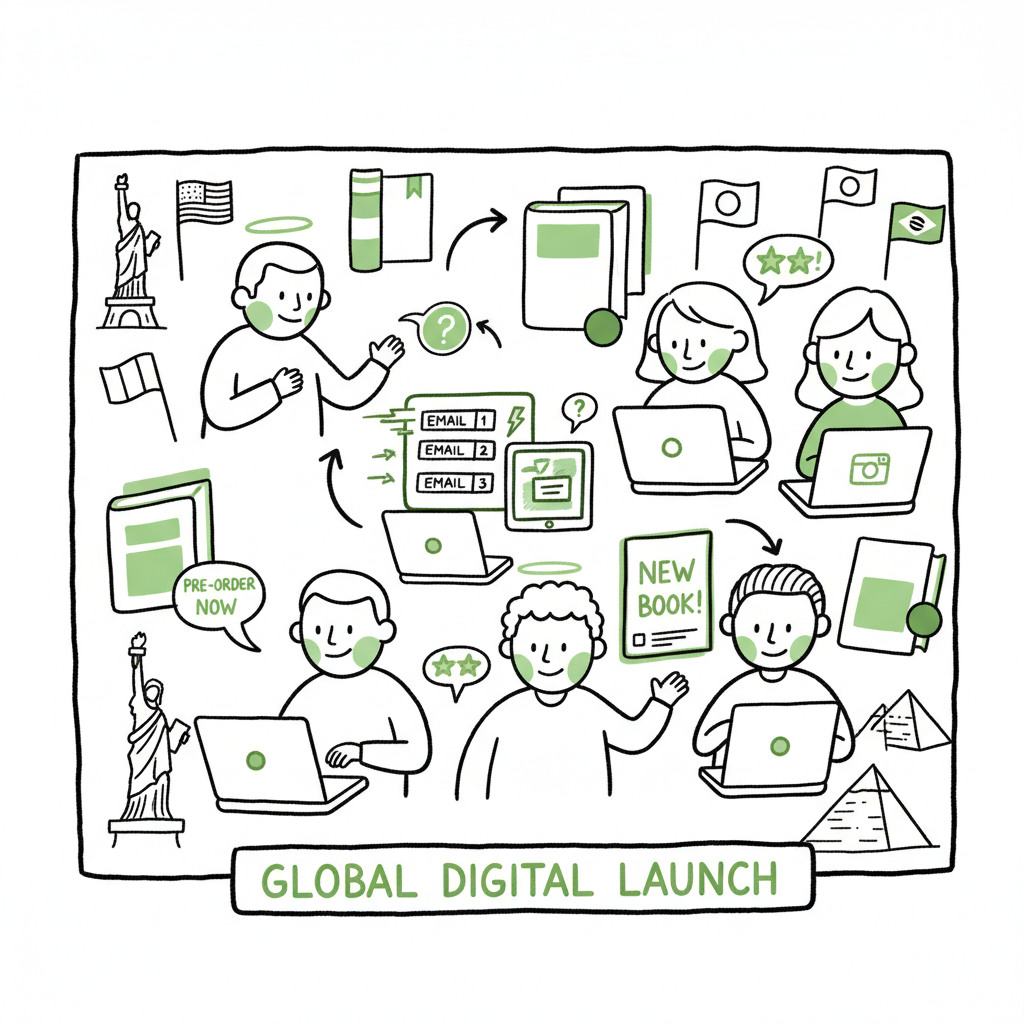
International Book Launch Strategy Guide for Authors
International Book Launch Strategy
Estimated reading time: 8 minutes
Key takeaways
- An international book launch strategy starts with clarity on audience, distribution channels, and realistic timelines.
- Digital-first tactics — pre-orders, email sequences, niche influencers, and platform-specific formats — deliver the widest reach with the smallest budgets.
- Automating multi-platform uploads and formatting saves time, cuts errors, and makes wide distribution practical when you scale.
Table of Contents
- Why an international book launch strategy matters
- Execute an international launch: pre-launch, launch day, platforms
- Use automation to scale distribution and cut busywork
- FAQ
Why an international book launch strategy matters
If you want readers beyond your home market, an international book launch strategy is not optional — it’s practical planning. Global readers use different storefronts, buy in different formats, and find books with different search terms. A plan forces you to pick targets, timelines, and measurement points so you don’t spray effort and hope for organic traction.
Start with three facts:
- Know the countries and languages that match your book’s topic or genre.
- Match formats to behavior: some markets prefer paperbacks, others favor ebooks or audiobook-first consumption.
- Plan for momentum across weeks, not just a single day. Pre-launch buzz and sustained follow-up drive long-term sales.
This approach reduces wasted spend and lets you use low-cost digital tactics — email, targeted ads, niche influencers, and virtual events — to reach readers across time zones.
Execute an international launch: pre-launch, launch day, platforms
Pre-launch (6–12 weeks)
- Define audience segments by country, interest, and platform behavior. Use that to tailor landing pages, ad copy, and email sequences.
- Open pre-orders where available. Offer a small bonus (exclusive chapter, worksheet, or short video) to increase early conversions.
- Build a short, automated email sequence that ramps excitement and gathers reviews or endorsements from advance readers.
Launch week
- Coordinate an announcement that favors one measurable goal (pre-orders, reviews, subscribers). Avoid chasing vanity metrics.
- Host a virtual event timed for one or two primary regions; record it for wider distribution. Use local influencers or community leaders to extend reach.
- Track platform-specific metrics: Amazon algorithms respond to early sales velocity and reviews; other stores have different discovery signals.
Platform notes
- Distribute widely: Amazon KDP, Apple Books, Kobo, Draft2Digital, and Ingram cover most channels. Different platforms require different file formats and metadata.
- Ebook formatting matters. If you convert your manuscript to EPUB, check reflow, images, and linked content before upload. If you need a reliable converter, use a trusted tool to avoid layout errors and rework. (For EPUB conversion help, see the EPUB converter.)
- Paperbacks need print-ready PDFs sized to each market. If you plan paperback and ebook releases, plan your timelines so print delays don’t stall global promotion. If you’re creating a paperback or ebook, use a tool that simplifies the output for each store.
Covers and assets
- A strong, localized cover concept helps in markets with different visual conventions. Create cover variants for testing and regional sensitivity. If you want a fast, consistent process for cover files and processing, consider an automated cover generator that produces store-ready files.
Measure and iterate
- Monitor sales, pre-order conversions, review velocity, and ad CPA by country. Use these signals to reallocate promotion dollars and adjust messaging.
- Keep promotions running beyond launch week: podcasts, guest posts, and targeted social ads extend the sales tail.
Use automation to scale distribution and cut busywork
Once you move beyond one book, manual uploads and format fixes become a bottleneck. Automation is the practical answer: it reduces repetitive tasks, lowers errors, and saves time so you can focus on marketing and writing.
Why automation matters for international launches
- Unified multi-platform publishing means you prepare once and distribute everywhere — Amazon KDP, Kobo, Apple Books, Draft2Digital, and Ingram — without repeating tedious uploads.
- CSV batch uploads let you push dozens of titles and variations in one pass. That’s essential for authors or small presses publishing series or translated editions.
- Platform-specific intelligence handles metadata quirks and cover requirements for each store, reducing rejections and late fixes.
- The time savings are significant: many teams see roughly 90% time reduction on upload tasks compared to manual work.
Practical workflow
- Finalize your manuscript and assets: formatted EPUB, print-ready PDF, and cover files sized per store.
- Use an EPUB converter early to validate ebook structure and catch layout issues before distribution.
- Batch metadata in a CSV: title, subtitle, series data, keywords localized for the target market, and pricing.
- Upload once to an automation tool that maps your CSV to each store’s API, runs format checks, and queues releases on the dates you choose.
When automation frees you from repetitive uploads, the obvious next step is more aggressive international testing: localized ads, translated metadata, and staggered rollouts to learn what works.
BookUploadPro fits naturally here: it automates repetitive uploads across major stores, offers CSV batch uploads, applies platform-specific intelligence to reduce errors, and makes wide distribution practical. For authors publishing seriously, it’s an obvious upgrade — automate the upload. Own the distribution.
Final thoughts
If you’re scaling beyond single-title launches, use tools that remove repetitive uploads, validate formats like EPUB and print files, and let you focus time on audience building. Automating those steps keeps launches consistent and makes global distribution practical.
Note: to explore further options, you can visit the BookUploadPro site for more details.
FAQ
Q: How soon should I start planning an international launch?
A: Start 2–3 months before your launch date. That gives time for cover design, endorsements, pre-orders, and building an email sequence.
Q: Do I need translated editions to sell internationally?
A: Not always. Some markets will buy English-language editions. But for broader reach, translated editions and localized metadata usually improve discoverability.
Q: Which formats should I prioritize?
A: Ebook first for speed and cost-efficiency; paperback next for discovery in some markets; audiobook if your audience listens heavily. Adjust by country behavior.
Q: Can automation handle ISBNs and local tax rules?
A: Many automation services handle ISBN mapping and distribution metadata, but tax and local pricing may require some manual checks. Use platform-specific intelligence to lower the workload.
Q: How do I collect early reviews in other countries?
A: Use advance reader copies, coordinate with local bloggers and reviewers, and run timed promotions tied to pre-orders to gather early feedback.
Sources
International Book Launch Strategy Estimated reading time: 8 minutes Key takeaways An international book launch strategy starts with clarity on audience, distribution channels, and realistic timelines. Digital-first tactics — pre-orders, email sequences, niche influencers, and platform-specific formats — deliver the widest reach with the smallest budgets. Automating multi-platform uploads and formatting saves time, cuts errors,…