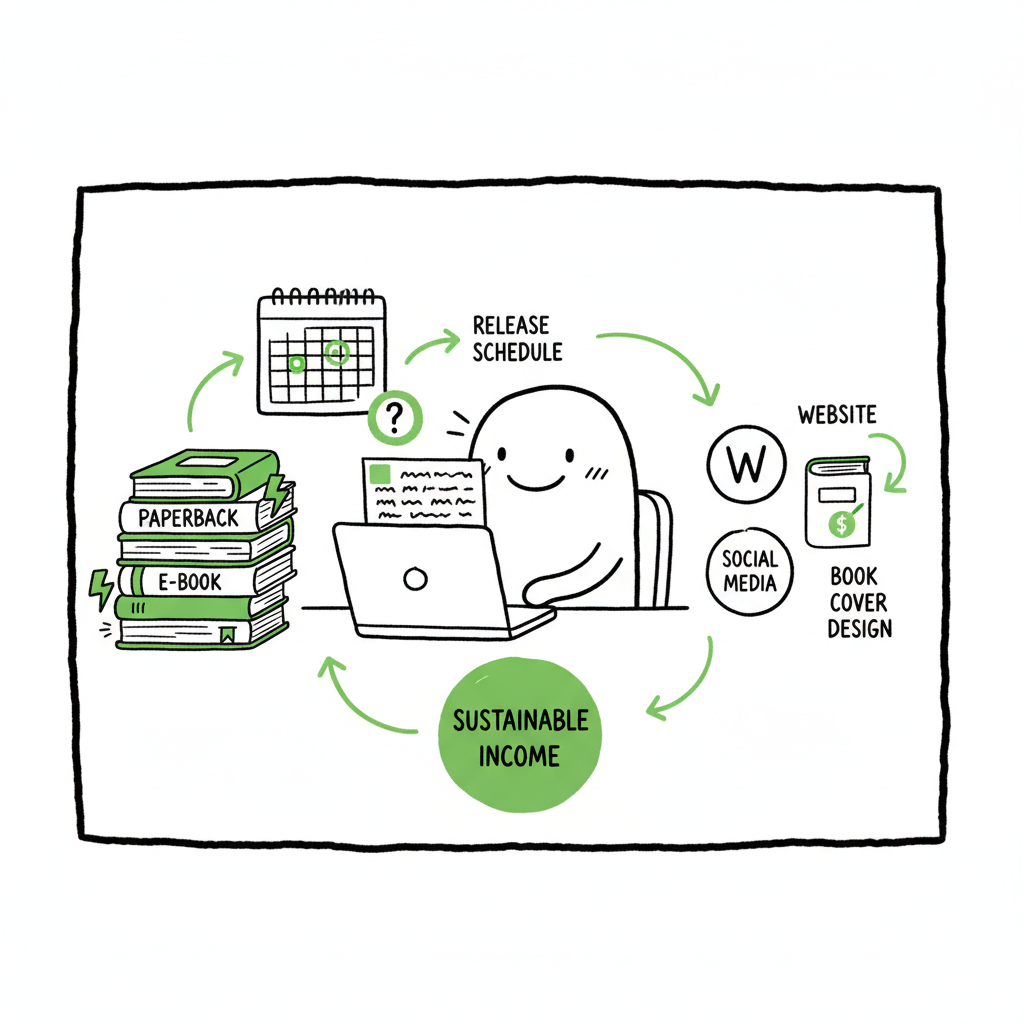
Indie Author Business Model and Publishing Systems
Indie author business model: Build a sustainable self-publishing income system
Estimated reading time: 16 minutes
Key takeaways
- The indie author business model treats you as a small publishing company: catalog, formats, channels, and a direct audience are the revenue drivers.
- Scale comes from systems and repeatable operations—series, consistent output, and multi-format publishing more than one-hit launches.
- Automation across platforms and batch workflows make wide distribution practical and profitable at scale.
Table of Contents
- What the indie author business model really is
- Revenue architecture: formats, channels, and pricing
- Publishing operations: build catalog, speed production, reduce errors
- Marketing and audience: the asset that pays forever
- FAQ
- Final thoughts
What the indie author business model really is
“Indie author business model” is a phrase that gets tossed around a lot. At its simplest, it means running your writing career like a small publishing company. That means you build a catalog of books, publish them in multiple formats, sell through several channels, and own at least one direct relationship with readers—usually an email list.
This model replaces the old single-book launch mindset. Instead of betting everything on one title and one launch window, successful indie authors focus on repeatable systems. They write to a genre, publish a steady stream of titles or series entries, and layer marketing and product formats over time so each reader drives lifetime revenue.
If you’re moving from hobby to business, it helps to read frameworks like Self Publishing as a Business and apply them. The practical shift is small but decisive: decide that publishing will be organized, measurable, and repeatable. When you think like that, choices about format, distribution, pricing, and tooling become decisions about efficiency and margin, not guesswork.
Revenue architecture: formats, channels, and pricing
How authors make money is changing, but the steady pillars remain.
Formats that pay
- Ebook and paperback: The backbone. Ebooks are easy to distribute and price-test; paperbacks provide visibility in catalog searches and a physical product for higher price points.
- Audiobooks: A growing, higher-margin channel. They cost more to produce but mature catalogs often add audio after ebooks and print.
- Special editions and bundles: Boxed sets, signed or limited editions, and serialized extras increase per-reader revenue.
When you produce those formats, keep the production pipeline simple and repeatable. If you convert manuscripts to EPUB frequently, use tools that standardize the process and cut rework—an EPUB converter speeds that up and avoids format errors. If you produce covers regularly, a reliable cover pipeline reduces iteration time and cost; a cover generator or processing service can speed design handoffs.
Channels and diversification
- Amazon: Still the primary revenue driver for most indies. It’s efficient and drives volume, especially if you use Kindle-specific tools and ads.
- Wide distribution (Kobo, Apple Books, Draft2Digital, Ingram): Reduces dependency on one platform and captures markets that Amazon doesn’t dominate.
- Direct sales: Higher margins and first-party customer data. High-earning authors often sell directly via their websites or storefronts.
- Subscription and reader-funding models: Patreon, Substack, or direct subscriptions can add reliable monthly income for serial writers.
Pricing strategy
- Use price testing for frontlist and permanent pricing for backlist.
- Keep a consistent royalty picture: lower price and volume on ebooks, higher price and lower volume for paperbacks and audio.
- Use promotions strategically (discounts, free book funnels) to drive email sign-ups and series reads.
The key is a layered approach. Ebook and paperback cover most purchases early. Layer audio and bundles when you can afford the investment. Use direct sales and subscriptions as margin multipliers when your audience and catalog allow.
Publishing operations: build catalog, speed production, reduce errors
A scalable indie author business depends on predictable operations. The more titles you publish, the more time you spend on production and distribution unless you streamline those tasks.
Catalog planning
- Treat a catalog like a product roadmap. Prioritize series and subgenres where readers buy multiple books.
- Plan to publish consistently. Many successful indies publish multiple books per year across the same worlds or series to maximize cross-buy.
Production pipeline
- Standardize formats. Keep a single manuscript master, and export from it to the needed formats. Convert to EPUB once, validate, and use that file to generate platform-specific output.
- Automate repetitive tasks. Batch metadata, templated descriptions, and CSV-based uploads speed distribution and reduce errors.
If you convert manuscripts to EPUB regularly, use a dependable EPUB converter to make the step painless and consistent. Cover creation is another repeatable task; a well-tuned cover design pipeline or automated cover tools reduce time between final draft and upload.
Distribution at scale
- Manual uploads work for one book. For dozens, they don’t. Batch CSV uploads and platform-aware automation cut the work by roughly 90% and remove the single-upload friction that slows growth.
- Use platform-specific intelligence. Each retailer treats metadata and categories differently. A system that adjusts per store—file naming, trim sizes, price matching—prevents platform rejections and listing errors.
Wide distribution requires careful handling of ISBNs, trim sizes, and BISAC categories. When you owner-issue ISBNs or work with a distribution partner, track which ISBN maps to which retailer to avoid confusion. Automation tools can track these mappings and apply them consistently across a catalog.
Tools and time savings
Running publishing tasks manually is time-consuming and error-prone. Services that automate uploads across Amazon KDP, Kobo, Apple Books, Draft2Digital, and Ingram let you focus on writing and marketing. They provide CSV batch uploads, platform-specific checks, and consistent metadata application, which is an obvious upgrade once you publish seriously. Automating uploads reduces repetitive work, cuts mistakes, and makes wide distribution practical.
When you scale production, track metrics: time per book, errors per upload, days from final draft to live. That lets you measure operations improvements and prioritize automation investments that lower cost per title.
Marketing and audience: the asset that pays forever
The most predictable lever in the indie author business model is an owned audience—an email list.
Audience-first launch mechanics
- Reader magnet: Offer a free short or the first book in a series to capture emails. The list is your best launch tool because it gives you direct access to buyers.
- Launch cadence: Use your email list to announce new releases, cross-promote series entries, and run sales. Lists outperform social channels for conversion and ROI over time.
Promotions and discoverability
- Platform promotions: Price promotions, Kindle Countdown Deals, and retailer-specific marketing tools support discoverability.
- Promo services and paid channels: Book promo sites, newsletter swaps, and targeted ads move units on demand, but they cost money. Use them after you’ve optimized your messaging and product pages.
- Organic discoverability: Consistent catalog growth in a subgenre and strong metadata (series information, keywords, clear blurbs) drives algorithmic visibility on retailer sites.
Direct sales and subscriptions
- Direct sales increase margin and give you customer contact details. If you can get readers onto your list through a purchase or free frontlist, direct buyers often have higher lifetime value.
- Subscription models like Patreon or membership tiers work well for authors who release serial content or frequent short works.
Metrics to watch
- Customer acquisition cost for paid channels.
- Open and click rates on your list.
- Series attach rate (how often a reader buys book 2 after book 1).
- Revenue per reader over 12, 24, 36 months.
Combine marketing with operations. If your production is slow or error-prone, promotions will be wasteful. Conversely, if distribution is narrow, you’ll lose reader momentum. A smooth pipeline plus a reliable list turns one launch into sustained catalog growth.
FAQ
Q: How many books do I need to make this work?
There’s no single answer, but catalog size correlates strongly with income. Most authors see income increase materially after five or more titles, and series work better than one-offs.
Q: Should I focus on Amazon or publish wide?
Start where you get traction. Amazon often drives initial sales, but high-earning indies diversify into wide and direct sales. Think of Amazon as a major channel, not the only channel.
Q: When should I add audiobooks?
Add audio once you have a stable ebook/print production system and a backlist large enough to justify the cost. Audio adds margin but requires production investment.
Q: Is direct sales worth the effort?
Yes, if you can capture customer data and maintain fulfillment. Direct sales increase margin and give you first-party relationships that protect against platform changes.
Q: What tools speed publishing operations?
Batch CSV uploads, platform-aware distribution tools, EPUB conversion services, and repeatable cover processes all reduce time and errors. When you publish multiple titles a year, these tools pay back quickly.
Final thoughts
The indie author business model is straightforward in theory: build a catalog, publish in multiple formats, diversify sales channels, and own reader relationships. In practice the work is about systems—clear production pipelines, predictable marketing funnels, and tools that remove repetitive manual work.
Automation is not an optional luxury when you publish at scale. It reduces errors, saves time, and lets you publish more often with less friction. Unified multi-platform publishing, CSV batch uploads, platform-specific intelligence, and integrations that cut manual steps are what turn a writer into a sustainable indie publisher. At that point, tools that provide ~90% time savings and reduce error rates aren’t experiments—they’re the operational backbone.
If you’re ready to treat publishing like a business, automate the upload and own the distribution. Automating repetitive tasks gives you the time to write more, test pricing, and grow your audience—the real sources of scale and repeatable income.
Visit BookUploadPro.com to try the free trial and see how batch uploads and platform-aware automation fit into your publishing workflow.
Sources
- https://indieauthormagazine.com/how-indie-authors-are-redefining-publishing-and-building-sustainable-self-publishing-businesses/
- https://www.writtenwordmedia.com/2025-indie-author-survey-results-insights-into-self-publishing-for-authors/
- https://selfpublishingwithdale.com/index.php/2025/05/21/indie-author-sales-strategy/
- https://www.allianceindependentauthors.org/wordpress/wp-content/uploads/2025/09/The-Big-Indie-Author-Data-Drop-FINAL.pdf
- https://kindlepreneur.com/the-truth-on-selling-books-direct-insights-from-authors/
- https://selfpublishingadvice.org/podcast-author-platform/
- https://productiveindiefictionwriter.com/when-writing-isnt-enough/
- https://reedsy.com/blog/indie-publishing
Indie author business model: Build a sustainable self-publishing income system Estimated reading time: 16 minutes Key takeaways The indie author business model treats you as a small publishing company: catalog, formats, channels, and a direct audience are the revenue drivers. Scale comes from systems and repeatable operations—series, consistent output, and multi-format publishing more than one-hit…