Book Niches for Low Content (Advanced) for Self-Publishers
Book niches for low content (advanced)
Estimated reading time: 11 minutes
Key takeaways
- Advanced low-content niches reward effort: pick medium-content formats (puzzles, activity books, specialized trackers) and niche down by age, interest, or condition.
- Validate demand with search and competition checks, then build higher-quality interiors and covers to raise barriers to entry.
- Use multi-platform automation to publish at scale and reduce repetitive work; this makes wide distribution practical and cost-effective.
Table of Contents
- Why advanced low-content works
- Research, production, and multi-platform publishing
- Marketing, scaling, and distribution
- Frequently asked questions
- Final thoughts
Why advanced low-content works
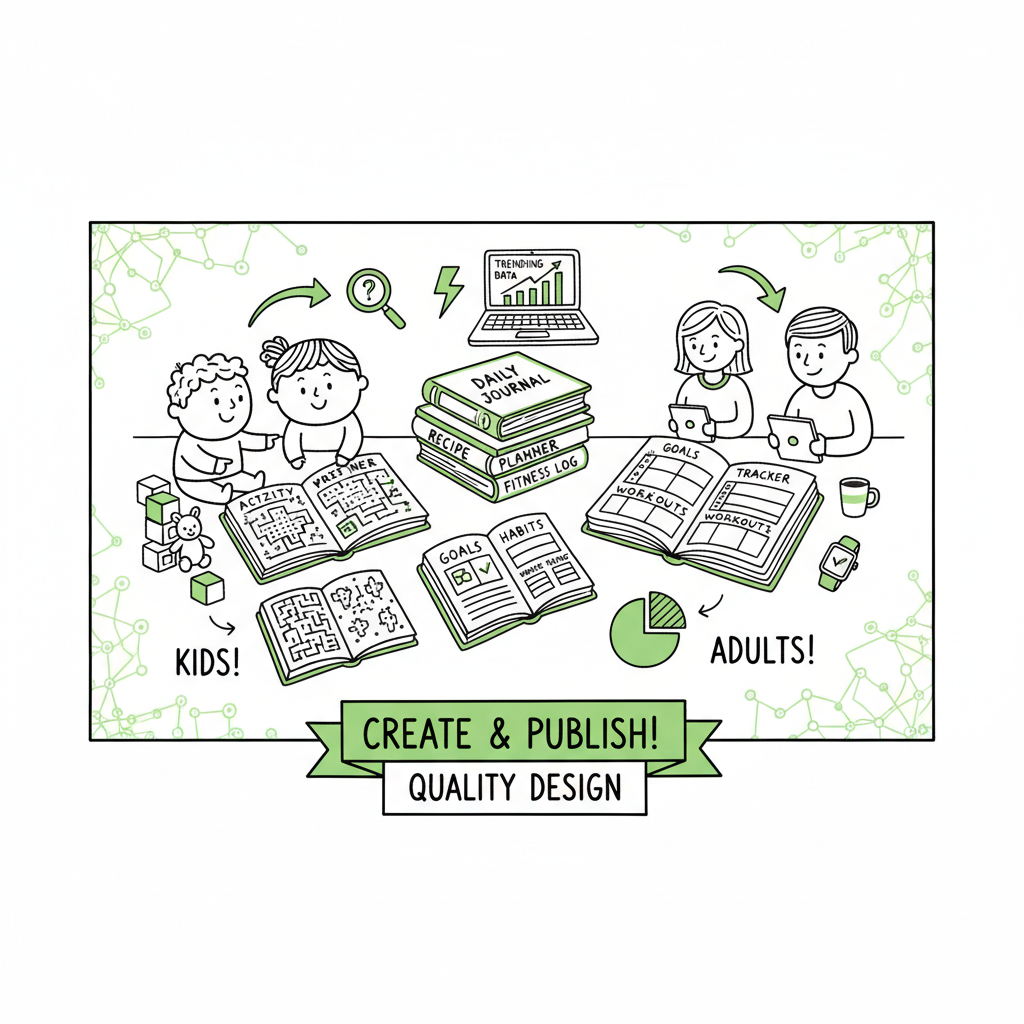
Low-content books evolved. By 2026 the best opportunities live in what I call advanced low-content: puzzle collections, activity books with varying difficulty, and practical logbooks that solve a real problem. The phrase book niches for low content (advanced) points to formats that need design thinking rather than copy-heavy writing. These books are not trivial journals; they include structured pages, progressive puzzles, age- or condition-specific variations, or specialized trackers.
If you want concrete subtopics that buyers search for, a short list like Book Niches That Sell helps you spot promising directions quickly. Advanced niches reward creators because they’re harder to replicate. A sudoku collection for seniors, a dementia-friendly spot-the-difference book, or a food-allergy log for parents require thoughtful layout and testing. Those details create buyer value and reduce direct competition.
Research, production, and multi-platform publishing
Start with research, then lock in a repeatable production process.
Find underserved sub-niches
- Look for medium-content formats: word puzzles, mazes, dot-to-dot, learning workbooks, habit trackers, and specialized logs.
- Niches that combine a format with an audience or condition (e.g., “crosswords for ESL learners” or “RV maintenance log”) tend to have low competition and clear buyer intent.
- Use tools to check search volume and current results, and scan product pages for poor interiors. If results exist but look low-quality, that’s an opening.
Validate with small tests
Publish one or two titles with distinct positioning, monitor organic sales and conversion, then iterate. For launches you may want a small ad budget to accelerate data collection, but strong covers and descriptions often move the needle without big spend.
Designing interiors and covers
Advanced low-content needs better interiors: varied puzzles, progressive difficulty, clear instructions, and attractive, readable layouts. Avoid repeating the same template across dozens of listings — quality gains you reviews and reduces returns.
– For covers, use a clean, genre-appropriate design with readable typography and clear age cues. If you need a fast option, a reliable book cover generator can speed work without sacrificing consistency.
– For ebook and print files, convert cleanly to EPUB and print-ready PDF. If you don’t want to manage conversions manually, an EPUB conversion tool can remove a lot of friction.
Format and file prep
– Create one master interior per niche and export platform-specific files: EPUB for ebook stores, PDF for print, and any other required formats.
– Build a CSV that maps titles, descriptions, prices, and platform-specific fields. A single upload process should populate fields for Amazon KDP, Kobo, Apple Books, Draft2Digital, and Ingram with platform-aware defaults.
Publish across platforms efficiently
Multi-platform distribution matters because it widens reach and reduces reliance on a single marketplace. Using unified tools that understand platform differences saves time and prevents listing errors. When your workflow supports CSV batch uploads and platform-specific intelligence, you can publish dozens of titles without repeating manual steps.
BookUploadPro fits here: it automates repetitive uploads across Amazon KDP, Kobo, Apple Books, Draft2Digital, and Ingram, cutting time by roughly 90% and reducing platform-specific errors. For publishers scaling to dozens or hundreds of titles, that automation is an obvious upgrade once authors start publishing seriously. Automate the upload. Own the distribution.
Marketing, scaling, and distribution
Once you have a validated niche and a few well-made books, focus on scale and distribution.
Organic visibility and metadata
Good metadata is non-negotiable. Use specific keywords in titles and subtitles where appropriate (age ranges, condition names, use-cases). Fill backend keyword fields per platform rules. High-quality covers and descriptive product text improve conversion, which in turn helps organic rank.
Pricing and print options
Set prices that match buyer expectations for the format and region. For print books, choose trim sizes and paper options that suit the content; puzzles often work better in larger trim sizes for readability, while trackers can be smaller and cheaper to print.
Use varied channels
Don’t rely on a single store. Wide distribution via Apple Books, Kobo, Draft2Digital, and Ingram increases exposure and smooths revenue fluctuations. When you can push the same product to multiple stores without re-entering every field, you remove the practical barrier to wide distribution.
Operational scale
As you add titles, processes must scale:
– Maintain a CSV catalog with standardized fields.
– Use templates for interiors and covers to keep visual consistency.
– Automate uploads and errors checks so mistakes don’t scale with volume.
BookUploadPro’s CSV batch uploads and platform-aware validation reduce manual checks and make wide distribution practical and affordable. When uploads are automated, the work shifts from repetitive entry to creative decision-making: testing new sub-niches, iterating interiors, and refining marketing.
Quality and customer feedback
Track returns, reviews, and buyer messages to find friction points. A low-content title that gets complaints about font size or unclear instructions should be updated. Re-upload revised interiors and communicate the change in the product description if needed. Continuous improvement is how passive formats stay competitive.
When to add paid ads
Use ads to jump-start visibility for a new sub-niche, not to prop up a weak product. If a book converts well organically with some impressions, a modest ad test can scale it. Prioritize books with clear differentiation and verified demand.
Frequently asked questions
Q: What makes a low-content niche “advanced”?
A: Advanced low-content goes beyond blank journals. It includes medium-content formats like puzzles, activity books, educational workbooks, and specialized logbooks that require design choices, sequencing, and audience targeting. These elements raise buyer value and create barriers to copycats.
Q: How do I test a niche without heavy investment?
A: Publish one or two titles with distinct angles and track conversions and initial sales. Use a small ad campaign to accelerate learning if needed. Keep file templates and CSV records so you can scale quickly once a niche proves itself.
Q: Do I need separate files for ebook and print?
A: Yes. Print requires a formatted PDF with correct bleed and trim, while ebooks need reflowable EPUBs or fixed-layout files depending on content. If you prefer not to handle this manually, tools exist for converting interiors efficiently.
Q: Should I publish everywhere or only on Amazon?
A: Wide distribution is safer and often more profitable. Some niches sell better off-Amazon. If you can publish across multiple stores without much extra effort, you’ll reach more buyers and reduce risk.
Q: How important is cover design for low-content books?
A: Very important. Covers are the single biggest driver of clicks. They must communicate the format, audience, and value succinctly. If you need rapid, repeatable covers, a book cover generator helps maintain quality across a catalog.
Final thoughts
Advanced low-content publishing rewards operational rigor: deep niche research, thoughtful interiors, and a production pipeline that scales across platforms. Focus on niches with clear buyer intent, make better products, and remove friction in publishing. When repetitive uploads are automated, the work that remains—researching niches, designing interiors, and testing marketing—becomes far more productive.
Visit BookUploadPro.com to try the free trial.
Sources
- 2000 KDP Low Content Book Ideas for 2026 (PDF Ebook) – Etsy
- 10 Best KDP Niches 2026 For Beginners & Advanced Self-Publishers
- Amazon KDP Niche Research for Beginners (2026)
- 5 Best KDP Niches Worth Starting in 2026 – YouTube
- Are Low Content Books Still Worth it in 2026? – YouTube
Book niches for low content (advanced) Estimated reading time: 11 minutes Key takeaways Advanced low-content niches reward effort: pick medium-content formats (puzzles, activity books, specialized trackers) and niche down by age, interest, or condition. Validate demand with search and competition checks, then build higher-quality interiors and covers to raise barriers to entry. Use multi-platform automation…