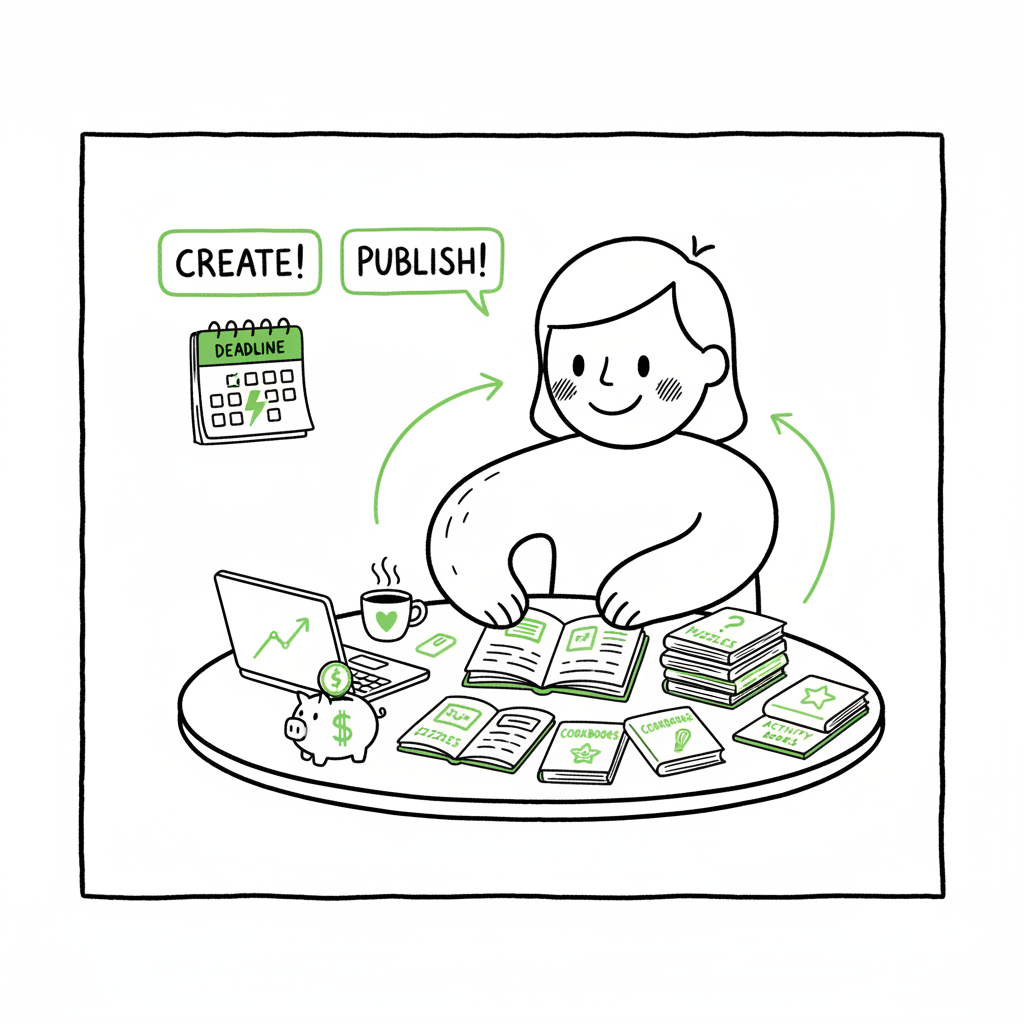
Book Niches for Passive Income Practical Guide for Authors
Book niches for passive income: A practical guide for self-publishers
Estimated reading time: 7 minutes
Key takeaways
- Medium-content books (puzzles, workbooks, activity books, niche cookbooks) offer the best balance of demand and defensibility for passive income.
- Validate niches with small, repeatable tests, then scale production with batch uploads and platform-specific formatting.
- Use unified multi-platform publishing and automation to save time, reduce errors, and make wide distribution practical.
- Focus on narrow sub-niches to build repeatable revenue streams and minimize competition.
Table of Contents
- How to choose and validate book niches for passive income
- Create, publish, and scale profitable niche books
- FAQ
- Sources
How to choose and validate book niches for passive income
If your goal is steady sales with minimal ongoing work, you need niches that sell reliably and can be produced at scale. The phrase book niches for passive income points to categories with repeat buyers, low churn, and enough variety to allow niching down. Examples include crossword and sudoku sub-niches, math workbooks for specific grade levels, themed activity books for kids, and focused cookbooks (diet + method combos like “Mediterranean Air Fryer”).
Start simple: pick a narrow sub-niche, make one clean product, measure results, iterate. For early validation, a single title can tell you a lot if you watch conversion and keyword rank. If conversion is weak, either test a different sub-niche or improve the interior and cover.
Where to look for niches
- Sales longevity: Look for steady, year-round demand (puzzles, kids’ activity books, diet cookbooks).
- Repeat purchase potential: Consumable or multi-volume formats (workbooks, puzzle series) convert readers into repeat buyers.
- Low-to-moderate competition: Avoid ultra-saturated broad categories—niching down is the defensible move.
- Keyword opportunity: Long-tail keywords with buyer intent are better than vague category terms.
A quick validation play
- Pick a narrow keyword phrase and check search volume and top listings.
- Create one high-quality interior and cover, upload with a focused title and description.
- Run a small test ad campaign or enroll in Kindle Unlimited (if applicable) and measure page reads, sales, and conversion rate.
- Decide: scale, refine, or pivot.
For a practical list of focused options that tend to outperform broad categories, see Book Niches That Sell — it’s a good starting point when you need direction for tests and sub-niche ideas.
Create, publish, and scale profitable niche books
Once a niche validates, your job becomes production, quality control, and distribution. Two priorities matter most: quality that meets customer expectations, and a repeatable workflow that keeps unit time low.
Product types that work
- Puzzle and activity books: Sudoku, crosswords, mazes, word searches, spot-the-difference. These perform well because buyers often buy in series.
- Workbooks and educational packets: Grade-specific math practice, handwriting, or language workbooks with progressive difficulty.
- Specialized cookbooks and niche how-tos: Diet + appliance combos, quick-reference guides for a hobby. These sell when they answer a specific need.
- Hobby and craft guides: Pattern collections, project journals, and step-by-step workbooks that hobbyists return to and recommend.
Production checklist (kept simple)
- Interior: Aim for functional, clean layouts. Templates are fine if you customize to the sub-niche.
- Cover: High-contrast, legible at thumbnail. If you don’t have in-house design, consider a cover generator that handles print and ebook sizes.
- File formats: You’ll typically need PDF for paperback, EPUB for most ebook storefronts, and platform-specific metadata files.
Tools and conversions
- For reliable EPUB conversion and formatting, use a dedicated converter that preserves layout and CSS for ebooks.
- If you use a cover generator or automated cover processing, choose a tool that outputs correctly sized assets for both print and ebook.
Note: If you need automated tools for cover processing, EPUB conversion, or full book generation, there are services that speed up production while reducing format errors. For example, a cover generator can cut design time and ensure print-ready files, and a good EPUB converter helps avoid rejections on stores that require strict formatting.
Multi-platform distribution
Publishing across Amazon KDP, Kobo, Apple Books, Draft2Digital, and Ingram widens reach and reduces dependency on a single platform. But uploading to five platforms manually kills scale.
This is where unified multi-platform publishing matters:
- CSV batch uploads and platform-specific intelligence let you push many titles with fewer clicks.
- Automation reduces human error in metadata and file selection.
- When you publish seriously, automating uploads is an obvious upgrade: it saves roughly 90% of the time compared with manual entry and makes wide distribution practical.
Platform tips
- Match deliverables to the platform: EPUB for Apple and Kobo, print-ready PDF for KDP print, and appropriate metadata for Ingram.
- Enroll select titles in Kindle Unlimited only if the strategy fits your audience; KU can provide steady page-read income for experimental niches.
- Monitor returns and customer feedback across platforms and replicate the best-performing variants.
Scaling production
- Batch interiors: Use a repeatable template system so you can swap prompts or content and generate multiple titles quickly.
- Reuse covers with clear variant text (e.g., “Volume 3,” “Math Workbook — Grade 4”) to keep design time low.
- Use CSV uploads to send metadata in bulk; the savings multiply as you move beyond handfuls of titles.
Automation and quality control
Automation is only valuable when paired with checks. Implement a quick QA pass: a sample download of each file, a spot-check of metadata on the storefront, and a thumbnail review. Automation reduces errors, platform-specific intelligence prevents common rejects, and batch uploads handle scale without burning human hours.
Positioning and pricing
- Price for perceived value and buybox competitiveness. Many medium-content books land in the $6–$15 paperback range or $2.99–$9.99 ebook range depending on length and utility.
- Test price points across platforms. Some niches tolerate higher price points if the product solves a clear problem (e.g., a structured workbook).
How BookUploadPro fits
When you move past a few titles, a service that automates uploads and handles platform quirks pays for itself. BookUploadPro focuses on unified multi-platform publishing, CSV batch uploads, platform-specific intelligence, and error reduction—making wide distribution practical for authors who want to publish seriously. Automate the upload. Own the distribution.
Final thoughts
Choosing book niches for passive income is both strategic and operational. Start with narrow, repeatable niches that show steady demand, validate with small tests, then build a production pipeline that minimizes time per title. Quality matters: a clean interior, clear cover, and correct formatting are table stakes. Once you prove a niche, scale with automation and multi-platform distribution to turn one-off sales into a reliable passive stream.
FAQ
Are low-content journals still a good passive income strategy?
Pure low-content journals are far more competitive now. Medium-content formats—puzzle books, workbooks, activity books, and niche cookbooks—tend to deliver better passive results because they offer more utility and easier niching opportunities.
How many titles should I publish before I can expect steady passive income?
There’s no fixed number, but many publishers see reliable returns after building several titles in a focused sub-niche (often 5–20). Success depends on niche selection, quality, and distribution.
Do I need a separate file for each store?
Typically yes. Print files and EPUBs differ, and some platforms require specific packaging. Use a converter for EPUB and a cover processor for print/e-book sizing to avoid re-uploads and rejects.
Should I enroll in Kindle Unlimited?
KU can help with steady page-read income and higher visibility for experimental niches. Evaluate by testing a title and watching page reads and conversion.
How do I avoid saturation in a niche?
Niching down, focusing on sub-topics, and adding series-level continuity (volumes, progressive levels) are effective ways to reduce direct competition.
Sources
- 10 Best KDP Niches 2026 For Beginners & Advanced Self-Publishers
- Most Profitable Amazon KDP Niches – Top 10
- Best Passive Income Ideas 2026: Complete Guide (2025)
- 20 passive income ideas in 2026 (+ real examples)
Book niches for passive income: A practical guide for self-publishers Estimated reading time: 7 minutes Key takeaways Medium-content books (puzzles, workbooks, activity books, niche cookbooks) offer the best balance of demand and defensibility for passive income. Validate niches with small, repeatable tests, then scale production with batch uploads and platform-specific formatting. Use unified multi-platform publishing…