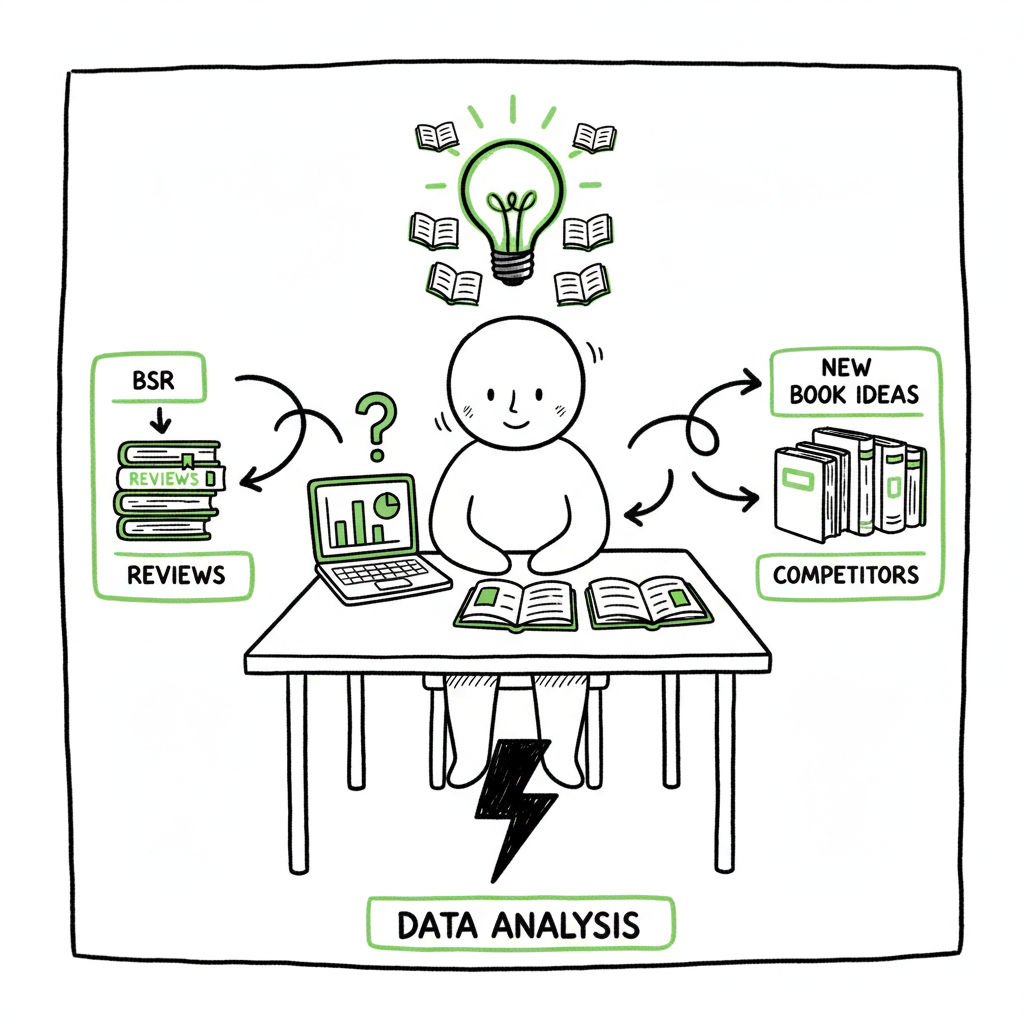
Book Niche Validation Quick Guide for Self-Publishing
Book Niche Validation: Test Ideas Before You Write
Estimated reading time: 8 minutes
Key takeaways
- Book niche validation reduces risk by combining Amazon sales signals (BSR, reviews) with competitor quality checks.
- A short, repeatable validation process—searches, BSR checks, review analysis, and sales estimates—lets you pick ideas that can sell.
- Use validation results to plan format, pricing, and distribution; automation tools make multi-platform publishing practical at scale.
Table of Contents
- Why validation matters
- Step-by-step validation process
- Using validation to plan publishing and distribution
- How validation differs for fiction
- Final thoughts
- FAQ
- Sources
Why validation matters
Book niche validation is the simple, repeatable work you do to check whether a book idea will find buyers before you spend time writing or designing. It separates wishful thinking from real opportunities. When you rely on actual purchase signals—Amazon Best Seller Rank (BSR), review counts, and visible sales patterns—you avoid the common trap of optimizing for search volume instead of buyer demand.
If you want concrete examples of categories that perform consistently, check useful resources like Book Niches That Sell to see how other authors position books and where demand concentrates. That kind of reference helps you compare a raw idea to proven niches and decide where to aim your effort.
Step-by-step validation process
Start with a clear reader problem or genre. Validation differs for nonfiction and fiction, but the steps below work for both.
1) Find raw ideas
- Nonfiction: List problems people want solved. Use Amazon search suggestions and look at related searches on product pages.
- Fiction: Pick a genre and subgenre, then collect recent bestselling titles and series patterns.
2) Scan search results and visible signals
Type your seed phrase into Amazon and note the first page results. Look at:
- Titles and subtitles for patterns
- Cover professionalism
- Presence of series or boxed sets
These visible signals help you judge whether you can match or beat the competition on presentation and positioning.
3) Check BSR and review counts
Amazon Best Seller Rank (BSR) and reviews are “credit card votes” — real sales evidence. For a practical rule of thumb:
- Aim for categories where the 20th-ranked book has a BSR under ~20,000 and top books have 50+ reviews. That indicates consistent demand and significant sales volume.
- Use the BSR of the top three books to average competition strength. If top books have professional covers and long descriptions, factor that into your decision.
4) Qualitative review analysis
Read a sample of reviews for top books. Look for:
- Common complaints or missing features (these are opportunities)
- Language readers use to describe the problem (useful for your title and description)
Reviews often reveal unsaid problems you can solve with a clearer promise or a different format.
5) Estimate sales and profitability
Translate BSR into estimated monthly sales using a simple spreadsheet or published correlations. Estimate:
- Production cost (editing, cover, formatting)
- Expected royalties at a target price
Even rough estimates tell you whether the niche can cover publishing costs and produce profit over time.
6) Decide format and execution
Validation informs format: short workbook, print paperback, Kindle ebook, or audiobook. If you plan multiple formats, make sure your manuscript and files are ready for conversion and distribution—for example, convert the finished manuscript to a clean EPUB and produce a print-ready interior. If you need quick tools for cover design, a book cover generator can speed the process, and a reliable EPUB converter will ease multi-platform distribution.
Using validation to plan publishing and distribution
Validation should flow directly into your publishing plan. Use the outcome to set priorities:
- Positioning and metadata: Use language from reviews and bestsellers to craft your title, subtitle, and bullets.
- Pricing strategy: Price where comparable books sell, then test promotions to see elasticity.
- Formats to publish: If validation shows readers prefer ebooks in that niche, prioritize digital. If print is common, prepare trim and cover files.
- Distribution channels: Wide distribution can multiply sales, but it adds complexity. At scale, automation matters.
When you’re ready to publish multiple titles or formats, automation tools become an obvious upgrade. Services that handle unified multi-platform publishing, CSV batch uploads, and platform-specific intelligence cut repetitive work by roughly 90% and reduce error rates. That makes wide distribution practical instead of painfully time-consuming. Automate the upload. Own the distribution.
Practical notes on files and finishing
- – Covers: A strong cover is table-stakes. Use a professional cover process or an automated cover generator to produce consistent designs quickly.
- – EPUB and print files: Convert the master manuscript to clean EPUB and print-ready files. An automated EPUB Converter saves hours and prevents formatting errors that trigger rejections.
- – Batch workflow: Prepare a CSV that holds title metadata, pricing, and keywords so you can upload multiple books at once to KDP, Apple Books, Kobo, Draft2Digital, and Ingram.
If you’re validating across a series of ideas, the time you spend standardizing files and templates pays back quickly when you roll out multiple titles. Automation is not just convenience—it’s an operational requirement once you publish seriously.
How validation differs for fiction
Fiction validation leans more on genre signals and reader expectations than straight problem-solving. Check:
- Genre bestsellers and series patterns
- Series length and release cadence
- Top covers, blurbs, and author branding
Look for openings such as underserved subgenres or strong reader complaints that hint at unmet expectations. Even for fiction, BSR and review patterns remain the most reliable purchase signals.
Final thoughts
Book niche validation is not a guarantee of success, but it shifts odds in your favor. Treat it as an early investment: a quick burst of research that prevents months of work on a low-demand idea. Combine quantitative checks (BSR, reviews, sales estimates) with qualitative reading (reviews, competitor descriptions) and use results to shape format, pricing, and distribution.
When you start publishing at scale, put repeatable templates and automation in place. Unified multi-platform publishing with CSV batch uploads and platform-specific intelligence makes distribution manageable and affordable. At that point, using an automation service becomes obvious: fewer manual uploads, fewer errors, and more time to write the next book.
FAQ
Q: How long does a proper validation take?
A: A focused validation on one idea can take 1–3 hours. Larger programs across several ideas may take a few days to gather and compare signals.
Q: Can I validate without using Amazon?
A: Amazon provides the strongest direct sales signals, so it should be your primary check. Other platforms add context, but they rarely replace Amazon’s purchase data for most English-language markets.
Q: What if my idea fails validation?
A: Adjust the idea. Reposition the angle, change the target reader, or choose a different format. Many weak ideas become viable after small pivots.
Q: Do I need a professional cover and editing before publishing?
A: Yes. Even in low-cost niches, poor covers and obvious editing errors reduce conversion. Use automated cover tools if you need speed, but aim for professional quality.
Q: How does automation fit into the validation-to-publish workflow?
A: Once an idea validates, automation helps you move quickly from manuscript to market: batch metadata, consistent covers, formatted EPUBs, and multi-platform uploads. It lets you scale without repeating tedious tasks.
Sources
- Finding Profitable Kindle Niches & Bestselling Book Ideas
- Book Idea Validation Mastery: Is Your Book Idea a Bestseller?
- Simple KDP Niche Validation & Keyword Research (YouTube)
- How to EASILY Find Hidden Profitable Niches on Amazon KDP (YouTube)
- How to Find Your Niche Before Writing Your Book
Book Niche Validation: Test Ideas Before You Write Estimated reading time: 8 minutes Key takeaways Book niche validation reduces risk by combining Amazon sales signals (BSR, reviews) with competitor quality checks. A short, repeatable validation process—searches, BSR checks, review analysis, and sales estimates—lets you pick ideas that can sell. Use validation results to plan format,…