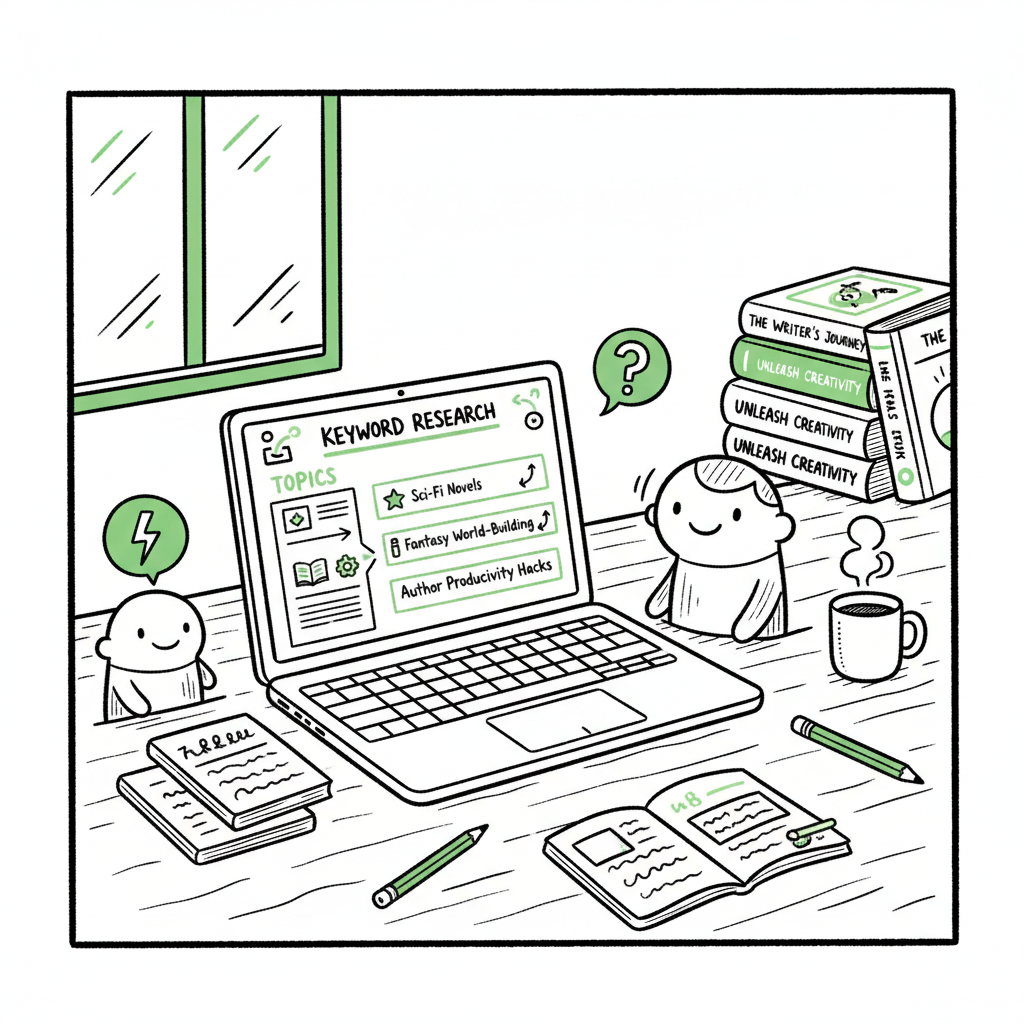
Practical Book Niche Keyword Research for Self-Publishers
Book niche keyword research: a practical guide for self-publishers
Estimated reading time: 9 minutes
Key takeaways
- Focus on reader search phrases, not inside-your-head genre names; start with seed ideas and expand.
- Use a mix of paid tools and manual checks to balance search volume against competition and recent sales.
- Put keywords where Amazon indexes them, and automate uploads once you publish seriously to save time and reduce errors.
Table of Contents
- How to do book niche keyword research
- Tools and manual checks
- Keywords in KDP metadata and distribution
- Final thoughts
- FAQ
- Sources
How to do book niche keyword research
If you want your book found, book niche keyword research is the starting point. It’s the simple, repeatable process of turning what readers type into words you use in titles, subtitles, descriptions, and backend fields. Good research narrows your focus to phrases people actually search for and shows where competition is light enough for your book to rank.
Start with the reader. Ask: who is this book for, and what words would they use? For example, a memoir for early-career nurses might use phrases like “first year nursing memoir,” “nurse transition to practice,” or “nurse burnout stories” as seed terms. Seed terms are the input for tools and for manual checks.
A practical workflow:
– Gather 5–10 seed phrases from your outline, reader persona, and competitor blurbs.
– Feed seeds into a paid tool or a free extension to get related searches and search volume estimates.
– Check the top results: how many books, average Best Seller Rank (BSR) where visible, prices, and review counts.
– Triage: keep phrases with reasonable search volume and fewer well-reviewed competitors.
Early in this process you’ll also spot niches worth exploring more deeply. If you’re unsure what niches work, a helpful resource is Book Niches That Sell — it shows practical examples and patterns for low-content and niche titles you can test.
Tools and manual checks
Tools speed this up, but you still need manual judgment.
What the tools do
- Suggest related keywords from seeds.
- Estimate search volume and competition.
- Show keywords competitors use in titles and descriptions.
Common paid tools give cleaner volume and competition metrics. Free tools and browser tricks can work too: Amazon autocomplete, category browsing, and scanning BSRs and recent releases. When you’re starting out, use a tool to shortlist phrases, then validate manually.
What to check manually
- Search results count: a very high number means heavy competition; very low might mean no demand.
- BSR patterns: look at the average BSR of the top 10–20 listings to judge how many books actually sell.
- Review counts and freshness: many older books with few recent releases often signal an opening.
- Price and format mix: note whether the niche is dominated by cheap low-content books, premium print books, or ebooks.
Cover, file format, and distribution matters too. If you plan to create your own cover, you can speed the design process using a cover generator that processes options quickly. If your book needs an EPUB, use a reliable EPUB converter early so the file is clean before distribution. And if you’re producing paperback or ebook editions for many platforms, consider a publishing workflow that handles the workflow for you to avoid repetitive uploads.
Keywords in KDP metadata and distribution
Amazon gives seven keyword slots of up to 50 characters each. You don’t need to repeat words that already appear in title or subtitle. Use the slots to capture alternate phrasings and longer descriptive searches—think “puzzle book for kids ages 6-8” not just “kids puzzle book.”
Where to apply keywords
– Title and subtitle: put the strongest phrase here if it reads naturally.
– Book description: use variations in the first 200–300 words where they matter most.
– Amazon backend keyword slots: use related terms that didn’t fit in the title/subtitle.
– Categories: pick two categories that match your niche and submit a category request if needed.
Multi-platform distribution
– Different platforms may index differently. Kobo and Apple are less opaque than Amazon in how they rank content.
– A unified, automated publishing workflow matters when you distribute widely. Batch CSV uploads and platform-specific intelligence let you tailor metadata without retyping everything for each store. That’s particularly useful when you test variations of keywords across platforms.
Practical tips
– Avoid subjective or banned words like “best” or “award-winning.”
– Combine related words into a single slot using natural phrases instead of comma lists.
– Track performance: change one element at a time—swap a keyword slot or rewrite a subtitle—and watch the sales trend for a few weeks.
When you publish many books, the time saved by automating uploads is not a nicety; it becomes essential. Automation reduces errors, keeps metadata consistent across KDP, Kobo, Apple Books, Draft2Digital, and Ingram, and can yield around 90% time savings on repetitive tasks. At that scale, a CSV batch upload and platform-specific presets are an obvious upgrade.
Final thoughts
Book niche keyword research is a repeatable craft. Start with reader-focused seed phrases, validate with tools and manual checks, then apply keywords where platforms actually look for them. When you move from one book to many, invest in a publishing workflow that automates uploads, handles format conversions and cover processing, and lets you test keywords across stores without retyping metadata.
FAQ
Q: How many keywords should I test at once?
A: Test a few at a time—two to three meaningful changes per test. Give a test at least two to four weeks if you’re seeing sales, longer if you’re in a slow niche.
Q: Can I use the same keywords across platforms?
A: You can reuse many keywords, but each store indexes differently. Use platform-specific intelligence to adjust phrasing and categories.
Q: Do keywords matter for low-content books like journals and puzzle books?
A: Yes. Low-content niches are driven by search phrases. Pay attention to recent releases, price, and review counts to find gaps.
Q: How often should I revisit keyword research?
A: Revisit every time you publish a new title in the niche, and recheck a live title’s keywords every three to six months or after a significant market shift.
Q: Should I focus on long-tail keywords?
A: Yes. Long-tail phrases can reduce competition and improve conversions; balance them with broader terms for coverage.
Q: Is it beneficial to test keywords across platforms in parallel?
A: Yes. Parallel testing helps you identify which terms perform best on each store, but track changes one at a time to understand impact.
Visit BookUploadPro.com to try a free trial and see how CSV batch uploads, platform-specific intelligence, and multi-platform automation make wide distribution practical. Automate the upload. Own the distribution.
Sources
- Conducting Keyword Research with Book Bolt: A Tutorial on Finding Profitable Keywords
- Mastering Keyword Research for Indie Publishers
- How to Find Profitable Keywords and Niches With Publisher Rocket (video)
- KDP Keyword Research for No & Low Content Book Niches (Free) (video)
- Niche Research 3: Keyword Research Tips
Book niche keyword research: a practical guide for self-publishers Estimated reading time: 9 minutes Key takeaways Focus on reader search phrases, not inside-your-head genre names; start with seed ideas and expand. Use a mix of paid tools and manual checks to balance search volume against competition and recent sales. Put keywords where Amazon indexes them,…