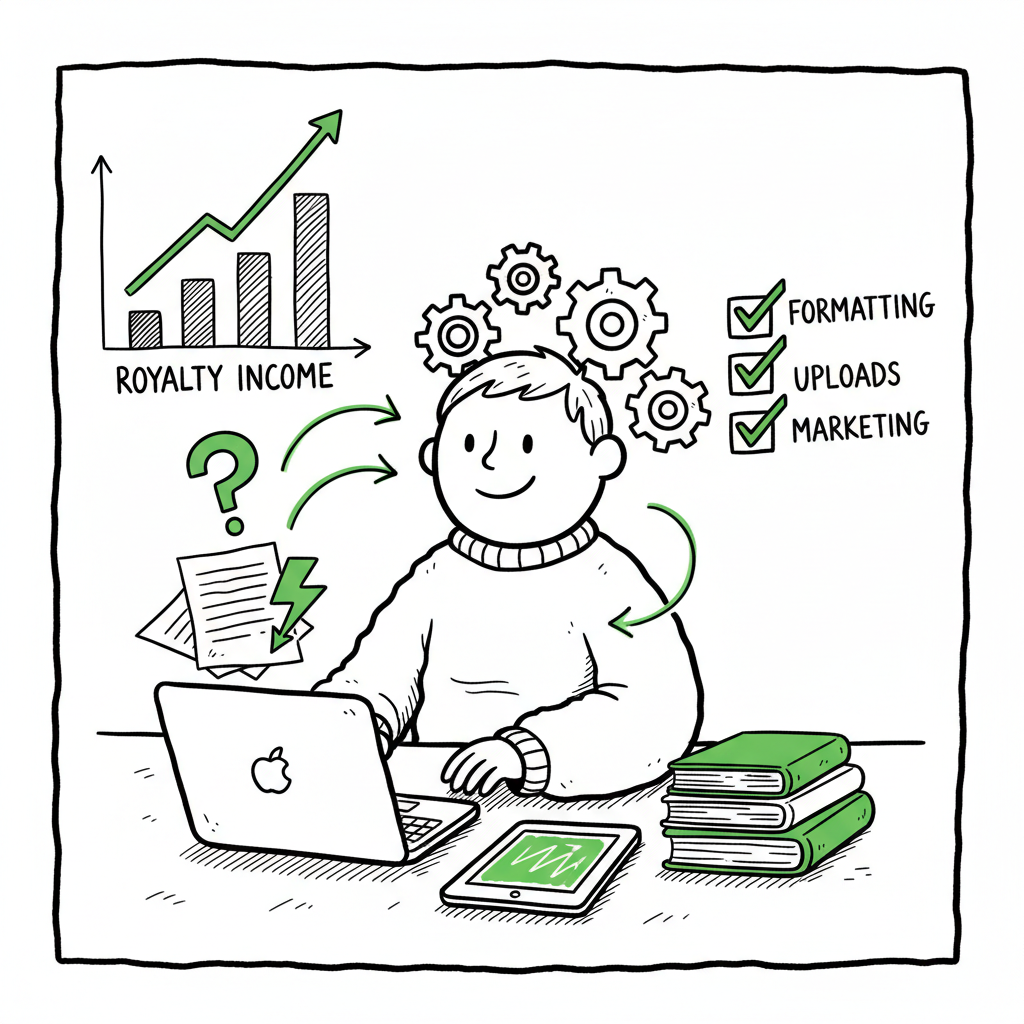
Author Income Automation to Create Predictable Royalties
Author Income Automation: How to Turn Books into Predictable Royalties
Estimated reading time: 10 minutes
Key takeaways
- Author income automation is a systems approach that reduces manual work and makes royalties more predictable.
- Start by automating the lowest-value tasks: formatting, uploads, and distribution; then add marketing and recurring revenue layers.
- Unified multi-platform publishing tools and CSV batch uploads let authors scale titles while cutting error rates and saving ~90% of time on repeats.
Table of Contents
- What author income automation is and why it matters
- Build the automation foundation for steady royalties
- Scale faster with unified multi-platform publishing
- Common risks, quality controls, and practical next steps
- FAQ
- Sources
What author income automation is and why it matters
Author income automation describes the set of systems and tools that turn book assets into steady, semi-passive revenue with less daily effort. In practice this means automating repetitive technical tasks — formatting, file conversion, metadata, platform uploads, and royalty tracking — while also creating repeatable marketing and distribution processes that sell books on autopilot. The phrase author income automation captures both the technical plumbing and the business design that makes author earnings reliable.
The goal is not to remove the author from the process. It is to remove the busywork so authors can publish more, test ideas faster, and own the channels that pay them. That’s why this approach pairs automated publishing with diversified passive author revenue streams like direct sales, subscriptions, licensing, and serialized content.
If you want a practical companion that shows how to package publishing into repeatable revenue, see Automated Passive Income With Books.
Why automation improves author earnings
Automation lowers the cost and time needed to publish each title. When formatting, uploads, and distribution are systematized, an author can publish many more books in the same time it once took to publish one. More titles plus broader distribution equals more royalty lines and more predictable monthly income.
Automation also reduces mistakes that cost time and revenue: incorrect metadata, bad interior files, or platform-specific errors. Fewer errors mean faster approvals, fewer delistings, and steadier royalty flows.
Build the automation foundation for steady royalties
Start small and practical. The fastest wins come from automating tasks that are repetitive, error-prone, and low-value for you to do manually. Focus on three foundations: production automation, format and delivery tools, and basic marketing sequences.
Production automation: get the manuscript production line right
Production automation means standardizing how manuscripts move from draft to final files. This includes:
- Standard file naming and folder structure
- Automated conversion to publishable formats
- Template-based covers and internal layout
For cover work, using a tool like a cover generator speeds early-round mockups and keeps design consistent across a series; this helps when you’re batching multiple releases. If you need a fast cover workflow, try a book cover generator to process art and export platform-ready files.
Format and delivery: make every title upload-ready
Different stores require different file types and metadata. Converting to EPUB and preparing print-ready files are classic time sinks. Use an automated EPUB converter to move from manuscript to a retailer-ready ebook quickly, and integrate checks that flag common formatting problems.
For paperback and ebook creation, a predictable, repeatable pipeline that produces both interior and cover files removes the last-mile headache of distribution. A reliable book creation process reduces re-uploads and approval delays.
Metadata and description generation
Generating clean, retail-ready descriptions, keywords, and category choices can be templated. When you publish many titles, small gains in metadata quality multiply. Keep templates for:
- SEO-friendly descriptions with benefits and hooks
- Keyword sets tailored to genre or topic
- Category mapping so each platform gets the best fit
Automate author royalties and reporting
Automating royalty collection and reporting means linking payout reports into a simple dashboard or spreadsheet so you can spot trends and errors early. It’s less glamorous than writing, but knowing which titles earn and why is the difference between guessing and managing a business.
Scale faster with unified multi-platform publishing
Once you have production and format automation in place, scale by expanding distribution and automating uploads. The core lever is unified multi-platform publishing: one source of truth that pushes correctly formatted files and metadata to Amazon KDP, Kobo, Apple Books, Draft2Digital, Ingram, and other retailers.
Why unified publishing matters
When you upload a title to one dashboard that handles platform-specific formatting, pricing, and category mapping, you eliminate duplicate work and platform-specific mistakes. That frees an author to test pricing, run promotions, and create bundles without manual repetition.
CSV batch uploads and platform intelligence
CSV batch uploads are a force multiplier. Instead of entering metadata and files one title at a time, authors can prepare a spreadsheet that includes titles, descriptions, SKU mapping, price tiers, and file links. A publishing platform that understands each retailer’s rules can ingest the CSV, transform fields as needed, and upload files in bulk.
Platform-specific intelligence reduces rejections
Platform intelligence reduces back-and-forth. Good systems know, for example, that Apple Books needs a slightly different EPUB structure, or that Ingram has particular ISBN and trim-size requirements. That intelligence cuts the back-and-forth and saves time.
How this changes author earnings automation
Wider, faster distribution both increases revenue and smooths it. If one store changes its algorithm or policy, the author still has other income sources. This diversification is the backbone of passive author revenue streams: multiple small royalty lines add up and are more stable than relying on a single bestseller.
BookUploadPro and the operational upgrade
For authors who publish seriously, a service that automates uploads across Amazon KDP, Kobo, Apple Books, Draft2Digital, and Ingram is an obvious upgrade. The right tool saves time on repetitive tasks, reduces errors, and handles bulk actions with CSV batch uploads and platform-specific intelligence. Many authors report near 90% time savings on the upload and formatting steps once they move to a unified system.
Automate the upload. Own the distribution. Once set up, the system becomes the foundation for author earnings automation: faster releases, broader reach, and fewer manual checks.
Production extras that pay off
Beyond core uploads, there are related automations that increase lifetime value per reader:
- Automated bonus delivery after purchase (e.g., extra chapters, worksheets)
- Evergreen email funnels that recommend backlist titles
- Bundling logic that creates boxed sets from existing files
These systems can be built gradually. Start with reliable delivery of files and clean metadata, then add marketing triggers and subscription layers.
Common risks, quality controls, and practical next steps
Automation helps, but it also introduces new points of failure if left unmonitored. The smartest approach is layered: automate the routine, but build checkpoints where a human confirms quality and brand voice.
Common risks and how to manage them
- Over-automation of creative checks: Use templates for formatting and metadata, but keep a human review step for the book description, author notes, and opening pages.
- Platform dependency: Don’t rely on a single retailer or a single tool. Diversify distribution and keep local copies of all master files.
- Complex stacks: Start with a minimal set of tools and add integrations only when the benefit is clear. Too many moving parts can make fixes hard.
Quality control checklist
Before any bulk upload run these quick checks:
- Correct EPUB and PDF interiors (spot-check a few pages)
- Cover trim and spine setup match print specs
- Metadata matches the book’s tone and keywords
- ISBNs and pricing tiers are assigned correctly
- Delivery files are stored in a central, backed-up location
Practical path to automation
1. Pilot one title: Automate formatting and upload for a single new or backlist title. Refine templates and fix issues.
2. Batch three to five titles: Use CSV batch uploads and cover templates to release a small batch together.
3. Add marketing automation: Create evergreen email flows and a direct-sales page, then link them to your publisher dashboard.
4. Monitor royalties and iterate: Use monthly reports to see which titles or formats perform best, then reallocate effort.
Tools to consider along the way
– A reliable EPUB converter saves manual file fixes.
– A tool for consistent cover file production speeds up batch releases.
– A multi-platform publishing tool that accepts CSV uploads and enforces platform-specific rules cuts errors.
If you need faster EPUB conversion, an EPUB converter can streamline the file prep step. If you are producing both ebooks and paperbacks, point your process at a tested book creation process.
Final practical notes about rights and licensing
Automating rights and licensing listings can add another recurring revenue layer. Platforms that expose works to translators, audio producers, or licensing partners make it easier to earn money from the same IP. Treat person-to-person deals as exceptions; automate the discovery, listing, and reporting of licensing opportunities where possible.
FAQ
Q: What exactly counts as author income automation?
A: Anything that makes a repeatable income-related task happen with less hands-on time. That includes automated formatting, batch uploads, metadata generation, royalty reporting, email funneling for sales, and systems to deliver paid extras. The goal is to lower time per title and stabilize income streams.
Q: How quickly can I expect results from automating publishing?
A: You’ll see time savings immediately on single tasks. Revenue gains are slower because they depend on more titles, distribution breadth, and marketing funnels. Expect the biggest financial improvements once you can produce and publish multiple titles reliably.
Q: Will automation harm my book’s quality or brand?
A: It can if you automate everything blindly. Protect quality with human review points for voice-sensitive elements like descriptions, front matter, and sample chapters. Use automation for structure and delivery; keep brand-sensitive checks manual.
Q: What are the best task candidates to automate first?
A: Formatting, file conversion, metadata templating, and uploads. These are repetitive and technical. After those, automate marketing sequences like welcome emails and launch drip campaigns.
Q: Do I need to learn code to automate publishing?
A: No. Many tools support CSV uploads, drag-and-drop interfaces, and simple integrations. The key skill is process thinking: knowing what steps are repeatable and documenting them for automation.
Q: Can automation help with rights and licensing?
A: Yes. Platforms that list rights, standardize offers, and report payouts make passive licensing easier. Automation helps with discovery and reporting, though complex negotiations still need human oversight.
Q: Can I rely on automation for book marketing?
A: Automation can support, not replace, thoughtful marketing. Use automated sequences to nurture readers and promote backlist, while preserving personal touches in outreach.
Q: Is there a risk to the author brand with automation?
A: Yes—if automation bypasses voice and quality checks. Maintain human oversight for descriptions, opening pages, and branding elements.
Q: Do I need to buy specialized software to start?
A: Not necessarily. Many tools support CSV uploads, drag-and-drop interfaces, and straightforward integrations. The key is defining repeatable steps and setting up repeatable checks.
Q: Can automation help with rights and licensing?
A: Yes. Platforms that list rights, standardize offers, and report payouts make passive licensing easier. Automation helps with discovery and reporting, though complex negotiations still need human oversight.
Final thoughts
This is a practical, staged approach. Start by removing the low-value, repeatable work from your plate. Build a reliable pipeline that converts manuscripts into clean files and pushes them to multiple platforms. Add marketing automation and rights listings only after the publishing engine runs reliably.
Tools that offer unified multi-platform publishing, CSV batch uploads, and platform-specific intelligence are the natural next step once you’re publishing seriously. They reduce errors, speed releases, and let you treat your catalog like an asset rather than a collection of one-off tasks. For many authors, a service that automates uploads across Amazon KDP, Kobo, Apple Books, Draft2Digital, and Ingram becomes an obvious upgrade. It’s the operational lever that scales output while keeping quality steady.
Automate the upload. Own the distribution.
Call to action
Visit BookUploadPro to learn more and try the free trial.
Sources
- How Author.Inc uses AI and Zapier to scale publishing — https://zapier.com/blog/authorinc-automates-publishing-and-increases-profits/
- 7 Revenue Streams Every Author Should Consider in 2025 (And How to Tie Them Into a Thriving Business)
- How Authors and Writers Can Make Money Online in 2025
- How to Make Money from Writing in 2025
- How To Start An Automated Book Business in 2025 (video)
- 2025 Indie Author Survey Results – Insights into Self-Publishing for Authors
- Publishing Industry Trends 2025: 10 Steps for Author Success
- The Future of Self-Publishing: Trends Authors Should Watch in 2025
- 7 New Ways to Earn Money from Writing in 2025 (That Most Freelancers Don’t Know Yet)
Author Income Automation: How to Turn Books into Predictable Royalties Estimated reading time: 10 minutes Key takeaways Author income automation is a systems approach that reduces manual work and makes royalties more predictable. Start by automating the lowest-value tasks: formatting, uploads, and distribution; then add marketing and recurring revenue layers. Unified multi-platform publishing tools and…