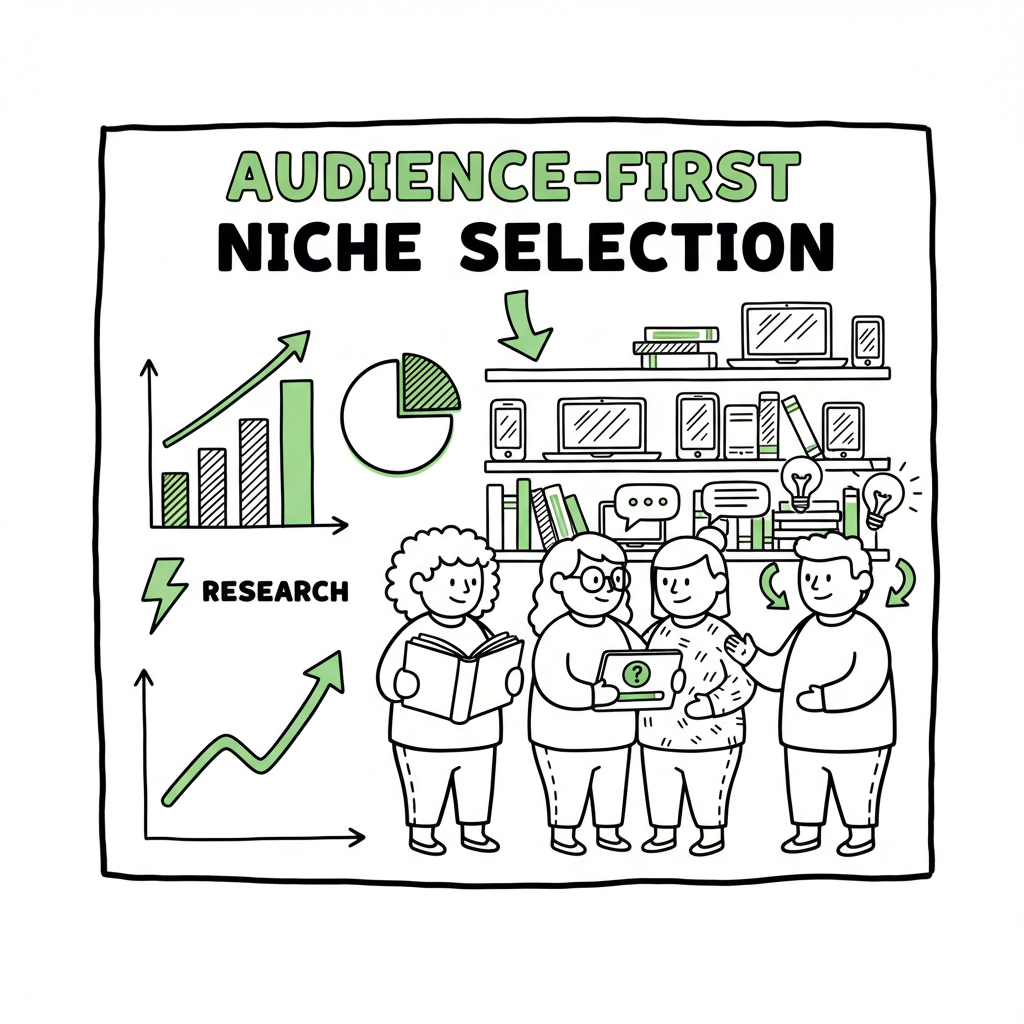
Audience-First Niche Selection for Self-Publishers
Audience-First Niche Selection: Find the Readers Who Buy
Estimated reading time: 9 minutes
Key takeaways
- Audience-first niche selection focuses on readers, not ideas — it identifies a specific group with unmet needs and builds books for them.
- Validate niches with simple research: surveys, forum listening, small ads, and measuring pre-orders or email signups.
- Use automation and multi-platform publishing to test more niches fast, reduce errors, and scale winners across Amazon KDP, Apple, Kobo, Draft2Digital, and Ingram.
- Practical tools — from batch CSV uploads to EPUB conversion and cover generation — make niche experiments affordable and repeatable.
- When a niche proves profitable, move from testing to systematic catalog growth and automation to protect your time and margins.
Table of Contents
- Why audience-first niche selection works
- Profile, validate, and size a niche
- Publish at scale: workflow and automation
- Measure, iterate, and grow
- FAQ
- Sources
Why audience-first niche selection works
Audience-first niche selection is a practical approach: start with the people, not the product. Instead of guessing which book will sell, you find a group of readers with a real problem or desire and make a book that fits their language, channels, and buying behavior. This lowers wasted effort and raises the chance a release will earn.
Authors who use this method write less content that performs better. It trims marketing costs because you advertise and place the book where that audience already gathers. If you want concrete examples and places to test ideas quickly, see Book Niches That Sell. That kind of focused testing lets you learn fast without committing to a long, expensive production cycle.
Why it matters for self-publishers
- Less competition: narrow audiences attract fewer publishers.
- Higher conversion: tailored copy and covers speak directly to specific needs.
- Repeatability: once you understand a niche, you can publish related titles and bundle them.
Profile, validate, and size a niche
Profile: turn a broad idea into a reader persona
Good niches are specific but not microscopic. Build a simple persona:
- Demographics: age, gender, location when relevant.
- Life context: occupation, hobbies, problems.
- Behavior: where they hang out online, how they buy books.
Example: instead of “fitness,” target “30–45-year-old busy parents who run 30–60 minutes three times a week and want quick strength routines.” That gives actionable tone, cover, and distribution decisions.
Validate: low-cost tests that prove demand
Before writing a full book, validate with small experiments:
- Search and keyword signals: look for recurring questions in forums and social posts.
- Small ad tests: a low-budget Facebook or Amazon ad to a landing page can show interest.
- Email signups and pre-orders: a small landing page with a sample chapter is a direct signal.
- Read reviews: competitor reviews reveal gaps you can fill.
Size the niche
A niche must be large enough to pay the bills. Use these simple checks:
- Look at category ranks and similar titles on the major stores.
- Estimate how many buyers you need and how long to reach profitability.
- Balance specificity with scale: if you’re too narrow, you may not reach break-even.
Practical research tools
Talk directly to places your readers gather. Reddit threads, Facebook groups, Amazon reviews, and niche blogs give clear, low-cost insight into language and needs. Compile the phrases readers use — those words become your back cover copy, metadata, and ad creatives.
Publish at scale: workflow and automation
Once you have a validated niche, the next step is efficient publishing. The difference between hobby and business is systems. Automation lets you test dozens of micro-niches without burning time on manual uploads or repeated formatting.
What to automate
- Metadata, pricing, and category choices across platforms.
- Batch uploads via CSV for repeated titles and series.
- Platform-specific file checks to avoid rejection or bad rendering.
Key elements of a repeatable workflow
- Template your content. Standardize file names, metadata fields, and cover specs so you can swap in new text and assets quickly.
- Automate format conversions. Turning a manuscript into EPUB and print files should not be a slow manual task; an EPUB converter speeds testing and reduces formatting errors.
- Automate covers and variations. Generate tested cover variations with a reliable tool so you can A/B visual styles without hiring a designer for every change. If you want to streamline cover production, use a cover generator to speed the process.
- Centralize distribution. A single interface that submits to Amazon KDP, Kobo, Apple Books, Draft2Digital, and Ingram saves hours and eliminates repetitive form entry.
Why multi-platform matters
Many niches buy from stores other than Amazon. Reaching readers on Apple Books, Kobo, and Ingram widens exposure and reduces dependency on one algorithm. When you automate the upload, you can publish simultaneously and measure which store gives the best return for a niche.
Operational benefits
- ~90% time savings on repeat uploads once templates and automation are in place.
- Fewer manual errors from copying metadata across portals.
- Faster iteration: publish, measure, tweak, and republish without long lag times.
Tools that matter
- CSV batch uploads for metadata and title variants.
- Platform-specific intelligence that maps categories and royalties correctly.
- Reliable EPUB conversion to ensure consistent eBook quality across stores.
- Scalable cover generation so you can test visual concepts quickly.
If you’re creating paperback or ebook files, take advantage of book creation tools to standardize print templates and interior formatting. These tools remove repetitive layout work so you can focus on content and marketing.
Measure, iterate, and grow
Treat early releases as experiments. Capture the metrics that matter for a niche:
- Conversion rate from page views to purchases.
- Cost per acquisition for paid channels.
- Average daily rank and long-tail sales after launch.
- Review themes and reader feedback.
A simple loop
- Launch a low-cost title or lead magnet.
- Run small promotion windows and measure ROI.
- Read qualitative feedback (reviews, messages).
- Improve the copy, cover, or targeting and relaunch.
When a niche wins
Scale by publishing adjacent titles and bundling. Use CSV batch uploads and platform automation to roll out sequels, workbooks, or short companion guides quickly. At this stage, investing in higher-quality covers and distribution strategies pays off because the audience is proven.
Common mistakes to avoid
- Overly broad targeting that wastes ad spend.
- Launching a full-length book before validating interest.
- Relying on a single store or marketing channel.
- Treating covers and metadata as afterthoughts — they are the primary sales drivers in niche markets.
Practical checklist for your next niche test (no frills)
- Build one reader persona.
- Create a one-page sample or lead magnet.
- Test with a small ad or targeted social post.
- Convert the sample to EPUB with a reliable EPUB converter.
- Build 2–3 simple covers and pick the top performer.
- Upload across stores using batch tools and track results.
Automate the upload. Own the distribution. When you reach the point of regular publishing, automation is an obvious upgrade: it reduces errors, saves time, and makes wide distribution practical without hiring a team.
FAQ
Q: How narrow is too narrow for a niche?
A: If you can’t find any comparable books, forums, or search interest, it’s probably too narrow. You want a specific audience, but you also need evidence of demand.
Q: Do I need to build an email list first?
A: No. An email list helps, but you can validate a niche with small ad tests, pre-orders, or direct community engagement first.
Q: What’s the fastest way to test a cover?
A: Use low-cost ad creatives pointing to a landing page with sample content. Rotate a few cover images and measure click-through and signup rates.
Q: Should I publish everywhere at once?
A: Publish where your audience shops. If you’re unsure, publish on the major platforms and use automation to avoid duplicated work. Track which stores give the best results and prioritize them.
Q: How do I price a niche book?
A: Test. Start with a sensible price for the format — $0.99–$4.99 for short niche ebooks, higher for bundles or workbooks — and watch conversion. Adjust based on perceived value and sales velocity.
Final thoughts
Audience-first niche selection is a disciplined, research-driven way to reduce risk and speed learning. Combine focused audience work with repeatable publishing systems and automation. That lets you test more ideas, scale winners, and keep your time on the things that move the business forward.
Sources
- Niche Audience: Definition, Benefits and How To Attract One – Indeed
- Strategies for Reaching Niche Audiences on Social Media – QuicklyHire
- How to Define Your Niche Audience & Make it Work – Latana
- How to Identify Your Target Audience in 5 steps – Adobe
- Identifying Your Business Niche: The Starting Point of a Successful … – BBOP Center
- Niche Audience: How brands identify and speak to them – Seedtag Blog
Audience-First Niche Selection: Find the Readers Who Buy Estimated reading time: 9 minutes Key takeaways Audience-first niche selection focuses on readers, not ideas — it identifies a specific group with unmet needs and builds books for them. Validate niches with simple research: surveys, forum listening, small ads, and measuring pre-orders or email signups. Use automation…