Amazon KDP Royalty Rates Explained for Ebook and Print
amazon kdp royalty rates explained
Estimated reading time: 10 minutes
Key takeaways
- KDP royalties depend on format, price, and territory: ebooks typically pay 35% or 70%; print and hardcovers follow different tables and include printing costs.
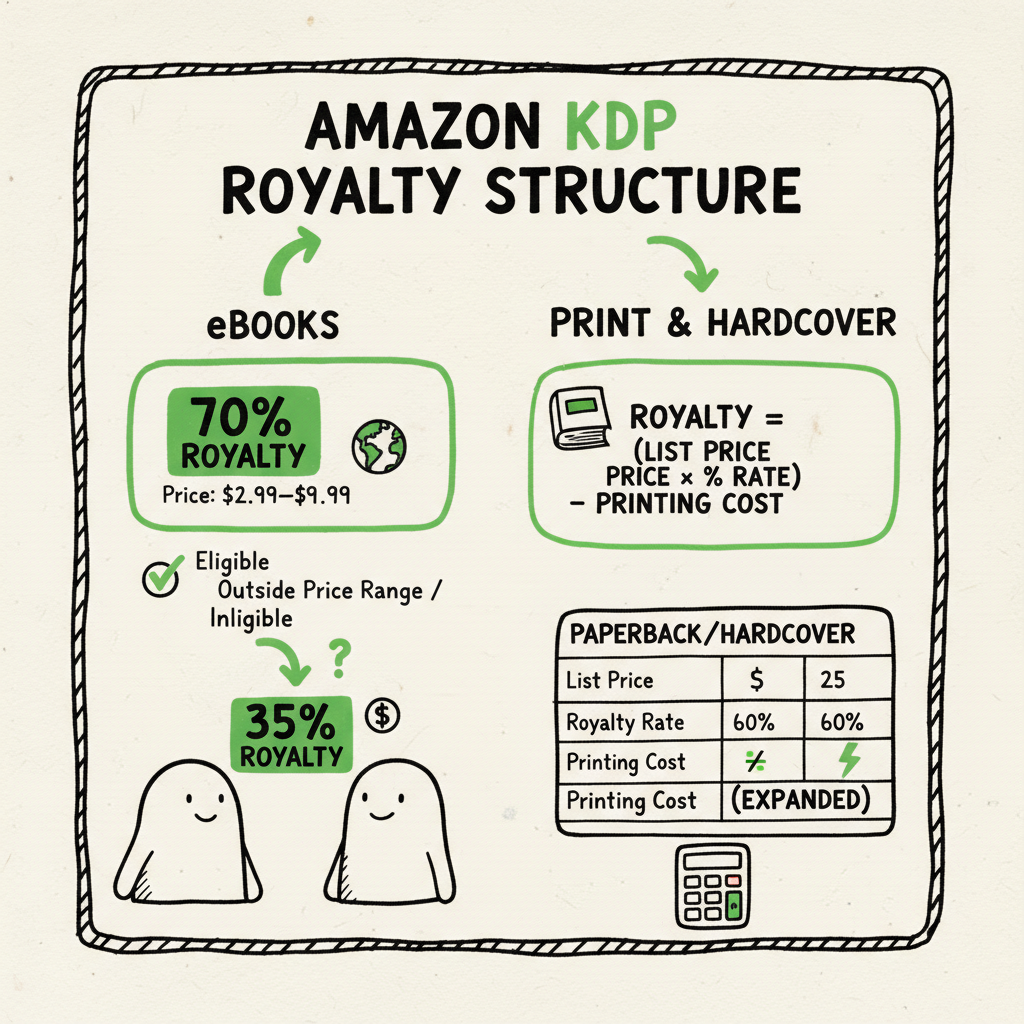
- The 70% ebook rate applies only in certain territories and price bands ($2.99–$9.99 for most markets) and has delivery fees; outside that band, ebooks earn 35%.
- Recent 2025 print changes lower royalties on low-priced paperbacks; always calculate printing costs, delivery fees, and taxes to see your real payout.
- For publishers scaling across channels, automating repetitive uploads saves time and reduces errors. BookUploadPro handles batch CSV uploads and platform rules to cut publishing time by roughly 90%.
Table of Contents
- How KDP royalties work
- Ebook royalties: 35% vs 70%
- Print royalties: paperbacks, hardcovers, expanded distribution
- Practical examples and what to check
- FAQ
How KDP royalties work
If you want a quick primer on getting a book live on Amazon, see Self Publish Book Amazon KDP. Amazon KDP royalty rates explained means looking at three moving parts: the format (ebook, paperback, hardcover, audiobook), the list price you set, and the delivery or printing costs that get deducted before you get paid. The simple formula is:
Royalty = (Royalty rate × list price) − printing or delivery costs − taxes.
That sounds straightforward, but the specifics matter. Ebooks have two main royalty tiers: 35% and 70%. Paperbacks and hardcovers pay by a different schedule where printing costs are subtracted and royalties can be 40%, 50%, 60% or other fixed rates depending on choices like expanded distribution. Audiobooks and exclusive deals follow separate models. Understanding these rules helps you price books so that revenue covers your costs and still reaches readers.
This article walks through the common scenarios, shows the math with realistic examples, and points out where authors often lose income by missing fees or thresholds. It also highlights how automation makes multi-platform publishing practical, especially if you publish many titles or multiple formats.
For more context on publishing workflows, see the related resources from BookUploadPro and industry guides.
Batch and automate repetitive uploads — BookUploadPro handles batch CSV uploads and platform rules to cut publishing time by roughly 90%.
Ebook royalties: 35% vs 70%
The ebook royalty split is the part most indie authors focus on. Here’s how it breaks down in clear terms.
Which rate applies?
- 70% royalty: Available when you price an ebook between $2.99 and $9.99 (or regional equivalent) and sell in eligible territories. A small delivery fee (based on file size) is deducted per sale.
- 35% royalty: Applies if you price outside the $2.99–$9.99 range, sell in an ineligible territory, or choose that option for other reasons. There is no delivery fee for 35% royalties.
Delivery fee and its effect
Amazon charges a delivery fee for 70% titles. The fee is based on the book’s file size (roughly $0.06/MB for many markets). For a text-heavy novel with a small file, delivery is minimal. For richly illustrated ebooks, expensive delivery fees can eat into the advantage of the 70% rate. That’s why calculating net revenue matters, not just the headline percent.
Example: quick ebook math
- List price $4.99, 70% rate → gross = $3.493. If delivery is $0.08, net = $3.413 per sale.
- Same book priced $2.99, 70% → gross = $2.093. Delivery same $0.08 → net ≈ $2.013.
- If you priced $1.99, you’d fall to 35% → gross = $0.697 per sale, with no delivery fee.
This is where the kdp 35 vs 70 royalty trade-off matters. The 70% option incentivizes mid-range pricing, but low-priced ebooks or heavy files may perform better revenue-wise under the 35% tier or with a different format offer.
Other ebook details
Kindle royalty rates explained often include territory restrictions: not every country is eligible for the 70% option. Kindle Unlimited and KOLL (Kindle Owners’ Lending Library) pay differently; payments come from a global fund and are calculated by pages read rather than list price.
Print royalties: paperbacks, hardcovers, expanded distribution
Print royalties are more nuanced because Amazon deducts printing costs from the list price before applying a percentage. You then earn a percentage of the remaining amount, and distribution choices change the rate.
Paperback rules (the practical view)
You set a list price. Amazon calculates a printing cost from page count, ink color, and trim size.
Traditional KDP rates: a percentage of the list price after printing costs. Historically 60% for many sales channels, but recent changes in 2025 reduced royalties for lower-priced paperbacks.
Post-2025 example: on Amazon.com, paperbacks priced at or below $9.98 USD may receive a 50% royalty instead of 60%. Expanded distribution often pays a lower fixed rate (for example, 40%).
Hardcover rules
Hardcovers on KDP typically have a fixed royalty percentage that also subtracts printing costs. Expect about 60% minus printing for many direct Amazon sales, but always check KDP help pages because thresholds and rates vary by market and by program.
Expanded distribution
If you enable expanded distribution (making your print book available to bookstores and libraries through third parties), the royalty falls—often to a fixed lower rate such as 40%—but reach increases. That is a trade-off: more exposure, less per-unit income.
Why printing cost calculation is essential
Printing cost depends on ink (black vs color), page count, and trim size. A 300-page black-and-white paperback has a different cost than a 120-page color interior.
Low-priced paperbacks are more affected by fixed printing costs. Recent 2025 updates made thin margins worse for books priced under certain thresholds. Small price changes can swing a title from profitable to losing money.
Practical examples and what to check
Making print profitable requires testing several price points and paying attention to costs, reach, and margins.
1) Check the ebook price band and territories
- If you want the 70% ebook royalty, confirm your price sits in the $2.99–$9.99 band in each currency you enable. Also confirm each territory you target is eligible for 70%.
2) Calculate delivery and file size
- Compress images when possible. Large image files drive delivery fees up. For illustrated books, compare revenue with 70% minus delivery versus 35% without delivery.
3) Run print cost scenarios
- Use KDP’s print cost estimator to see how page count and ink type affect profit at multiple price points. A $9.99 paperback might have a different effective royalty than a $12.99 one, after you subtract printing costs.
4) Consider expanded distribution trade-offs
- If you need bookstores and libraries to carry your title, accept lower per-unit royalties for broader reach. For many backlist titles with steady demand, expanded distribution adds value.
5) Batch and automate repetitive uploads
- If you publish multiple formats or titles, a batch upload system avoids manual errors and saves time. BookUploadPro supports unified multi-platform publishing with CSV batch uploads, platform-specific intelligence, and error reduction. Automate the upload. Own the distribution.
Real-world example
Imagine a 200-page black-and-white paperback:
- Printing cost (estimate): $3.50
- List price: $12.99
- Royalty rate: 60% on Amazon sales
- Royalty calculation: (60% × $12.99) − $3.50 = $7.794 − $3.50 = $4.294 per sale
Compare that to a $9.99 list price under the 50% adjusted rate:
- (50% × $9.99) − $3.50 = $4.995 − $3.50 = $1.495 per sale
That shows why price thresholds and print costs matter. The same book sells more copies at a lower price sometimes, but revenue per unit can drop dramatically. If you publish many titles, these calculations become repetitive and error-prone; automation with CSV batch uploads and platform rules keeps pricing consistent and reduces the chance of misconfigurations.
Covers and file prep
A correct cover for print needs the exact spine width and safe zones. If you’re generating many covers, using a cover processing tool can save hours. When you produce both paperback and ebook versions, you may use a single cover design adapted to each format—automating this step avoids mismatched artwork.
When to choose each format
Ebook first: low-cost to publish, quick distribution, and favorable margins at the right price point.
Paperback: good for readers who prefer print; margin depends on price and printing.
Hardcover: better for premium editions and higher margins if priced sufficiently above print costs.
Audiobook: expanding revenue but requires separate production and rights decisions.
Note on automation:
No matter how you publish, automation helps with consistency and scale.
For fast EPUB conversion, EPUB converter can handle retailer specs. For cover work, a cover generator processing tool helps you generate correctly sized cover files for print and digital.
If you plan to publish across multiple formats, you may also consider automation tools to convert manuscripts, generate covers, and push files to retailers.
Final thoughts
Understanding amazon kdp royalty rates explained is about more than memorizing percentages. It means running the numbers, testing price points, and picking distribution options that fit the business case for each title. For authors who publish one book, manual steps make sense. For anyone publishing multiple titles or formats, automation becomes an obvious upgrade: it reduces mistakes, enforces pricing rules, and frees time for writing and marketing.
If you create ebooks and paperbacks, make sure your files meet each retailer’s specs. Convert manuscripts carefully, check EPUB output, and produce covers at correct sizes. For fast EPUB conversion, use an EPUB converter that handles retailer specs. For cover work, a cover generator processing tool helps you generate correctly sized cover files for print and digital.
Sources
- Paperback Royalty – Kindle Direct Publishing
- eBook Royalties – Kindle Direct Publishing
- Amazon KDP Royalty Rates & Pricing Strategies – PublishDrive
- Amazon KDP Royalty Changes 2025: What to Know and Do
- Amazon Royalties: What’s Your Share of the KDP Pie? – Reedsy
amazon kdp royalty rates explained Estimated reading time: 10 minutes Key takeaways KDP royalties depend on format, price, and territory: ebooks typically pay 35% or 70%; print and hardcovers follow different tables and include printing costs. The 70% ebook rate applies only in certain territories and price bands ($2.99–$9.99 for most markets) and has delivery…