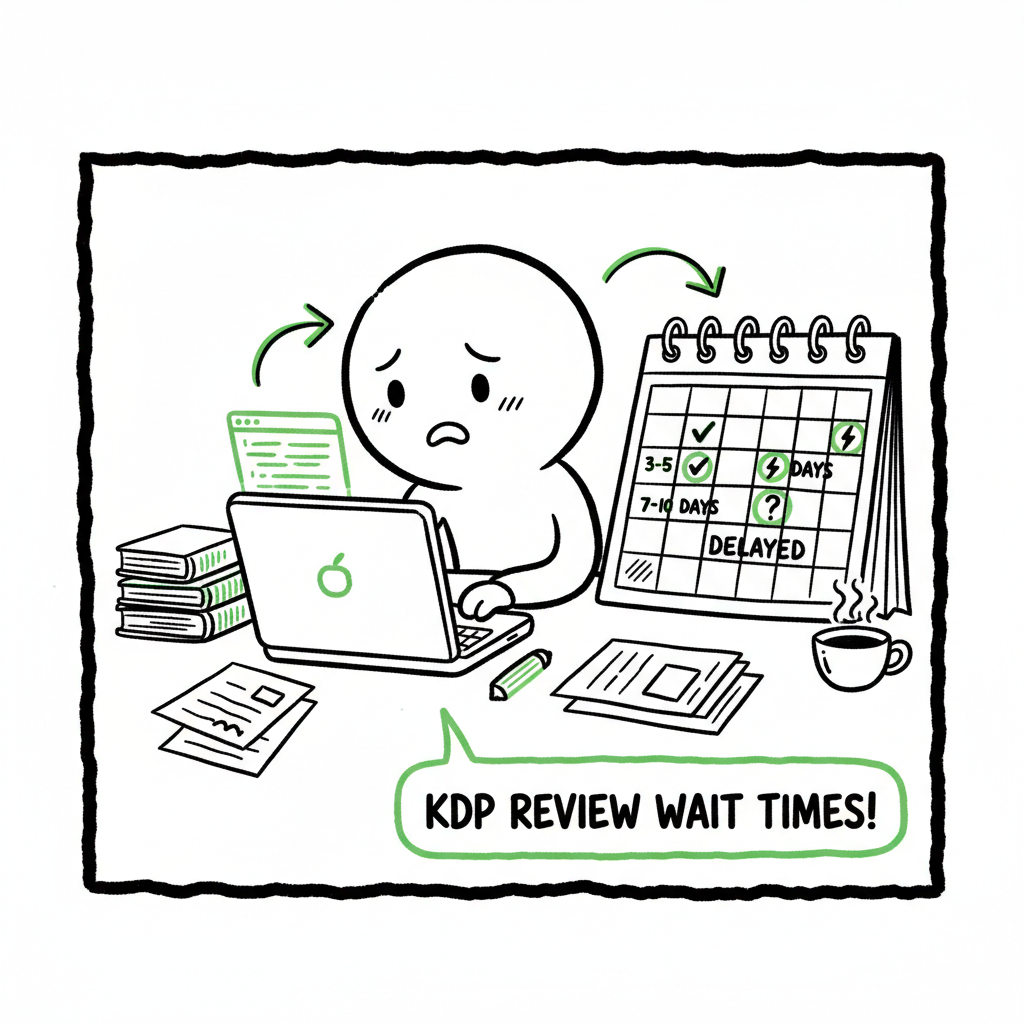
Amazon KDP Review Time Delays for Self-Publishing Authors
Amazon KDP Review Time Delays: What Authors Need to Know in 2025
Estimated reading time: 13 minutes
Key takeaways
- Amazon KDP review time delays are now more variable: plan for 3–10 business days normally, but expect longer windows for low‑content and peak periods.
- Build realistic buffers for launches, optimize files and metadata to avoid avoidable requeues, and use multi‑platform distribution to protect revenue.
- Services that automate compliant uploads and batch distribution (CSV, platform‑specific intelligence) can cut repetitive work by ~90% and reduce human error.
- BookUploadPro focuses on KDP‑ready formatting and metadata so files spend less time stuck in review; it’s an obvious upgrade once authors publish at scale.
Table of Contents
- What’s changing with Amazon KDP review time delays
- How delays affect publishing schedules and launches
- Practical steps to minimize the impact of extended KDP review periods
- FAQ
- Sources
What’s changing with Amazon KDP review time delays
Amazon KDP review time delays have become a practical reality for many self-publishing authors in 2025. Where authors once expected a 24–72 hour turnaround, KDP’s published guidance and independent reports now place most uploads in a 3–10 business day window, with low‑content print books explicitly taking longer. That means journals, notebooks, and some paperback updates can sit in review for up to ten business days — and in busy seasons some titles have taken even longer.
This matters because “live” email confirmations sometimes arrive while product pages remain unavailable, or files return errors days after submission. If you rely on a tight launch calendar, these timing shifts can break coordinated promotions, paid ad schedules, and newsletter pushes.
If you want a focused breakdown of timing patterns and recent community reports, see Amazon KDP Review Delays. Those longer and more variable timelines are driven by several factors:
- Category and content type. KDP treats low‑content books differently from standard single‑title paperbacks and hardcovers. Low‑content updates frequently hit longer review windows.
- Volume and seasonality. Q4 and other high‑volume periods push review queues longer. Increased marketplace traffic and policy checks create bottlenecks.
- Quality and policy flags. Files that trigger automated checks or require human review can add days or weeks. Metadata problems, cover issues, or interior formatting errors are common triggers.
- Platform changes. Amazon adjusts systems and enforcement over time, and tighter checks have raised the baseline for how long an average submission spends in review.
What’s more, the official guidance and what authors report don’t always align perfectly. KDP’s help pages set ranges and expectations, but community experience shows real cases outside those windows — particularly when content is resubmitted or listings fall into edge‑case categories. For publishers that release many titles, a few delayed listings can have outsized operational impact.
How delays affect publishing schedules and launches
A delayed KDP approval is not just an administration problem; it’s a business problem. Here’s how slower turnarounds translate into practical complications.
Launch timing and marketing
- Planned, date‑driven launches depend on predictable availability. If your book doesn’t appear on Amazon on schedule:
- Preorders may not convert cleanly to live pages.
- Paid ad campaigns can waste budget while the product page returns errors.
- Newsletter and publicity dates can lose momentum if links fail.
Sales and ranking
When a book appears late, early sales and ranking momentum are lost. That first week on Amazon often sets the tone for discoverability. Delays compress opportunity windows and can diminish the impact of coordinated promos across platforms.
Inventory and print copies
KDP print proofs and production may be slow for certain paperbacks. If you sell print copies on other channels or want Ingram distribution, timing mismatches between platforms complicate fulfillment and stock planning.
Administrative overhead
Longer reviews mean more time spent checking status, resubmitting fixes, and hunting support threads. For individual authors this is a distraction; for publishers it multiplies across titles, adding significant cost.
Risk to time‑sensitive projects
Books tied to event dates, seasonal buying, or media tie‑ins are especially vulnerable. A ten‑day delay in Q4 or just before a coordinated promotion can be effectively unrecoverable for that campaign.
Practical steps to minimize the impact of extended KDP review periods
You can’t control Amazon’s internal queues. You can control what you submit and how you plan. The following steps reduce avoidable delays and create resilience around KDP variability.
-
1) Build a realistic schedule buffer
Assume 3–10 business days for a standard submission and up to 10 business days (or more in peak season) for low‑content print titles. For time‑sensitive launches, schedule file submission at least two weeks earlier than your intended live date. That extra buffer buys room for resubmission if KDP flags content.
-
2) Optimize files and metadata to avoid requeues
Many review holds are preventable. Before uploading:
- Validate interior files against KDP specs and proof them at the expected print size.
- Check margins, fonts, and embedded images to avoid technical rejections.
- Use clear, policy‑compliant metadata and avoid keyword stuffing that can trigger a manual review.
If your workflow includes cover creation, generate final artwork that follows KDP trim and spine guidelines. For an automated option that speeds cover processing, consider using an automated book cover generator that produces print‑ready files aligned with platform rules.
-
3) Convert and test ebook files early
Convert your manuscript to EPUB and test on multiple devices. Errors in EPUBs often cause additional human review. If you need a reliable conversion tool, use a dedicated EPUB converter to produce validated files that meet KDP and other retailers’ requirements.
-
4) Prepare both ebook and print packages
When possible, prepare full distribution packages so you can publish on other stores if Amazon lags. Creating both an ebook and a paperback offers redundancy: if KDP’s paperback review stalls, your ebook can still sell through other retailers. If you create paperbacks or ebooks with consistent templates, you reduce formatting mistakes and speed up reuploads when necessary.
-
5) Use multi‑platform distribution to protect launches
Broad distribution reduces single‑platform dependency. Uploading to Kobo, Apple Books, Draft2Digital, and Ingram diversifies exposure and revenue. For authors who publish seriously, a single‑tool approach to batch uploads and CSV distribution makes wide distribution practical and affordable. Automating repetitive uploads for multiple platforms cuts the manual burden and minimizes the chance of human error.
-
6) Batch uploads and CSV workflows
If you publish multiple titles, use CSV batch uploads to reduce repetitive work. Structured batches let you validate metadata at scale, reducing per‑title errors that invite KDP checks. Services that support CSV batch imports can save significant time and reduce resubmissions.
-
7) Keep a log of live checks
Maintain a simple tracker for each submitted title: submission date, file versions, proof link, and any KDP messages. That log improves visibility and helps you detect patterns that predict future problems. Over time you’ll see which categories and formats attract longer reviews.
-
8) Coordinate promotions around buffer windows
Plan marketing and ad spend to align with your expected live window rather than the submission date. For launches, schedule paid traffic to begin after the maximum expected review period, or run prelaunch promos that don’t require a live purchase link.
-
9) Communicate with readers proactively
If a book is delayed, be transparent with your audience. Share new expected dates and explain you’re waiting for platform approval. Readers are more forgiving when informed; silence increases cancellation and confusion.
FAQ
Q: How long should I expect a typical KDP review to take?
A: Official guidance and community experience point to a typical window of 3–10 business days. Standard paperbacks often clear in around three business days under normal conditions, but low‑content print updates and peak seasons can extend that to 10 business days or more.
Q: Do low‑content books always take longer to review?
A: Not always, but they are more likely to. KDP explicitly calls out longer processing times for low‑content paperbacks, and community reports in 2024–2025 show journals and notebooks frequently take longer to become fully available.
Q: What triggers manual review and delays?
A: Common triggers include formatting errors (margins, bleed, embedded fonts), metadata problems, policy flags, and resubmissions. Also, high submission volumes during peak seasons increase the chance of human checks.
Q: Can a third‑party service guarantee faster KDP approvals?
A: No service can override Amazon’s systems. A reliable provider reduces avoidable errors and improves the chance of smooth automated checks, but platform variability and policy holds remain external risks.
Q: Should I publish on multiple platforms to mitigate KDP delays?
A: Yes. Publishing across Kobo, Apple Books, Draft2Digital, and Ingram protects sales and discoverability if Amazon is slow. Multi‑platform distribution becomes essential for authors who need resilience and consistent availability.
Q: Where can I get tools for covers or EPUB conversion?
A: For automated cover creation and print‑ready processing, use a dedicated book cover generator that outputs correct trim and spine files. For stable ebook files, use a validated EPUB converter to reduce format errors and minimize review friction.
Q: How does BookUploadPro help with these delays?
A: BookUploadPro creates KDP‑ready interiors, covers, and metadata, applies platform‑specific validation, and supports CSV batch uploads for multi‑platform distribution. That reduces the number of manual resubmissions and lowers the operational burden caused by extended review periods.
Sources
- https://kdp.amazon.com/help/topic/G200627450
- https://kdp.amazon.com/help/topic/G202173620
- https://selfpublishingchecklist.com/how-long-does-the-kdp-review-process-take/
- https://amarketingexpert.com/2024/11/21/amazon-delays-what-to-do-when-your-book-launch-hits-a-kdp-roadblock/
- https://www.youtube.com/watch?v=ncVch0p0rKs
- https://kdpcommunity.com/s/question/0D5at00000Ukt6jCAB/how-long-does-it-usually-take-for-kdp-to-approve-a-book-after-resubmitting-files
Visit BookUploadPro.com to try the free trial.
Amazon KDP Review Time Delays: What Authors Need to Know in 2025 Estimated reading time: 13 minutes Key takeaways Amazon KDP review time delays are now more variable: plan for 3–10 business days normally, but expect longer windows for low‑content and peak periods. Build realistic buffers for launches, optimize files and metadata to avoid avoidable…