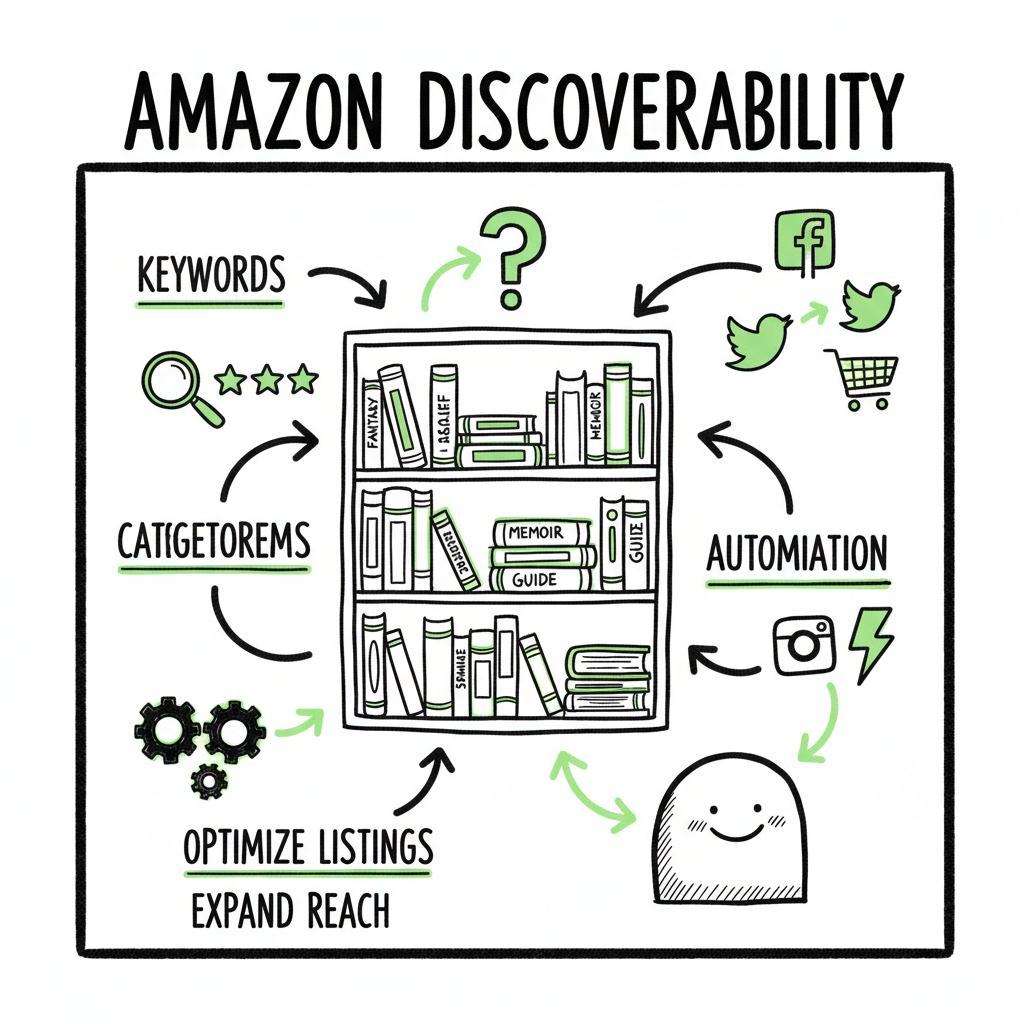
Amazon Book Discoverability Practical Tactics for Authors
Amazon Book Discoverability: Practical Tactics for Multi-Platform Authors
Estimated reading time: 8 minutes
Table of Contents
- Why Amazon book discoverability still matters
- Optimize keywords, metadata, and listings
- Scale reach with multi-platform publishing and automation
- FAQ
Why Amazon book discoverability still matters
Amazon book discoverability is the gateway to sales on the world’s largest book marketplace. Readers find books through search, category browsing, and algorithmic recommendations that value relevance, engagement, and proven buyer intent. That means your listing — title, subtitle, metadata, keywords, description, and categories — must be tuned for both human readers and Amazon’s models.
Start with the reader’s language. Think about the exact phrases a reader types or says when looking for your book. Then test those phrases in the Amazon search box. If you want a deeper how-to on keyword research that focuses on Amazon patterns, see our guide Amazon Book SEO For Authors for practical, field-tested methods. Early testing and small wins compound: better keywords drive more impressions, which can lead to more clicks and stronger ranking signals.
Optimize keywords, metadata, and listings
Keywords remain central. Use the seven KDP keyword fields with up to 50 characters each. Put logical phrases and long-tail terms there instead of single words. Avoid punctuation like quotation marks and avoid repeating words that already appear in your title or subtitle. Think in reader intent: “cozy mystery with cats” or “plant-based instant pot recipes” are better than broad, competitive words.
Titles and descriptions must be clear and consistent across formats. Match keywords in your description naturally. Keep category choices accurate and consider two-category strategies where allowed. Use Amazon Ads and A+ Content to amplify visibility for titles that already convert; paid spend can accelerate organic traction if you use it to test messaging and audience fit.
In 2026, AI-powered search is changing discoverability. Generative outputs favor books that match complete reader queries and can be surfaced in conversational responses. That raises the value of long, specific metadata and clear, answer-oriented descriptions. Regularly review and update keywords based on performance, seasonal trends, and new reader language.
Scale reach with multi-platform publishing and automation
If you publish more than one title a year, manual uploads and repeated form-filling become a bottleneck. That’s where automation and distribution matter. A multi-platform approach places your book where readers already buy — Amazon, Apple Books, Kobo, Ingram, and others — and lets platform-specific search behave in parallel. Distribution also gives you more data points: performance on other stores often signals new keywords or markets to test on Amazon.
Automation tools cut repetitive work and reduce errors. CSV batch uploads, platform-specific intelligence that presets spine sizes and metadata, and consistent file handling mean you can publish more often without adding overhead. For authors scaling output, automation is an obvious upgrade once you start publishing seriously: it saves time, lowers mistakes, and makes wide distribution practical.
Practical production details matter here too. Convert clean, final manuscripts to EPUB to meet retailer requirements and preserve layout across stores. If you need a reliable tool for that step, consider an EPUB converter that handles images, TOC, and metadata correctly. Similarly, when creating paperback and ebook files, use tools that standardize trim sizes, interior specs, and metadata to avoid rejections. If you handle covers in-house or via a designer, a dedicated book cover generator can speed iteration without sacrificing quality.
Automation does not replace listing strategy. Use it to free time for testing keywords, writing better blurbs, and running targeted ads. The right stack will let you iterate faster: update keywords based on sales data, refine description copy, and push new formats to stores without repeating manual uploads.
Wrap-up paragraph: Publishers and serious indie authors win by treating discoverability as an ongoing operation, not a one-time task. Tune your Amazon listing for readers first, use data to iterate, and scale distribution with automation so you can spend time on writing and promotion. Automate the upload. Own the distribution.
FAQ
Q: How often should I update my Amazon keywords?
A: Update when you see changes in search behavior, after promotional campaigns, or every 4–8 weeks for active titles. Small, measured changes are better than wholesale swaps. Track impressions, clicks, and conversion to judge impact.
Q: Do keywords in the KDP fields need to match my book description?
A: They should use the same reader language but not duplicate verbatim. Use the keyword fields for search phrases and the description to answer reader questions and sell the book. Consistent messaging across title, subtitle, and description strengthens relevance.
Q: Will publishing on other stores hurt my Amazon sales?
A: Not usually. Wider availability can drive overall awareness and sometimes traffic back to Amazon for loyal buyers. Multi-platform distribution also gives you new data to improve your Amazon listing.
Q: How does automation change the publishing process?
A: Automation removes repetitive tasks: batch uploads, metadata mapping, file conversion, and platform-specific checks. It reduces human error and frees time to focus on discoverability tactics like wording, categories, and ads.
Q: Where can I try automated multi-platform publishing?
A: If you’re ready to scale uploads and make wide distribution practical, consider trying an automated service like BookUploadPro to explore CSV batch uploads, platform intelligence, and error reduction through automation.
Sources
- Make Your Book More Discoverable with Keywords
- 2026 Trends And Predictions For Indie Authors
- Amazon Keywords For Books: Complete Guide
- 26 Ways to Promote Your Book (or Brand) in 2026
Amazon Book Discoverability: Practical Tactics for Multi-Platform Authors Estimated reading time: 8 minutes Table of Contents Why Amazon book discoverability still matters Optimize keywords, metadata, and listings Scale reach with multi-platform publishing and automation FAQ Why Amazon book discoverability still matters Amazon book discoverability is the gateway to sales on the world’s largest book marketplace.…