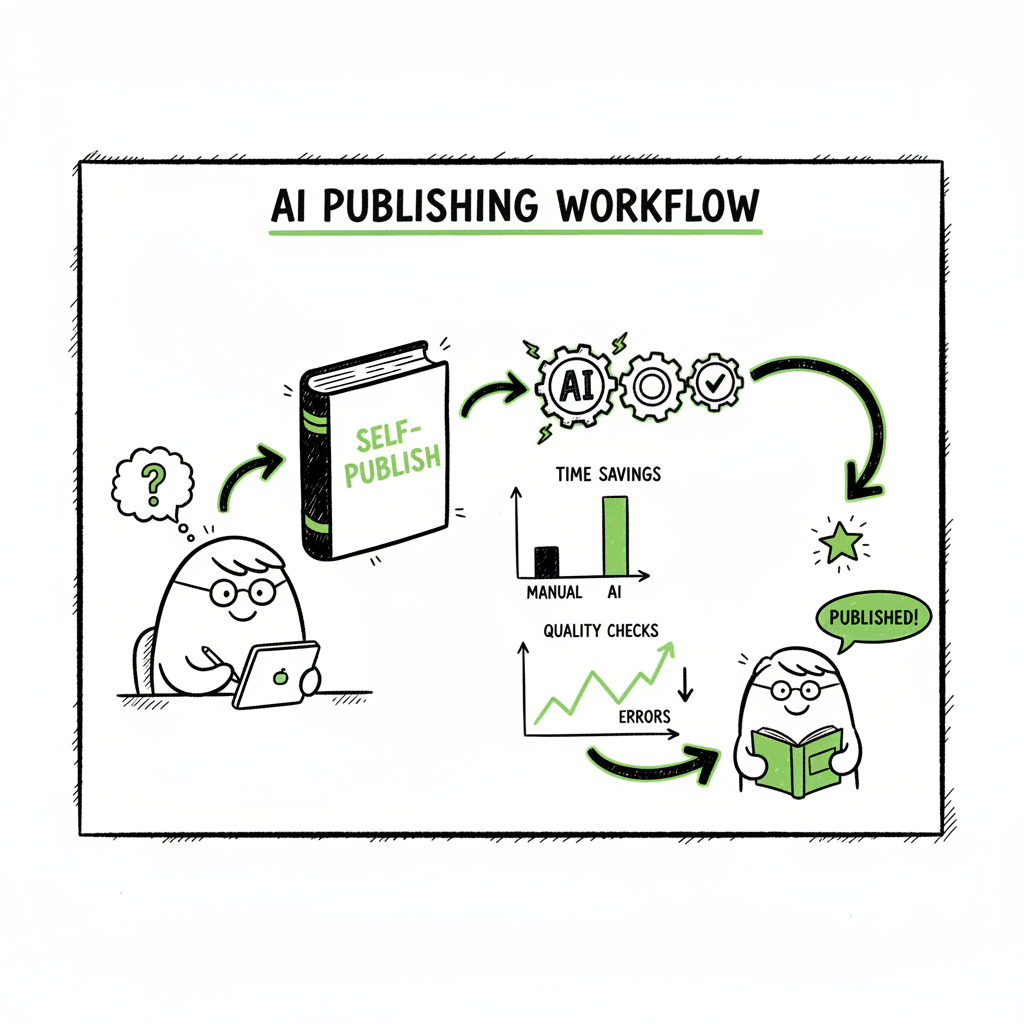
AI Powered Publishing Workflows for Self-Publishing Authors
AI Powered Publishing Workflows: A Practical Guide for Self-Publishing Authors
Estimated reading time: 10 minutes
Table of Contents
- What ai powered publishing workflows deliver
- Why this matters for indie authors
- How to adopt an ai publishing pipeline for your books
- Platform-aware tasks, time savings, and quality checks
- Time savings you can expect
- Quality checks that reduce rejections
- Tools to use and a practical rollout plan
- Phase 1: Audit and inputs (Weeks 1–2)
- Phase 2: Add simple checks and conversions (Weeks 3–6)
- Phase 3: Map platforms and batch uploads (Weeks 6–10)
- Phase 4: Iterate and scale (Weeks 10–12+)
- Practical tool notes and integration tips
- Where automation pays off
- Where human editors still matter
- Positioning BookUploadPro in your stack
- Sources
- FAQ
What ai powered publishing workflows deliver
AI powered publishing workflows change how a single author or a small imprint publishes to Amazon KDP, Apple Books, Kobo, Draft2Digital, and Ingram. At its best, this approach reduces repetitive manual steps, enforces consistent quality, and speeds the path from final manuscript to live products in stores.
Three concrete outcomes you’ll see quickly:
- Faster batch publishing. A CSV-driven pipeline can push dozens of titles with correct metadata and platform-specific assets, rather than repeating the same upload form dozens of times.
- Fewer format errors. AI can validate manuscript structure, detect common EPUB issues, and predict problems that cause rejections at stores.
- Better version control and reporting. Instead of guessing what was uploaded, you get logs, error lists, and simple audit trails that show success or required fixes.
If you want a practical step-by-step reference for AI-led self-publishing processes, see our Ai In Self Publishing Guide — it shows how authors move from one-off uploads to predictable, repeatable production. That guide ties the common checks and file outputs into standard inputs for multi-platform distribution.
Why this matters for indie authors
Most indie authors start with a single book and a single storefront. As you publish more titles, manual upload becomes the bottleneck: typing metadata, cropping covers differently, reformatting, and fixing failed EPUBs. An ai publishing pipeline takes those repeated decisions and applies consistent rules so you can scale without hiring full-time operations help.
How to adopt an ai publishing pipeline for your books
Start with three principles: simplify inputs, standardize processing, and validate outputs.
1) Simplify inputs: one source of truth
Create a single source file and a metadata spreadsheet. The manuscript should be your canonical text. Metadata—title, subtitle, series, contributors, ISBN, pricing, territories, and keywords—should live in one CSV or spreadsheet per batch. That single source of truth is the simplest lever: once your system reads consistent inputs, AI-driven checks and actions are reliable.
2) Standardize processing: predictable steps
Map the minimal steps needed to turn that source into store-ready assets:
- Clean manuscript text (remove stray styles, fix smart quotes)
- Generate or verify front/back matter and toc
- Convert to required formats (EPUB, MOBI where needed, print PDF)
- Create platform-specific covers and spine files
- Prepare metadata payloads for each storefront
Standardization turns guesswork into repeatable processing. You can then apply lightweight AI to each step for speed and quality. For example, a trained model can detect inconsistent chapter numbering, incomplete front matter, or missing contributor roles before you invest time on final packaging.
3) Validate outputs: automated checks you trust
Validation is the most practical use of AI for publishers. Train or use tools that:
- Report EPUB errors and give plain-language fixes
- Verify image DPI and color space for print
- Compare metadata across channels to catch price or territory mismatches
- Flag legal or rights inconsistencies
Validation makes multi-store publishing reliable. When a store rejects a file, the validation step should have already caught the root cause. That saves time and frustration.
Platform-aware tasks, time savings, and quality checks
Every storefront wants slightly different things. The smarter the publishing process, the earlier it decides what each store needs. Below are common platform tasks and how intelligent publishing systems AI helps.
Amazon KDP
- KDP expects specific metadata formats, image requirements, and interior PDFs that match trim size.
- AI checks can ensure spine text fits, margins meet bleed requirements, and the interior PDF includes fonts embedded properly.
- Using CSV-driven uploads and platform-specific intelligence, authors can publish multiple KDP titles with the same consistent settings.
Apple Books
- Apple requires well-formed EPUBs and responsive styles for reflowable content.
- AI-based EPUB checks can catch common issues like malformed navs or broken CSS that cause Apple to reject a file.
Kobo, Draft2Digital, Ingram
- Each distributor has rules around pricing, territory restrictions, and metadata fields.
- A central pipeline that maps your CSV fields to each distributor format removes manual entry and mismatched fields.
Time savings you can expect
From operational experience, moving from manual single-store uploads to a CSV-driven, intelligently checked process cuts repetitive time by roughly 70–90% on the upload and QA side. That time gets reallocated to cover design, marketing, or writing. When this becomes the operating model, publishing several titles per quarter becomes practical for a solo author or a small team.
Quality checks that reduce rejections
Automated checks reduce the common rejections that waste your time: incorrect EPUB navs, missing embedded fonts, low-resolution cover images, and metadata conflicts. AI here is not creative—it’s a quality gate. It enforces rules so you don’t learn the hard way when a store rejects a file.
Tools to use and a practical rollout plan
A pragmatic rollout focuses on 60–90 day improvements. You don’t retool everything at once. Use simple gates and measure results.
Phase 1: Audit and inputs (Weeks 1–2)
- Inventory your titles and common failure points.
- Create a canonical manuscript file type (clean Word or Markdown) and a single metadata CSV for all books.
- Identify frequent formatting issues and list them as validation rules.
Phase 2: Add simple checks and conversions (Weeks 3–6)
- Add an EPUB conversion step so every manuscript produces a validated EPUB. If you need straightforward conversion, use a tested tool that handles reflow and fixed layout if necessary. For a reliable converter, consider an EPUB converter that integrates with your process.
- Add a cover check step. If you do covers yourself or through designers, set a standard template and use an automated check for DPI, trim, and spine text. If you want to automate cover production or batch processing, a book cover generator can speed drafts and ensure consistent sizing.
- Create a single PDF export for print that follows your chosen trim and margin templates.
Phase 3: Map platforms and batch uploads (Weeks 6–10)
- Map your CSV fields to each storefront’s required fields.
- Test a small batch of titles across KDP, Apple, Kobo, and Ingram.
- Build error-handling: when a store rejects an upload, the system returns specific, actionable feedback.
Phase 4: Iterate and scale (Weeks 10–12+)
- Measure time saved per title.
- Add predictive checks if you see patterns (e.g., certain file types cause problems more often).
- Scale to larger batches as confidence grows.
Practical tool notes and integration tips
- CSV batch uploads: A CSV is the simplest format to scale. Make sure it includes all platform fields you’ll ever need. When you add a new platform, update the CSV template—not the process.
- Versioning: Keep exported store payloads and final files in a simple folder structure by ISBN and date. That makes rollbacks and edits straightforward.
- Error classification: Store rejection messages are often opaque. Normalize them into categories your system can act on (metadata, interior, cover, rights).
Where automation pays off
– Metadata consistency: Avoid small manual typos that create discoverability issues.
– Image and EPUB validation: These are repetitive and rules-based—perfect for AI checks.
– Multi-platform mapping: A single CSV feeding many endpoints removes errors and saves hours.
– Reporting and monitoring: Simple dashboards that show failed uploads and reasons turn repetition into data you can act on.
Where human editors still matter
AI is best where rules are clear. Human judgment is still essential for:
- Editorial quality and narrative decisions.
- Cover creative strategy and fine art direction.
- Marketing copy that needs nuance.
A balanced operation uses AI for the repeatable parts and people where nuance matters. When authors scale, that blend is the most cost-effective.
Positioning BookUploadPro in your stack
BookUploadPro focuses on:
- Unified multi-platform publishing across Amazon KDP, Kobo, Apple Books, Draft2Digital, and Ingram
- CSV batch uploads that feed platform-specific payloads
- Platform-specific intelligence to reduce common errors
- Roughly 90% time savings on the upload and QA process for batch publishing
- Affordable pricing and a free trial so teams can validate gains before committing
Automate the upload. Own the distribution. For authors who publish multiple titles, BookUploadPro becomes the natural operations layer that keeps metadata correct, files matched to store requirements, and releases predictable.
Sources
- The AI Shift in Publisher Workflows: Transforming Digital Content Management in 2025 — https://www.sarasotamagazine.com/advantagepoint/2025/09/the-ai-shift-in-publisher-workflows-transforming-digital-content-management-in-2025
- The Rise of Intelligent Workflows in Academic Publishing 2025 — https://www.luminadatamatics.com/resources/blog/the-rise-of-intelligent-workflows-in-academic-publishing-speed-accuracy-and-compliance-in-2025/
- AI-Powered Workflows that Help Publishers Thrive – Integra — https://integranxt.com/blog/ai-powered-workflows-that-help-publishers-thrive/
- How AI Is Transforming Editorial Workflows in Digital Magazine Publishing — https://www.3dissue.com/how-ai-is-transforming-editorial-workflows-in-digital-magazine-publishing/
- Guest Post – Three Ways to Innovate and Reimagine Publisher Value in an AI World — https://scholarlykitchen.sspnet.org/2025/12/18/guest-post-three-ways-to-innovate-and-reimagine-publisher-value-in-an-ai-world/
- The year of now: an AI turning point for publishers — https://digitalcontentnext.org/blog/2025/08/18/the-year-of-now-an-ai-turning-point-for-publishers/
FAQ
Q: How soon will I see time savings?
A: Expect immediate reductions on repetitive tasks. Once you have a CSV and validated conversion steps, single-title upload time drops and batch uploads scale quickly. Measurable savings are usually visible within the first few releases.
Q: Do I need to be technical to set this up?
A: No. Many parts are point-and-click once you standardize inputs. If you use BookUploadPro, the service handles mapping and platform-specific payloads so you don’t build custom code.
Q: Will AI change editorial quality?
A: AI helps with rule-based checks and format validation. It does not replace human editing or design judgment. Use it to catch format errors and metadata mismatches, not to decide creative direction.
Q: Can I still control pricing and territories per store?
A: Yes. The CSV-driven approach maps those choices into each store’s settings. You keep final control and can override defaults when needed.
Q: What should I do first?
A: Create a canonical manuscript file, build a metadata CSV, and run a single title through a validated EPUB conversion and cover check. From there, scale to small batches.
AI Powered Publishing Workflows: A Practical Guide for Self-Publishing Authors Estimated reading time: 10 minutes Table of Contents What ai powered publishing workflows deliver Why this matters for indie authors How to adopt an ai publishing pipeline for your books Platform-aware tasks, time savings, and quality checks Time savings you can expect Quality checks that…