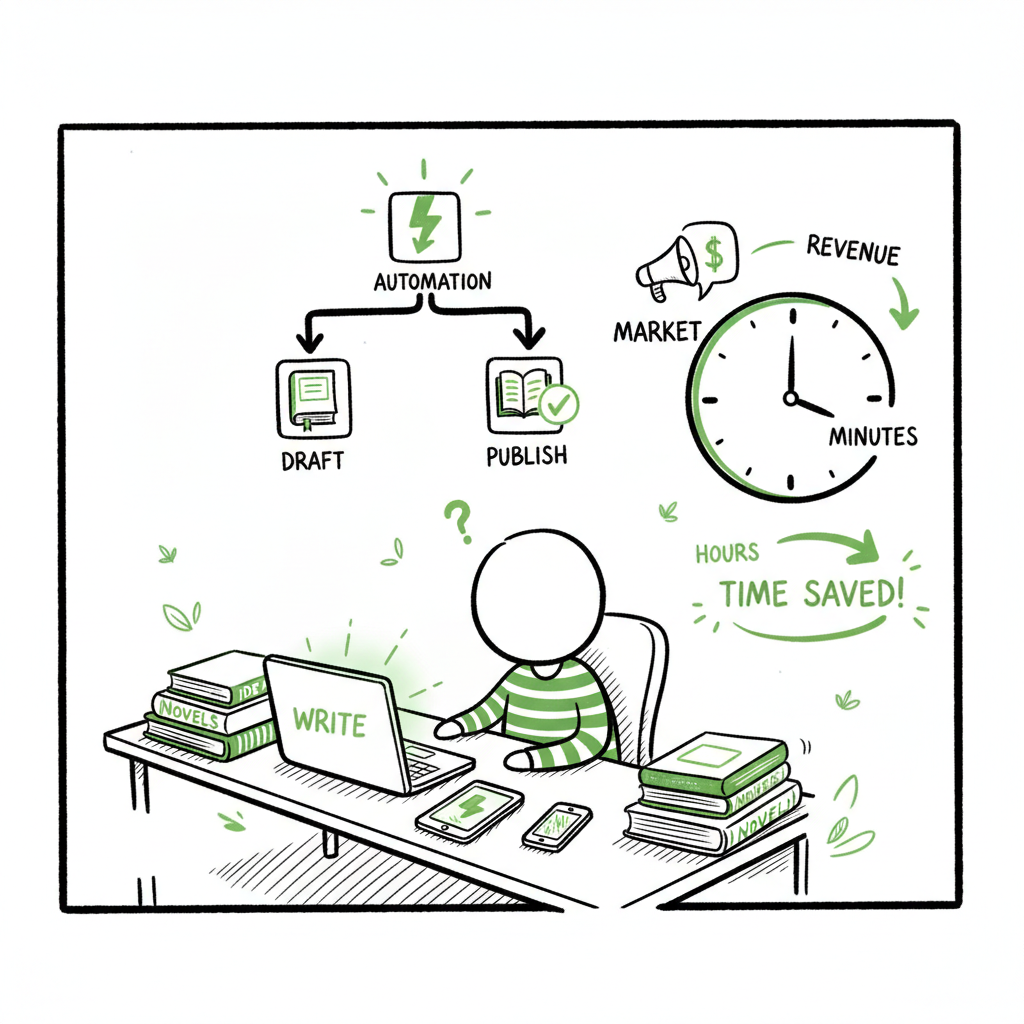
Automation for Prolific Authors to Scale Publishing
Automation for Prolific Authors: How to Scale Output and Distribution
Estimated reading time: 10 minutes
A practical example of this approach can be seen in Automated Passive Income With Books.
Key takeaways
- Automation reduces repetitive work so you can publish more without burning out.
- The right systems combine writing workflows, publishing uploads, and marketing tasks.
- Multi-platform upload automation saves time, reduces errors, and makes wide distribution practical.
Table of Contents
- Why automation for prolific authors matters
- Core automation systems for prolific authors
- Publishing automation and multi-platform uploads
- FAQ
- Sources
Why automation for prolific authors matters
If you want to publish many books and keep quality high, automation is not optional. It is the set of repeatable steps and tools that let one person manage dozens or hundreds of titles without dropping details. That is what “automation for prolific authors” means in practice: clear workflows, predictable outputs, and fewer manual uploads.
Automation is not a magic replacement for writing. It is a practical way to remove friction. Editors still edit, cover designers still design, and authors still choose voice and story. Automation takes over the repeating parts: file conversions, metadata handling, batch uploads, and routine marketing tasks. When those steps are automated, you get time back for writing and strategy.
One direct result many authors miss is revenue compounding. When the catalogue grows, small improvements in distribution or pricing compound across many titles. If you want to see how a catalog can act like a revenue engine rather than a single-file project, read guidance on Automated Passive Income With Books.
Automation also makes mistakes predictable. Manual uploads invite human error: wrong ISBNs, mismatched files, or incorrect categories. Scripts, CSV templates, and platform-aware upload tools can validate inputs and flag problems before they go live. That reduces takedowns, slow approvals, and unexpected rework.
Finally, automation supports consistency. Readers come back for predictable releases, consistent formatting, and reliable metadata. That reliability builds discoverability over time. If your aim is sustained output rather than a one-off breakout, automation is how you scale without losing control.
Core automation systems for prolific authors
Think of your publishing business in three layers: writing and editing, publishing and distribution, and marketing and management. Each layer has automation opportunities that matter for prolific output.
Writing and editing
- Project boards and templates. Use a repeatable project template for each book: chapter milestones, draft deadlines, and editing rounds. Templates reduce setup time.
- Drafting tools and AI assistants. AI can help with outlines, scene notes, and first-pass drafts. Best practice is to use AI as an assistant, not the final voice. Human revision keeps books authentic.
- Automated style and quality checks. Tools that run grammar, consistency, and readability checks save a lot of manual passes. They catch repeated problems across many files.
Publishing and distribution
- File formatting and conversion. Converting manuscripts to ebooks and paper-ready PDFs is routine. A reliable EPUB converter removes manual formatting steps and creates consistent outputs across titles. If you want a fast, repeatable way to convert manuscripts, use a dedicated EPUB converter that preserves structure and metadata.
- Cover processing. When you run many books, standard cover workflows help. A cover generator or processing pipeline helps create consistent, publishable covers from templates and asset sets.
- Batch metadata and ISBN management. Keep a single CSV or database of metadata. That CSV becomes a single source of truth for title, author name variations, categories, BISAC codes, pricing, and ISBNs.
- Multi-platform upload automation. Instead of uploading the same title five times, use a tool that maps your CSV to platform-specific fields and uploads in bulk. This is the place where automation saves the most time and reduces failures.
Marketing and management
- Automated email funnels and segmentation. Let email automation handle reader onboarding, pre-order sequences, and backlist promos.
- Social scheduling and cross-posting. Schedule core promotional posts and let them propagate across platforms.
- Analytics and rebalance rules. Use simple dashboards that flag underperforming titles, letting you reprice, relaunch, or repackage quickly.
These systems work best when they are connected. A CSV that flows from your project board to your formatter, then to your upload tool, closes the loop and removes duplicate entry. That connection is the operating model of prolific author automation tools.
Publishing automation and multi-platform uploads
This is where most authors see the biggest time savings. Manual uploads are slow and brittle: each platform has its own fields, image rules, and quirks. A unified publishing approach treats each platform’s differences as known variables and automates the mapping.
What unified, multi-platform publishing looks like
- One master CSV for all books. Put title-specific metadata, file paths, cover art references, prices, territories, and ISBNs into one spreadsheet. This csv-first approach lets you reason about the catalog rather than about single files.
- Platform-specific intelligence. The upload system should understand Amazon KDP, Kobo, Apple Books, Draft2Digital, and Ingram. It does the field mapping, validates file size and format, and warns about issues the platform would reject.
- Batch uploads and retry logic. The system should upload many titles in a job, retry failed uploads automatically, and report what needs manual attention.
Operational gains you can expect
- ~90% time savings on uploads. When you move from one-off manual uploads to CSV batch jobs, the clock time drops dramatically. That time frees you to write more books or handle selective quality improvements.
- Error reduction. Validations catch problems early. Common errors—wrong trim size, mismatched ISBNs, or improper cover dimensions—get flagged before the platform receives them.
- Wider distribution becomes practical. When you can upload to multiple stores in a few clicks, you are more likely to place titles where readers are. That increases visibility and sales opportunities.
Tools and integration points
- CSV batch upload engine. This is the heart of multi-platform publishing automation.
- Formatter / converter. A tool that creates ebook files and print-ready PDFs. If your workflow includes creating paperback or ebook files regularly, a reliable EPUB converter reduces formatting drama.
- Cover processing or generator. For consistent cover production, especially at volume, a cover generator or processing service helps you apply branding and size rules. Cover generator can simplify this at scale.
- Platform APIs. A good system uses APIs where possible and falls back to validated UI automation where APIs lack required fields.
Practical steps to set this up
- Build a single metadata spreadsheet. Make fields explicit and test with one title.
- Convert and validate files. Run your manuscript through an EPUB converter and your print files through a PDF validator. Fix issues once at the source.
- Create cover templates. Use a cover generator or standardized templates so covers meet platform specs automatically.
- Run a batch job to two platforms first. Start small: pick KDP and one other store. Watch logs and adjust mappings.
- Expand to all distributors and set up regular syncs. Once mappings are stable, roll out across your catalog.
Tools that remove friction
When you are publishing many titles, choose tools that automate the repetitive steps without stripping control. For file conversion, a dedicated EPUB converter will preserve chapter structure and table of contents automatically. For covers, a cover generator that supports batch processing will scale better than manual design for every single title.
Why BookUploadPro fits this workflow
BookUploadPro automates repetitive uploads across Amazon KDP, Kobo, Apple Books, Draft2Digital, and Ingram. It uses CSV batch uploads, platform-specific intelligence, and retry logic to cut routine work. For authors who publish seriously, it becomes an obvious upgrade: you keep control of files and metadata but remove the repetitive entry and the upload treadmill. Automate the upload. Own the distribution.
Practical case: from one title to a catalog of fifty
At one title, manual uploads are fine. At fifty, they are not. A repeatable setup will typically include:
- Curated CSV maintained in a single place.
- Automated EPUB and print file generation.
- Batch uploads that map a single row to all target stores.
- A lightweight dashboard that shows job status, rejections, and approvals.
This shifts the work from “uploading” to “managing exceptions” and quality. Exceptions are fewer and faster to fix when the rest of the pipeline is automated.
Integrations you will want
When building a scale system, prioritize connectors that reduce double entry:
- Link your project management template to the CSV so new titles inherit metadata.
- Connect your formatter to the CSV to generate the actual files automatically.
- Use the upload engine to push files and metadata to stores and capture job logs.
Common pitfalls and how to avoid them
- Poor metadata hygiene. If your CSV has inconsistent author names, you will face listing fragmentation. Standardize names and aliases.
- Ignoring platform rules. Each retailer has quirks. Build validations into your pipeline to catch them early.
- Skipping cover size checks. Covers that fail platform checks stop a job. Use a cover generator that outputs correct dimensions and spine thickness for print files.
- Treating automation as “set and forget.” Automation needs maintenance when platforms change fields or validation rules. Plan for quarterly checks.
Automating marketing and catalog management
Automation does not stop at upload. For prolific authors, blunting the marketing grind is essential:
- Schedule pre-order and launch emails. Use segmented flows so series readers get notified automatically.
- Automate price changes and promos. For example, a rule can lower the price of book one in a series when a new release goes live.
- Use simple analytics to decide which titles need attention. Low-performing titles can be repackaged or bundled via automated batch edits.
Realistic expectations for AI and writing automation
AI tools are useful for outlines, first drafts, and ideation. But prolific authors who last have strong editing skills and voice control. Use AI to scale certain tasks—research summaries, title variants, and metadata copy—while keeping core storytelling human-driven.
How to start: a practical rollout plan
- Week 1–2: Build a single source CSV and test with one title.
- Week 3–4: Automate file conversions and cover processing for a small batch.
- Month 2: Run your first multi-platform batch upload and evaluate errors.
- Month 3: Add automated marketing sequences for post-launch follow-up.
- Ongoing: Quarterly audits of platform rules, metadata, and pricing.
FAQ
Q: Will automation replace my voice or quality?
A: No. Automation handles repetitive tasks. It preserves your voice by freeing time for writing and editing. Use automation to standardize production, not to replace authorial decisions.
Q: How much time can I realistically save?
A: Time savings vary. For uploads, authors commonly see around 80–90% reduction in hands-on time compared with manual uploads. Formatting and cover workflows also speed up meaningfully when automated.
Q: Is a CSV approach hard to manage?
A: It takes a short setup. Once fields are defined and validated, the CSV becomes your catalog control center. Validate a few columns and add scripts or tools to prevent mistakes.
Q: Should I use AI to generate entire books?
A: Treat AI as a tool, not a sole author. AI can accelerate drafts and help with outlines. Final books need human editing to ensure voice, coherence, and quality.
Q: Which platforms should I automate first?
A: Start with the platforms where you see most readers or that are most painful to upload to manually—often Amazon KDP plus one wide distributor like Draft2Digital or Ingram.
Sources
- Automation for Authors: How automation can boost your author career
- 23 SaaS Automation Tools and Technology for Modern Publishers
- Using Tools To Automate Your Author Business with Chelle Honiker
- 8 Best Content Automation Tools to Boost Your Workflow
- AI Writing Assistants: Ultimate Guide to Your Automated Co-Author
- How to Be a Prolific Author in 2025 Despite Significant Life Challenges
Automation for Prolific Authors: How to Scale Output and Distribution Estimated reading time: 10 minutes A practical example of this approach can be seen in Automated Passive Income With Books. Key takeaways Automation reduces repetitive work so you can publish more without burning out. The right systems combine writing workflows, publishing uploads, and marketing tasks.…