Passive Income Publishing Systems for Book Publishers
How Passive Income Publishing Systems Work
Estimated reading time: 18 minutes
Key takeaways
- Passive income publishing systems are repeatable workflows that turn book publishing into a scalable, low-touch business.
- Automation is about reliable processes: niche research, batch uploads, platform-specific optimization, and ongoing measurement.
- BookUploadPro automates multi-platform uploads (KDP, Kobo, Apple, Ingram, Draft2Digital) with CSV batch tools, platform intelligence, and large time savings — an obvious upgrade when you publish seriously.
Table of Contents
- How passive income publishing systems work
- Building a repeatable book ops process
- Quality, compliance, and niches that scale
- Measuring results and scaling safely
- Final thoughts
- FAQ
- Sources
How passive income publishing systems work
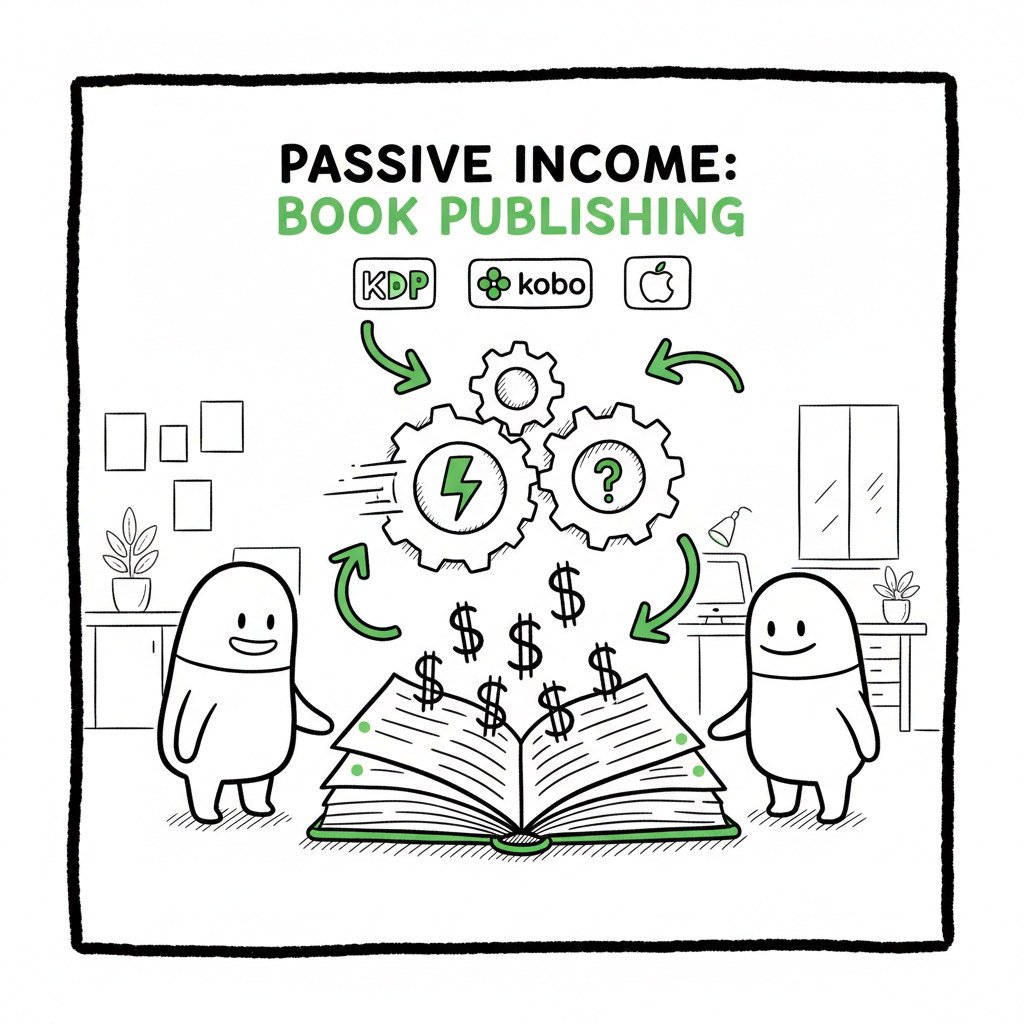
Passive income publishing systems are not a magic trick. They are organized operations that use templates, data, and automation to publish many titles with minimal daily effort. At their core they follow a simple loop: find demand, produce a compliant file, upload across storefronts, and monitor sales. That loop repeats and scales.
The phrase “passive income” here means the revenue comes from evergreen listings that require little ongoing content work. You still spend time upfront to research niches, set up templates, and verify quality. The automation comes next: batch uploads, CSV feeds, standardized metadata, and platform-specific tuning that reduce manual work by roughly 80–90% for repeat titles.
Why this works now
- Platform breadth: Amazon KDP, Kobo, Apple Books, Draft2Digital, and Ingram each pay royalties, and more stores mean more chances to be discovered.
- Low-content economy: Journals, workbooks, guided planners, and simple nonfiction scale easily with templates.
- Tools and integrations: Modern tools handle formatting, cover generation, and multi-platform publishing so one operator can manage large portfolios.
A practical note: if you’re ready to move from manual uploads to automated, consider the step that connects research to execution. A well-designed upload engine that handles CSV batch jobs and platform-specific quirks removes most repetitive friction. For authors and publishers ready to scale, Automated Passive Income With Books is the logical next step in turning those processes into throughput you can rely on.
Building a repeatable book ops process
Scaling publishing is an operational problem. Treat it like a simple factory: raw input (manuscripts and assets), standard processing (formatting, cover, metadata), quality gate, and distribution (multi-platform upload). Design each stage to be repeatable and auditable.
1) Inputs — templates, assets, and metadata
Start with reusable templates for interiors and covers. Create a naming convention for files and a CSV template for metadata that includes title variants, descriptions, keywords per platform, price points, and ISBNs or UPCs if needed. For most low- and mid-content books you’ll use the same interior template with small variations.
If you generate covers frequently, use a reliable cover process that produces consistent results. A dedicated book cover generator helps keep styles consistent across a catalog and speeds production without design bottlenecks. If you rely on EPUB workflows for reflowable ebooks, a dedicated EPUB converter smooths the step from manuscript to platform-ready file.
2) Formatting and conversion
Automate formatting as much as you can. Use tools that output platform-ready files: print-ready PDF for paperbacks, EPUB for ebook stores, and properly framed files for fixed-layout content when needed. Converting to EPUB is a common choke point; a clean EPUB export avoids rejection and bad reader experiences.
3) Cover and assets
Covers are the most visible asset. Standardize size, spine math, and bleed margins for print. For speed, use a cover generator that can accept a title list and batch create covers. Keep a small set of proven layouts and rotate colors and imagery to test performance without rebuilding designs each time.
4) Batch uploads and platform intelligence
Manual uploads scale poorly. A CSV batch upload system that maps your metadata template to each store’s required fields is essential. Each platform has unique rules: image specs, keyword limits, description formatting, and territory options. Automations that understand those rules reduce errors and rejections.
Platform-specific intelligence matters. For example, KDP requires cover and interior sizes to match precisely for print; Apple Books has different EPUB validation rules; Ingram has specific BISAC and imprint expectations. A publishing tool that applies these rules automatically saves a lot of time and frustration.
5) Quality gates
Automated systems should not be fully blind. Implement lightweight checks: file validation, a quick preview of interior and cover, and metadata flagging for missing fields. A human spot-check at scale — sampling a percentage of uploads — is a sensible control that keeps quality high without reintroducing full manual effort.
6) Distribution and tracking
Once titles are distributed, track ASINs, store IDs, and payment settings. Central reporting that aggregates royalties and sales across stores turns a messy wide distribution into actionable insights.
Operational benefits you should expect
- ~90% time savings on upload and management once templates are in place
- Lower error rates because platform rules are applied consistently
- Faster time-to-market for test titles and niche plays
- Capacity to publish at volume without hiring a large team
Quality, compliance, and niches that scale
Automation accelerates output, but it does not fix bad product-market fit. The most sustainable passive income publishing systems balance speed with discipline: find niches that actually sell, maintain quality, and respect platform policies.
Niche selection — the practical approach
Finding niches that scale is a mix of data and judgment. Look for topics with steady demand and moderate competition. Thin markets — where customers look for very specific content — can work well if you can own a subtopic with multiple titles.
- Start with keyword research and sales estimates across stores.
- Validate with small, testable titles before rolling out dozens.
- Prefer niches that allow series or repeatable products (e.g., guided journals, planners, workbooks).
Product quality and reader experience
Low-quality uploads lead to returns, poor reviews, and eventually account problems. Establish standards:
– Clean interiors with consistent pagination and margins
– Legible covers that match the genre
– Honest, keyword-rich descriptions
Also, be careful with automated content generation. AI can speed writing, but you must verify for accuracy, plagiarism, and coherence. For non-fiction, subject accuracy is critical; for journals and low-content books, formatting and layout matter most.
Compliance and platform rules
Every store enforces rules differently. Some common pitfalls:
– Keyword stuffing in descriptions or metadata
– Copyrighted images used without license for covers
– Incorrect trim size or bleed settings for print files
– Improperly formatted EPUBs that fail validation
Automation reduces errors when it encodes platform rules. But don’t assume “set and forget.” Add automated validations and periodic audits to catch rule changes or edge cases.
Practical production tools
There are tools for every step: cover generators, EPUB converters, and multi-store uploaders. If your workflow includes creating a paperback or ebook, pick tools that integrate or export consistent files so your distribution layer accepts them without rework. When you need a faster cover solution, a focused book cover generator will cut design time; when you need reliable EPUBs, use a dedicated EPUB converter to avoid rejections.
Measuring results and scaling safely
Scaling responsibly means measuring the right metrics and using the feedback loop to improve titles and processes. Don’t rely on vanity metrics — focus on the signals that drive decisions.
Key metrics to track
- Revenue per title and royalties by storefront
- Conversion rate on product pages (impressions → purchases)
- Cost of creation and upload time per title
- Return and refund rates
- Error and rejection rates during uploads
- Time-to-live (how long a title sells consistently)
Use these metrics to decide where to invest:
– If conversion is low but impressions are high, test covers and descriptions.
– If revenue per title is acceptable, increase volume in that niche.
– If uploads fail often for one platform, improve the platform-specific rules in your processing pipeline.
Testing at scale
Run controlled tests before committing to full-scale rollouts:
– A/B test two covers for the same interior to find higher-converting designs.
– Price test across regions and stores to identify sweet spots.
– Test short runs of titles to validate niche demand.
Automation helps with testing because it removes the operational bottleneck. Once you have a template and a validated upload pipeline, producing variations is fast. But always test a few before automating a hundred copies.
Risk management and account health
High-volume publishing can trigger scrutiny. Protect accounts and revenue streams by:
– Avoiding spammy metadata practices
– Ensuring each title meets quality standards
– Spreading distribution across multiple legitimate platforms (not duplicates with different metadata)
– Keeping records for each upload and an audit trail for rights and assets
Tools that centralize distribution and track platform IDs make it practical to manage risk and respond to disputes.
How BookUploadPro fits operationally
BookUploadPro isn’t a consultant — it’s a straightforward upgrade for publishers who are ready to stop manual uploads and scale properly. It automates repetitive uploads across Amazon KDP, Kobo, Apple Books, Draft2Digital, and Ingram. The core benefits are practical:
– Unified multi-platform publishing from a single CSV or dashboard
– Platform-specific intelligence that applies rules and reduces errors
– Significant time savings: operators report about 90% less time spent on upload tasks once templates are set
– CSV batch uploads and bulk metadata mapping that let you push many titles without repetitive clicking
For teams or individuals publishing seriously, that kind of time saving shifts the business model from “one-off” publishing to an actual product business. BookUploadPro is the core platform to automate the upload. Own the distribution.
Final thoughts
Passive income publishing systems work when they are built like simple manufacturing lines: repeatable inputs, standardized processing, reliable quality checks, and clear measurement. The technical pieces — cover generation, EPUB conversion, batch uploads — are available and mature. The human piece — choosing niches, setting standards, and running tests — remains the part that separates occasional authors from scalable publishers.
A sensible approach is incremental: build templates, validate a niche with a few titles, then invest in automating the upload and distribution steps. When the manual effort drops and accuracy rises, you can scale confidently.
FAQ
Q: What types of books work best for passive income publishing systems?
A: Low- and mid-content books (journals, planners, workbooks), evergreen nonfiction, and repeatable series typically scale well. These formats let you reuse layouts, create variations, and test covers without large writing investments.
Q: How much time does automation actually save?
A: Once templates and CSV mapping are set, upload and metadata entry time can drop by about 80–90% per title. That turns a daily manual task into a weekly review process.
Q: Is using automation risky for my store accounts?
A: Automation itself isn’t risky. Risks come from poor quality, copyright violations, or metadata abuse. Use validation checks and occasional human spot audits to keep account health strong.
Q: Do I still need to create covers and EPUBs manually?
A: You can automate much of it. Batch cover generation and EPUB conversion tools produce platform-ready files. For higher-quality frontlist titles, a custom cover and manual EPUB check are usually still best.
Q: Should I distribute to every platform?
A: Wider distribution increases reach and reduces reliance on a single platform algorithm. Focus on platforms where your audience shops, but multi-platform publishing usually pays dividends for volume-focused strategies.
Sources
- AI Book Generators for Passive Income – BookAutoAI
- 7 Ways To Automate Your Amazon Publishing Business
- How To Start An Automated Book Business in 2025 – YouTube
- Royalty Profits AI Review – The Fastest KDP Publishing Tool Ever?
Automate the upload. Own the distribution.
Visit BookUploadPro.com and try the free trial.
How Passive Income Publishing Systems Work Estimated reading time: 18 minutes Key takeaways Passive income publishing systems are repeatable workflows that turn book publishing into a scalable, low-touch business. Automation is about reliable processes: niche research, batch uploads, platform-specific optimization, and ongoing measurement. BookUploadPro automates multi-platform uploads (KDP, Kobo, Apple, Ingram, Draft2Digital) with CSV batch…